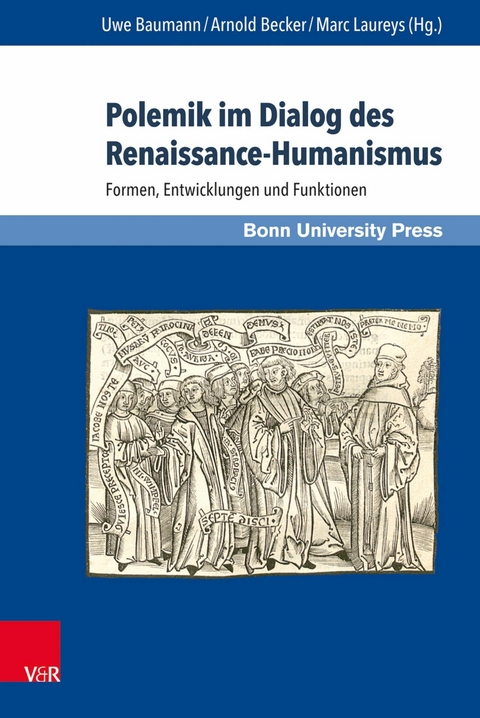
Polemik im Dialog des Renaissance-Humanismus (eBook)
324 Seiten
Vandenhoeck & Ruprecht Unipress (Verlag)
978-3-8470-0486-8 (ISBN)
Prof. Dr. Uwe Baumann lehrt Anglistik: Literatur- und Kulturwissenschaft an der Universität Bonn.
Prof. Dr. Uwe Baumann lehrt Anglistik: Literatur- und Kulturwissenschaft an der Universität Bonn.
Title Page 3
Copyright 4
Table of Contents 5
Body 7
Uwe Baumann / Arnold Becker / Marc Laureys (Bonn): Einleitung: Polemik im Dialog des Renaissance-Humanismus. Formen, Entwicklungen und Funktionen 7
Bibliographie 15
Wolfgang G. Müller (Jena): Prinzipien einer Poetik des Dialogs, dargestellt am Beispiel des Prosadialogs der englischen Renaissance 17
Das Problem 17
Die Renaissance als dialogisches Zeitalter 18
Der Dialog als humanistische Gattung 20
Dialog als allgemeines sprachliches Phänomen und als Gattung 21
Dialog und Konversation 24
Dialog und Traktat 24
Rezeption 25
Fiktionalität und Realität 27
Dialog: Die Problematik einer Gattungsdefinition 29
Zwei Dialoge von Sir Thomas Smith 31
Bibliographie 33
Carmen Cardelle de Hartmann (Zürich): Kirchenstreit und humanistischer Dialog: Piccolominis Libellus dialogorum 37
Bibliographie 59
1. Primärliteratur 59
2. Forschungsliteratur 60
Marc Laureys (Bonn): Competence matters: Grammar and Invective in Girolamo Balbi's Rhetor gloriosus 63
Bibliography 81
1. Sources 81
2. Secondary literature 82
Arnold Becker (Bonn): Strategien polemischer Positionierung in Huttens Dialogen 87
Dialogi novi 99
Huttens Selbstpositionierung in seinen polemischen Dialogen 100
Bibliographie 108
Primärliteratur 108
Übersetzungen: 108
Übersetzungen einzelner Dialoge: 108
Sekundärliteratur 108
Uwe Baumann (Bonn): Die humanistischen und kontroverstheologischen ‚Streitschriften` des Thomas Morus als ‚Polemische Dialoge` 111
I. Prolog 111
Thomas Morus: Streitschriften 112
II. Die ‚Streitschriften` des Thomas Morus 115
1. Declamatio Lvcianicae Respondens (1505/6) 115
2. Brief an Martin van Dorp (R. 15) 117
3. Brief an die Universität Oxford (R. 60, März 1518) und 118
4. Briefe an Edward Lee (R. 48, 75, 84 und 85) 118
5. Epigramme & Brief an Germain de Brie (Brixius) (R. 86)
6. Brief an einen Mönch (R. 83) 122
7. Responsio ad Lutherum 123
8. Brief an Johann Bugenhagen (R. 143) 125
9. Dialogue Concerning Heresies (1529) 127
10. Supplication of Souls (1529) 129
11. The Confutation of Tyndale's Answer I (1532) und 132
13. The Confutation of Tyndale's Answer II (1533) 132
12. Brief an John Frith (R. 190) 133
14. The Apology (1533) 135
15. The Debellation of Salem and Bizance (1533) und 139
16. Answer to a Poisoned Book (1533, veröffentlicht Anfang 1534) 139
III. Conclusio 141
IV. Bibliographie 143
1. Primärtexte 143
2. Forschungsliteratur 145
Gislind Rohwer-Happe (Bonn): Unzuverlässiges Erzählen im englischen polemischen Dialog: Thomas Elyots The Defence Of Good Women (1540) 155
Bibliographie 169
Uwe Baumann (Bonn): Humanistischer Dialog als inszenierte Humanistische Historiographie: William Thomas' The Pilgrim (1547) 171
I. Prolog 171
II. Dialog: Realitätsreferenzen – Lehren aus der Geschichte – Historiographie 174
1. Thomas More, Utopia 174
2. Thomas More, Apology 176
3. Thomas More, Dialogue Concerning Heresies 178
III. Dialog als inszenierte humanistische Historiographie 182
1. „the first wife [] did he not cast her off?“ 188
2. „did he not disannul the authority of the Holy Roman Church?“ 189
3. „the Cardinal of Rochester, and Thomas More [] did he not cause them to be beheaded?“ 190
4. „did he not presume to take on him the Papal title and authority?“ 191
5. „The poor St. Thomas of Canterbury [] did he not cause his bones openly to be burned?“ 191
6. „all the places where God by his saints vouchsafed to show so many miracles, did he not cause them to be spoiled of their riches, jewels, and ornaments?“ 192
7. „The monasteries [] did he not overthrow them?“ 192
8. „After the insurrection in the North [] did he not cause a number of the most noble of them [] to be put to death?“ 193
9. „And not his first wife, but three or four more, did he not chop, change, and behead them []?“ 193
10. „Did he not persecute the Cardinal Pole [] and hath he not wrongfully murdered the Cardinal's mother, his brother, and so many other nobles?“ 198
11. „He hath by force subdued the realm of Ireland, [] and wasted, he hath, no small part of Scotland“ 199
12. „Against all conscience, he hath moved war unto France, and by force usurped the strong town of Bollogne“ 199
13. „His daughter, the Lady Mary, [] through his devilish obstinacy, could never be married“ 200
14. „And, finally, to finish his cruel life with bloody rage, [] hath he not beheaded the old Duke of Norfolk with his son, for what cause no man can tell?“ 200
IV. Epilog 205
V. Bibliographie 207
1. Primärtexte 207
2. Forschungsliteratur 208
Bernd Häsner (Berlin): Questo quasi arringo del ragionare – Dialektik, Disputation und Dialog bei Torquato Tasso 225
1. Tassos Dialoge in Theorie und Praxis 225
2. Zur Vorgeschichte des Cataneo 227
3. Medienkritisches Vorspiel: lettere vs. viva voce 228
4. Die Reprise einer disputa dialettica als deren Simulation 234
5. Tassos Kritik der viva voce und ihre (nicht nur) dialogtheoretischen Implikationen 240
Bibliographie 249
Primärtexte 249
Sekundärliteratur 249
Edeltraud Werner (Halle): Das Dialogmuster im italienischen Geschlechterdiskurs bis 1600. Am Beispiel von Baldassare Castigliones Il Cortegiano und Moderata Fontes Il merito delle donne 253
1. Einleitung 253
2. Kurzpräsentation der beiden Dialoge 255
2.1 Baldassare Castiglione, Il Cortegiano 255
2.2 Moderata Fonte, Il Merito delle donne 258
2.3 Resümee 261
3. Die Dialoge im Geschlechterdiskurs 262
4. Polemik in den Dialogen 264
4.1 Il libro del Cortegiano: Ein Spiel im Spiel 264
4.2 Il Merito delle donne: Die Umkehr des „Normalen“ 272
5. Schlussbetrachtungen 280
Bibliographie 286
Imke Lichterfeld (Bonn): Do not banish reason – Dialog und Dialogisierung in Shakespeares Measure for Measure 291
Bibliographie 313
Beiträgerinnen und Beiträger 317
Index 321
| Erscheint lt. Verlag | 9.12.2015 |
|---|---|
| Reihe/Serie | Super alta perennis |
| Super alta perennis | |
| Super alta perennis. | Super alta perennis. |
| Co-Autor | Edeltraud Werner |
| Zusatzinfo | mit 3 Abbildungen |
| Verlagsort | Göttingen |
| Sprache | deutsch |
| Themenwelt | Geisteswissenschaften ► Sprach- / Literaturwissenschaft |
| Schlagworte | Dialog • Fiktion • Kommunikation • Literaturgeschichte • Öffentlichkeit • Polemik • Realität • Renaissance-Humanismus • Streitkultur |
| ISBN-10 | 3-8470-0486-7 / 3847004867 |
| ISBN-13 | 978-3-8470-0486-8 / 9783847004868 |
| Informationen gemäß Produktsicherheitsverordnung (GPSR) | |
| Haben Sie eine Frage zum Produkt? |
 PDF (Ohne DRM)
Digital Rights Management: ohne DRM
Dieses eBook enthält kein DRM oder Kopierschutz. Eine Weitergabe an Dritte ist jedoch rechtlich nicht zulässig, weil Sie beim Kauf nur die Rechte an der persönlichen Nutzung erwerben.
Dateiformat: PDF (Portable Document Format)
Mit einem festen Seitenlayout eignet sich die PDF besonders für Fachbücher mit Spalten, Tabellen und Abbildungen. Eine PDF kann auf fast allen Geräten angezeigt werden, ist aber für kleine Displays (Smartphone, eReader) nur eingeschränkt geeignet.
Systemvoraussetzungen:
PC/Mac: Mit einem PC oder Mac können Sie dieses eBook lesen. Sie benötigen dafür einen PDF-Viewer - z.B. den Adobe Reader oder Adobe Digital Editions.
eReader: Dieses eBook kann mit (fast) allen eBook-Readern gelesen werden. Mit dem amazon-Kindle ist es aber nicht kompatibel.
Smartphone/Tablet: Egal ob Apple oder Android, dieses eBook können Sie lesen. Sie benötigen dafür einen PDF-Viewer - z.B. die kostenlose Adobe Digital Editions-App.
Buying eBooks from abroad
For tax law reasons we can sell eBooks just within Germany and Switzerland. Regrettably we cannot fulfill eBook-orders from other countries.
aus dem Bereich