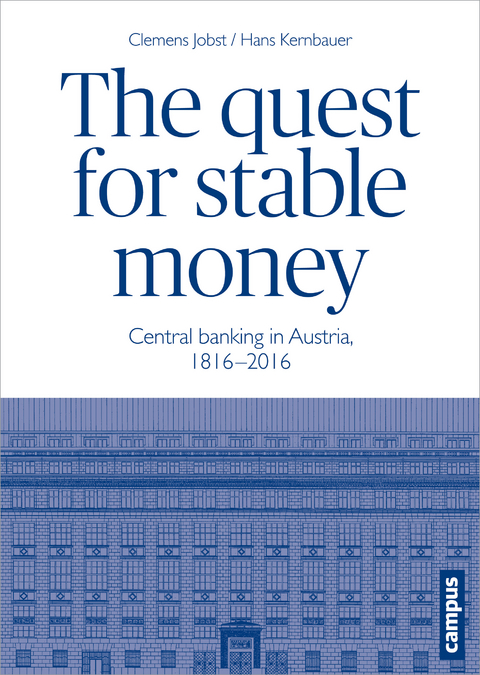
The quest for stable money
During the 200 years that followed, the Nationalbank emerged from the treasury's banker of choice into a central bank, and from a private stock corporation into a public institution. Yet the challenges facing today's Nationalbank are a surprising echo of the past: How to provide stable money? How far must central bank independence go? How does monetary policy making work in a multinational monetary union? How to provide stable money?
This engaging book provides the first extensive overview of monetary history in Austria, from the Nationalbank's predecessor, the Wiener Stadtbanco, to Austria's integration into the euro area today.
Caught up in the costly Napoleonic wars, Austria went into sovereign default in 1811. Five years on, the public authorities founded a national bank to be financed and run by private shareholders, the idea being that an independent bank would help rebuild trust in money.
During the 200 years that followed, the Nationalbank emerged from the treasury's banker of choice into a central bank, and from a private stock corporation into a public institution. Yet the challenges facing today's Nationalbank are a surprising echo of the past: How to provide stable money? How far must central bank independence go? How does monetary policy making work in a multinational monetary union? How to provide stable money?
This engaging book provides the first extensive overview of monetary history in Austria, from the Nationalbank's predecessor, the Wiener Stadtbanco, to Austria's integration into the euro area today.
Table of contents
6 Introduction
12 A first try at monetary autonomy-the Wiener Stadtbanco (1706-1816)
13 Public banks in the 1600s and 1700s-innovative payment services and public debt management
15 A bankrupt sovereign in need of a public bank
23 Paper money and inflation
34 Fragile stability during the Nationalbank's formative years (1816-1848)
35 A private stock corporation as a guardian of Austria's currency
46 Note-issuing bank of an economically and politically heterogeneous empire
52 The tasks of the Nationalbank
64 Turning from the treasury's banker to the banker's bank (1848-1878)
65 1848-the revolution accelerates long-term change
70 The return to convertibility proves to be a moving target
81 Taking on a new role in the financial system
88 Monetary policy after 1866: from fiscal to monetary dominance against all odds
96 200 years of monetary policy in pictures
112 Two governments, one bank-the Austro-Hungarian monetary union (1878-1914)
114 A separate note-issuing bank for Hungary?
124 Return to a stable external value
131 Conducting business in a large empire
142 World War I and the collapse of monetary union (1914-1919)
143 War preparations and the initial weeks of conflict
144 State financing and central bank policy during the war
150 The end of the monarchy and the joint currency
152 Hyperinflation and a new currency (1919-1931)
153 Hyperinflation and stabilization
156 The League of Nations loan
161 Central bank policy under foreign control, 1923-1929
167 The schilling replaces the crown
174 The Creditanstalt crisis, the Great Depression and World War II (1931-1945)
176 The Creditanstalt crisis
183 Restructuring of banks
186 Stable exchange rate, stagnating economy
189 Liquidation of the OeNB, the reichsmark replaces the schilling
194 Schilling reinstatement and economic miracle (1945-1971)
195 The schilling returns
214 Dynamic catch-up process and stability risks
222 Austria's hard currency policy (1971-1999)
223 The crisis of the Bretton Woods system
225 Exchange rate policy as an anti-inflation policy
234 Financial market liberalization, EU accession and preparations for the euro
242 A single European currency-the OeNB as a Eurosystem central bank (1999-2016)
244 Monetary policy may change, but the objective does not
254 The common monetary policy, 1999 to 2015
257 New instruments to ensure financial stability
268 Conclusion
274 Currencies
276 Notes
298 References
311 Sources
312 List of tables, charts and maps
312 Photo credits
313 Index
317 Acknowledgments
Introduction
Milestone birthdays present an opportunity to reflect not just on one's own age but also to anticipate upcoming family birthdays of significance or recall past family anniversaries. Central banks are no different in this respect. Many central bank histories start with a reference to the oldest surviving member of the family, the Swedish Riksbank, founded in 1668. In the genealogical table of the oldest central banks in the world, drawn up by Forrest Capie, Charles Goodhart and Norbert Schnadt in their seminal contribution marking the tercentenary of the Bank of England, the privilegirte oesterreichische National- Bank (OeNB) comes in sixth. Apart from the above-mentioned Sveriges Riksbank and the Bank of England (1694), the only central banks founded before the OeNB were the Banque de France (1800), the Bank of Finland (originally established as the Finnish Office for Exchange, Lending and Deposits in 1811) and De Nederlandsche Bank (1814). Finishing sixth was in fact close for the OeNB: Founded on June 1, 1816, it is just 13 days older than Norges Bank. Yet this genealogy does not list defunct family members like the Banco di San Giorgio (1407-1805), the Bank of Amsterdam (1609-1820), or the Wiener Stadtbanco (1706-1816), precursors who would change the ranking had they survived. Moreover, central banks' birth dates are frequently stated with the reservation that early on, these banks had few similarities with contemporary monetary authorities, evolving into central banks as we know them only in a slow process and over an extended time span. Passage to adulthood, to continue the analogy, is generally linked to the assumption of a lender-of-last-resort role, meaning the provision of sufficient central bank money during a financial crisis if required. To this end, the central bank must have "grown up" to be a neutral, nonprofit-oriented economic agent who acts in the general economic interest rather than competing with other commercial banks.
Two recurring challenges
Now, if the OeNB was born in 1816, when did it reach adulthood? The eventful history of Austria's central bank does not lend itself easily to a teleological interpretation according to which early banks of issue developed into modern central banks at a determinable point in time. Thus, rather than judging at what point and to what degree the OeNB fulfilled modern-day criteria of central banking, a more appropriate approach is to view the bank as an institution that operates in a space that both in the past and today is defined by two dimensions: monetary stability and financial stability.
Of course, the meaning of monetary and financial stability has changed during the past 200 years. Originally, money was considered to be stable if all coins were struck with consistent amounts of metal; later, the notion of monetary stability was linked with the convertibility of paper money against coins with a specified metal content. Not until the 20th century was monetary stability understood as the stability of a broadly defined index of consumer prices. Financial stability, on the other hand, has typically been a much broader concept, embracing the smooth operation of payment systems; last resort lending; the supervision of individual banks and other financial intermediaries; or the prevention of macroeconomic imbalances such as real estate price bubbles driven by excessive mortgage lending, which may jeopardize the stability of the entire financial system. The basic issue of monetary and financial stability has always been the same: Since money has been around, the sovereigns who exercised the right of coinage had an incentive to finance their expenditure by debasing the currency, either by reducing the weight of coins or by adding base metals to the alloy. Numerous instances of inflation from Classical antiquity to the modern age demonstrate this process; paper money, once it had been invented, made debasement only easier. As money and credit are closely r
| Erscheinungsdatum | 29.02.2016 |
|---|---|
| Übersetzer | Christopher J. Anderson, Michaela Beichtbuchner, Ingrid Haussteiner, Rena Mühldorf, Sylvi Rennert, Ingeborg Schuch, Susan Starling |
| Zusatzinfo | div. Abbildungen und Schaubilder |
| Verlagsort | Weinheim |
| Sprache | englisch |
| Original-Titel | Jobst, Die Bank. Das Geld. Der Staat. |
| Maße | 167 x 231 mm |
| Gewicht | 907 g |
| Themenwelt | Sachbuch/Ratgeber ► Geschichte / Politik ► Regional- / Landesgeschichte |
| Geschichte ► Teilgebiete der Geschichte ► Wirtschaftsgeschichte | |
| Schlagworte | austria • Bohemia • Currency • Euro • Europe • Finance • Financial Policy • Gulden • History • hungaria • monetary policy • MONEY • national banking • OeNB • Oesterreichische Nationalbank • Österreich • Österreich, Geschichte; Sozial-/Wirtschafts-Geschichte • Schilling • Sozial-Wirtschaftsgeschichte • Vienna • Währungspolitik • Wien • Zentralbank |
| ISBN-10 | 3-593-50535-5 / 3593505355 |
| ISBN-13 | 978-3-593-50535-0 / 9783593505350 |
| Zustand | Neuware |
| Informationen gemäß Produktsicherheitsverordnung (GPSR) | |
| Haben Sie eine Frage zum Produkt? |
aus dem Bereich