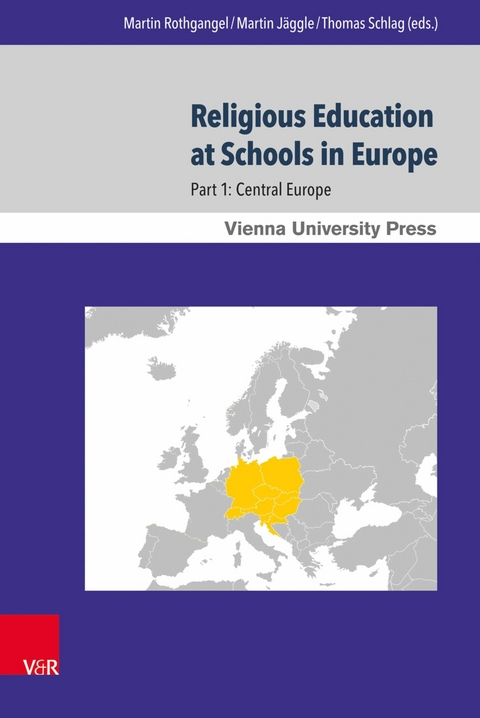
Religious Education at Schools in Europe (eBook)
310 Seiten
Vandenhoeck & Ruprecht Unipress (Verlag)
978-3-8470-0513-1 (ISBN)
Dr. Martin Rothgangel ist Professor für Religionspädagogik an der Evangelisch-Theologischen Fakultät der Universität Wien.
Dr. Martin Rothgangel ist Professor für Religionspädagogik an der Evangelisch-Theologischen Fakultät der Universität Wien.
Title Page 3
Copyright 4
Table of Contents 5
Body 7
Preface: Religious Education at Schools in Europe 7
1. The socio-religious background of the country 10
2. Legal framework for religious education and the relationship between religious communities and the state 10
3. Developments in the country's education policy 10
4. Role of religiously sponsored schools, including any changes and developments, legal relationships 10
5. Conceptions and tasks of religious education 10
6. Practice / reality of religious education in different schools 11
7. Observations on alternative subjects / learning areas like ethics, philosophy etc. 11
8. Dealing with religious diversity 11
9. Religion in school outside of religious education 11
10. Training of teachers of religious education: institutes, structures, priorities issues 12
11. Empirical Research concerning religious education 12
12. Desiderata / challenges for religious education in a European context 12
13. Further information (e.g., relevant literature on religious education, institutions, websites) 12
References 13
Friedrich Schweitzer: Comparing Religious Education in Schools in European Countries: Challenges for International Comparative Research 15
1. What Is Comparative Research in Religious Education? – Initial Considerations 17
2. Reasons and Expectations 18
2.1 The need for integrated international research in religious education is clearly growing 21
2.2 Research in religious education must include international comparisons in order to evaluate national models and to capture international developments 21
2.3 International comparative research in religious education can challenge assumptions otherwise taken for granted 22
2.4 Intercultural, ecumenical, and interreligious dialogue must include the ways in which different cultures, denominations, and religions practise religious education 23
2.5 Political reasons make it desirable to develop shared international standards for religious education 24
3. Obstacles for Comparative Research 25
4. Existing Studies: A Preliminary Typology 26
4.1 Country Reports and Country-By-Country Comparisons 27
4.2 Problem-Centred Comparative Studies 28
4.3 Integrated International Empirical Studies 29
4.4 Comparative Historical Studies 30
5. Suggestions for the Methodology of International, Interdenominational, and Interreligious Comparative Research in Religious Education 30
References 35
Martin Jäggle / Philipp Klutz: Religious Education at Schools in Austria 39
Introduction 39
1. The socio-religious background of the country 40
1.1 General information 40
1.2 Developments 41
1.3 Religion among young people 42
2. Legal framework for religious education and the relationship between religious communities and the state 42
3. Developments in the country's education policy 45
4. Role of religiously sponsored schools, including any changes and developments, legal relationships 47
5. Conceptions and tasks of religious education 48
6. Practice / reality of religious education in different schools 50
7. Observations on alternative subjects / learning areas like ethics, philosophy etc. 52
8. Dealing with religious diversity 53
9. Religion in school outside of religious education 55
10. Training of teachers of religious education: institutes, structures, priorities issues 57
11. Empirical Research concerning religious education at schools 59
(a) Studies on students', parents' and (RE) teachers' perspectives on RE 59
(b) Evaluation of `Ethics' 60
(c) Studies on classroom interaction, curricula and textbooks 60
12. Desiderata / challenges for religious education in a European context 61
Competences and educational standards 61
Collective and cooperative RE 61
Conceptualisations for a diaconal presence of religion.(s) at public schools 61
School development and religion 62
Training 62
13. Further information (e.g., relevant literature on religious education, institutions, websites) 62
13.1 Journals 62
13.2 Further literature 62
References 65
Legal foundations (http://www.ris.bka.gv.at/) 67
Curricula (http://www.ris.bka.gv.at/) 67
Austrian Federal Chancellery (http://www.bka.gv.at/) 67
Federal Ministry of Education and Women's Affairs (https://www.bmbf.gv.at/) 67
Statistik Austria (http://www.statistik.at/) 68
Ana Thea Filipovic: Religious Education at Schools in Croatia 69
Introduction 69
1. The socio-religious background of the country 69
2. Legal framework for religious education and the relationship between religious communities and the state 71
3. Developments in the country's education policy 73
4. Role of religiously sponsored schools, including any changes and developments, legal relationships 75
5. Conceptions and tasks of religious education 76
6. Practice / reality of religious education in different schools 77
7. Observations on alternative subjects / learning areas like ethics, philosophy etc. 78
8. Dealing with religious diversity 79
9. Religion in school outside of religious education 79
10. Training of teachers of religious education: institutes, structures, priorities issues 80
11. Empirical Research concerning religious education at schools 81
12. Desiderata / challenges for religious education in a European context 82
13. Further information (e.g., relevant literature on religious education, institutions, websites) 83
13.1 Journals 83
13.2 Encyclopaedia, documents, curricula 83
13.3 Further literature 84
13.4 Important websites 85
References 85
Ludmila Muchová: Religious Education at Schools in the Czech Republic 89
Introduction 89
1. The socio-religious background in the country 89
2. Legal framework for religious education and the relationship between religious communities and the state 92
3. Developments in the country's education policy 93
4. Role of religiously sponsored schools, including any changes and developments, legal relationships 95
5. Conceptions and tasks of religious education 97
6. Practice / reality of religious education in different schools 100
7. Observations on alternative subjects / learning areas like ethics, philosophy etc. 104
8. Dealing with religious diversity 105
9. Religion in school outside of religious education 107
10. Training of teachers of religious education: institutes, structures, priorities issues 108
11. Empirical Research concerning religious education 111
12. Desiderata / challenges for religious education in a European context 111
13. Further information (e.g., relevant literature on religious education, institutions, websites) 112
On the issue of religiosity in the Czech Republic 112
Chapters in monographs by Tomás Halík 112
On RE in czech schools 113
References 113
Martin Rothgangel / Hans-Georg Ziebertz in cooperation with Philipp Klutz: Religious Education at Schools in Germany 115
Introduction 115
1. The socio-religious background of the country 115
1.1 General information 115
1.2 A comparison between the generations 116
1.3 Religious orientation of young people 118
2. Legal framework for religious education and the relationship between religious communities and the state 119
3. Developments in the country's education policy 121
4. Role of religiously sponsored schools, including any changes and developments, legal relationships 122
5. Conceptions and tasks of religious education 124
a) Church communiqués on Catholic RE 124
b) Church communiqués on Protestant RE 127
6. Practice / reality of religious education in different schools 130
7. Observations on alternative subjects / learning areas such as ethics, philosophy etc. 133
8. Dealing with religious diversity 134
9. Religion in school outside of religious education 135
10. Training of teachers of religious education: institutes, structures, priorities issues 136
11. Empirical Research concerning religious education at schools 138
(a) Studies on students' perspectives on RE 138
(b) Studies on (RE) teachers' and parents' perspectives on RE 138
(c) Studies on classroom interaction and didactics of RE 140
(d) Studies with focus on religion in school outside of RE and in a wider context concerning RE 142
12. Desiderata / challenges for religious education in a European context 143
13. Further information (e.g., relevant literature on religious education, institutions, websites) 144
References 146
Mónika Solymár: Religious education at schools in Hungary 149
Introduction 149
1. The socio-religious background of the country 149
1.1 Hungary Basic information and special features 149
1.2 Demographic situation and developments 150
1.3 Religiosity in Hungary: Christian denominations and trends 151
2. Legal framework for religious education and the relationship between religious communities and the state 153
2.1 The churches and other religious groups in Hungary after 1989 153
2.2 RE in public schools 154
2.3 Financing RE 156
3. Developments in the country's education policy 157
3.1 Statistics for the Hungarian education system 157
3.2 Developments in, and perspectives on, education policy 158
3.3 Education policy and the churches and religious groups: network of denominational schools 160
4. Role of religiously sponsored schools, including any changes and developments, legal relationships 161
4.1 Pluralization of the education system, patronage of denominational schools, unique features in each denomination 161
4.2 A profile of the denominational schools 163
4.3 Financing of denominational schools 164
5. Conceptions and tasks of religious education 165
6. Practice / reality of religious education in different schools 166
6.1 RE in figures, types of RE, registrations, withdrawals 166
6.2 Curricula and textbooks, RE in various types of schools, RE as a subject for final exams (Matura) 168
6.3 Qualification requirements for teachers, church appointment, practical challenges 170
7. Observations on alternative subjects / learning areas like ethics, philosophy etc. 171
8. Dealing with religious diversity 172
9. Religion in school outside of religious education 174
10. Training of teachers of religious education: institutes, structures, priorities issues 175
10.1 Universities and technical colleges under church patronage, locations for religion teacher training, state and church provisions 175
10.2 Teacher training between the Bologna system and the undivided new model of teacher training, structure of religion teacher training, acquisition of skills and qualifications 177
10.3 Further training, opportunities in professional life 178
11. Empirical Research concerning religious education at schools 179
12. Desiderata / challenges for religious education in a European context 179
13. Further information (e.g., relevant literature on religious education, institutions, websites) 181
References 183
Cyprian Rogowski: Religious Education at Schools in Poland 185
Introduction 185
1. The socio-religious background of the country 186
1.1 General information 186
1.2 Developments 187
1.3 Religious orientation of young people 188
2. Legal framework for religious education and the relationship between religious communities and the state 189
3. Developments in the country's education policy 191
4. Role of religiously sponsored schools, including any changes and developments, legal relationships 192
5. Conceptions and tasks of religious education 197
6. Practice / reality of religious education in different schools 198
7. Observations on alternative subjects / learning areas like ethics, philosophy etc. 200
8. Dealing with religious diversity 201
9. Religion in school outside of religious education 202
10. Training of teachers of religious education: institutes, structures, priorities issues 202
11. Empirical Research concerning religious education 203
12. Desiderata / challenges for religious education in a European context 205
13. Further information (e.g., relevant literature on religious education, institutions, websites) 205
The following textbooks provide an initial insight into the discussion on religious education in Poland 205
The following magazines provide further insights into the topic of religious education 206
The following websites are worthy of note 206
Institutions 207
References 207
Stefan Hirschlehner: Religious Education at Schools in the Principality of Liechtenstein 209
Introduction 209
1. Socio-religious background of the country 209
1.1 General information 209
1.2 Religious affiliation 210
1.3 The Roman Catholic Church: From a deanship to an archdiocese 210
1.4 Religiousness in the Principality of Liechtenstein 211
1.5 Funding of religious communities 212
2. Legal Frameworks of re and the relationship between religious communities and the state 212
3. Developments in the country's education policy 214
Recent key developments in the Education system 214
4. Role of religiously sponsored schools, including any changes and developments, legal relationships 214
5. Conceptions and tasks of religious education 214
6. Practice / reality of religious education in different schools 217
7. Observations on alternative subjects / learning areas like ethics, philosophy etc. 218
8. Dealing with religious diversity 218
9. Religion in schools outside of religious education 218
10. Training of teachers of religious education: institutes, structures, priorities issues 219
11. Empirical research concerning religious education 219
12. Desiderate and challenges for religious education in a European context 219
13. Further information (e.g., relevant literature on religious education, institutions, websites) 220
Legal fundations 220
Curricula 220
Agreements 220
Order of the government 221
Information brochure 221
Statistics 221
References 221
Tibor Reimer: Religious education at schools in Slovakia 223
Introduction 223
1. The socio-religious background of the country 223
2. Legal framework for religious education and the relationship between religious communities and the state 226
3. Developments in the country's education policy 228
4. Role of religiously sponsored schools, including any changes and developments, legal relationships 231
5. Conceptions and tasks of religious education 233
6. Practice / reality of religious education in different schools 235
7. Observations on alternative subjects / learning areas like ethics, philosophy etc. 237
8. Dealing with religious diversity 239
9. Religion in school outside of religious education 240
10. Training of teachers of religious education: institutes, structures, priorities issues 242
11. Empirical Research concerning religious education 244
12. Desiderata / challenges for religious education in a European context 245
13. Further information (e.g., relevant literature on religious education, institutions, websites) 247
13.1 Important institutions in the area of religious education and RE 247
13.2 Relevant literature on religious education 248
References 248
Stanko Gerjolj / Andrej Saje: Religious Education at Schools in Slovenia 249
Introduction 249
1. The socio-religious background of the country 249
2. Legal framework for religious education and the relationship between religious communities and the state 251
3. Developments in the country's education policy 252
4. Role of religiously sponsored schools, including any changes and developments, legal relationships 253
5. Conceptions and tasks of religious education 254
6. Practice / reality of religious education in different schools 257
7. Observations on alternative subjects / learning areas like ethics, philosophy etc. 259
8. Dealing with religious diversity 260
9. Religion in school outside of religious education 261
10. Training of teachers of religious education: institutes, structures, priorities issues 262
11. Empirical Research concerning religious education 263
12. Desiderata / challenges for religious education in a European context 263
13. Further information (e.g., relevant literature on religious education, institutions, websites) 264
References 264
Thomas Schlag: Religious Education at Schools in Switzerland 269
Introduction 269
1. The socio-religious background of the country 269
1.1 General information 270
1.2 A comparison between the generations 272
1.3 Religious orientation of young people 273
2. Legal framework for religious education and the relationship between religious communities and the state 275
3. Developments in the country's education policy 279
3.1 The responsibility of the state schools without any shared responsibility from the religious communities recognised under public law: the examples of Aargau, Berne and Zurich 280
3.1.1 Aargau 280
3.1.2 Berne 280
3.1.3 Zurich 281
3.2 The shared responsibility of the religious communities recognised under public law: the examples of Upper Valais and Grisons 282
3.2.1 Upper Valais 282
3.2.2 Grisons 283
3.3 The responsibility of the religious communities recognised under public law in cooperation with the state: the example of St. Gallen 283
3.4 No state RE: the example of Geneva 284
3.5 Current and future developments 284
4. Role of religiously sponsored schools, including any changes and developments, legal relationships 286
5. Conceptions and tasks of religious education 288
6. Practice / reality of religious education in different schools 290
7. Observations on alternative subjects / learning areas like ethics, philosophy etc. 293
8. Dealing with religious diversity 294
9. Religion in school outside of religious education 296
10. Training of teachers of religious education: institutes, structures, priorities issues 298
11. Empirical Research concerning religious education at schools 299
12. Desiderata / challenges for religious education in a European context 300
13. Further information (e.g., relevant literature on religious education, institutions, websites) 302
References 302
Contributors 309
| Erscheint lt. Verlag | 18.11.2015 |
|---|---|
| Reihe/Serie | Wiener Forum für Theologie und Religionswissenschaft |
| Wiener Forum für Theologie und Religionswissenschaft | |
| Wiener Forum für Theologie und Religionswissenschaft. | Wiener Forum für Theologie und Religionswissenschaft. |
| Co-Autor | Friedrich Schweitzer, Martin Rothgangel, Hans-Georg Ziebertz, Stefan Hirschlehner, Ana Thea Filipovic, Martin Jäggle, Philipp Klutz, Cyprian Rogowski, Thomas Schlag, Tibor Reimer, Stanko Gerjol, Andrej Saje, Mónika Solymár, Ludmila Muchova |
| Verlagsort | Göttingen |
| Sprache | englisch |
| Themenwelt | Geisteswissenschaften ► Religion / Theologie |
| Schlagworte | Bildungswesen • Internationalität • Pädagogik • Religion • Religion in Europa • Religionspädagogik • Schule |
| ISBN-10 | 3-8470-0513-8 / 3847005138 |
| ISBN-13 | 978-3-8470-0513-1 / 9783847005131 |
| Informationen gemäß Produktsicherheitsverordnung (GPSR) | |
| Haben Sie eine Frage zum Produkt? |
 PDF (Ohne DRM)
Digital Rights Management: ohne DRM
Dieses eBook enthält kein DRM oder Kopierschutz. Eine Weitergabe an Dritte ist jedoch rechtlich nicht zulässig, weil Sie beim Kauf nur die Rechte an der persönlichen Nutzung erwerben.
Dateiformat: PDF (Portable Document Format)
Mit einem festen Seitenlayout eignet sich die PDF besonders für Fachbücher mit Spalten, Tabellen und Abbildungen. Eine PDF kann auf fast allen Geräten angezeigt werden, ist aber für kleine Displays (Smartphone, eReader) nur eingeschränkt geeignet.
Systemvoraussetzungen:
PC/Mac: Mit einem PC oder Mac können Sie dieses eBook lesen. Sie benötigen dafür einen PDF-Viewer - z.B. den Adobe Reader oder Adobe Digital Editions.
eReader: Dieses eBook kann mit (fast) allen eBook-Readern gelesen werden. Mit dem amazon-Kindle ist es aber nicht kompatibel.
Smartphone/Tablet: Egal ob Apple oder Android, dieses eBook können Sie lesen. Sie benötigen dafür einen PDF-Viewer - z.B. die kostenlose Adobe Digital Editions-App.
Buying eBooks from abroad
For tax law reasons we can sell eBooks just within Germany and Switzerland. Regrettably we cannot fulfill eBook-orders from other countries.
aus dem Bereich