


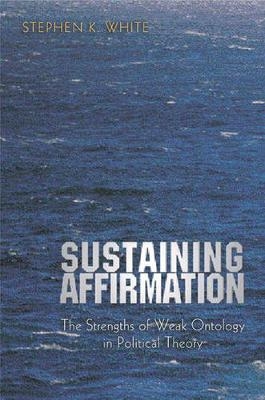
Sustaining Affirmation
The Strengths of Weak Ontology in Political Theory
Seiten
2000
Princeton University Press (Verlag)
978-0-691-05032-4 (ISBN)
Princeton University Press (Verlag)
978-0-691-05032-4 (ISBN)
- Titel ist leider vergriffen;
keine Neuauflage - Artikel merken
Elaborating the idea of weak ontology and the broad criteria behind it, this text shows how these are already at work in the thought of contemporary writers of seemingly very different perspectives. Among these thinkers he exposes the commonalities that emerge around the idea of weak ontology.
In light of many recent critiques of Western modernity and its conceptual foundations, the problem of adequately justifying our most basic moral and political values looms large. Without recourse to traditional ontological or metaphysical foundations, how can one affirm--or sustain--a commitment to fundamentals? The answer, according to Stephen White, lies in a turn to "weak" ontology, an approach that allows for ultimate commitments but at the same time acknowledges their historical, contestable character. This turn, White suggests, is already underway. His book traces its emergence in a variety of quarters in political thought today and offers a clear and compelling account of what this might mean for our late modern self-understanding.
As he elaborates the idea of weak ontology and the broad criteria behind it, White shows how these are already at work in the thought of contemporary writers of seemingly very different perspectives: George Kateb, Judith Butler, Charles Taylor, and William Connolly. Among these thinkers, often thought to be at odds, he exposes the commonalities that emerge around the idea of weak ontology. In its identification of a critical turn in political theory, and its nuanced explanation of that turn, his book both demonstrates and underscores the strengths of weak ontology.
In light of many recent critiques of Western modernity and its conceptual foundations, the problem of adequately justifying our most basic moral and political values looms large. Without recourse to traditional ontological or metaphysical foundations, how can one affirm--or sustain--a commitment to fundamentals? The answer, according to Stephen White, lies in a turn to "weak" ontology, an approach that allows for ultimate commitments but at the same time acknowledges their historical, contestable character. This turn, White suggests, is already underway. His book traces its emergence in a variety of quarters in political thought today and offers a clear and compelling account of what this might mean for our late modern self-understanding.
As he elaborates the idea of weak ontology and the broad criteria behind it, White shows how these are already at work in the thought of contemporary writers of seemingly very different perspectives: George Kateb, Judith Butler, Charles Taylor, and William Connolly. Among these thinkers, often thought to be at odds, he exposes the commonalities that emerge around the idea of weak ontology. In its identification of a critical turn in political theory, and its nuanced explanation of that turn, his book both demonstrates and underscores the strengths of weak ontology.
Stephen K. White teaches political theory at Virginia Tech. He is the editor of the journal Political Theory and author of several books, including Political Theory and Postmodernism and Edmund Burke: Politics, Modernity, and Aesthetics.
| Verlagsort | New Jersey |
|---|---|
| Sprache | englisch |
| Maße | 152 x 235 mm |
| Gewicht | 425 g |
| Themenwelt | Geisteswissenschaften ► Philosophie ► Metaphysik / Ontologie |
| Sozialwissenschaften ► Politik / Verwaltung ► Politische Theorie | |
| ISBN-10 | 0-691-05032-5 / 0691050325 |
| ISBN-13 | 978-0-691-05032-4 / 9780691050324 |
| Zustand | Neuware |
| Informationen gemäß Produktsicherheitsverordnung (GPSR) | |
| Haben Sie eine Frage zum Produkt? |
Mehr entdecken
aus dem Bereich


aus dem Bereich
eine philosophische Reise
Buch | Softcover (2024)
Goldmann (Verlag)
CHF 21,90


