


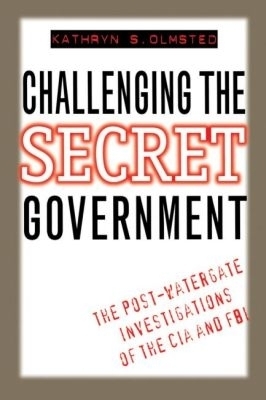
Challenging the Secret Government
The Post-Watergate Investigations of the CIA and FBI
Seiten
1996
|
New edition
The University of North Carolina Press (Verlag)
978-0-8078-4562-2 (ISBN)
The University of North Carolina Press (Verlag)
978-0-8078-4562-2 (ISBN)
This text describes the post-Watergate investigations of the CIA and FBI by the media and Congress, which caused observers to predict changes in the intelligence agencies. It also explains how neither the media nor Congress pressed for reforms, resulting in a return to the status quo.
Just four months after Richard Nixon's resignation, ""New York Times"" reporter Seymour Hersh unearthed a new case of government abuse of power: the CIA had launched a domestic spying programme of Orwellian proportions against American dissidents during the Vietnam War. The country's best investigative journalists and members of Congress quickly mobilized to probe a scandal that seemed certain to rock the foundations of this secret government. Subsequent investigations disclosed that the CIA had plotted to kill certain foreign leaders and that the FBI had harrassed civil rights and student groups. Some called the scandal ""son of Watergate"". Many observers predicted that the investigations would lead to far-reaching changes in the intelligence agencies. Yet, as Kathryn Olmsted shows, neither the media nor Congress pressed for reforms. For all of its post-Watergate zeal, the press hesitated to break its long tradition of deference in national security coverage. Congress, too, was unwilling to challenge the executive branch in national security matters. Reports of the demise of the executive branch were greatly exaggerated, and the result of the ""year of intelligence"" was a return to the status quo.
Just four months after Richard Nixon's resignation, ""New York Times"" reporter Seymour Hersh unearthed a new case of government abuse of power: the CIA had launched a domestic spying programme of Orwellian proportions against American dissidents during the Vietnam War. The country's best investigative journalists and members of Congress quickly mobilized to probe a scandal that seemed certain to rock the foundations of this secret government. Subsequent investigations disclosed that the CIA had plotted to kill certain foreign leaders and that the FBI had harrassed civil rights and student groups. Some called the scandal ""son of Watergate"". Many observers predicted that the investigations would lead to far-reaching changes in the intelligence agencies. Yet, as Kathryn Olmsted shows, neither the media nor Congress pressed for reforms. For all of its post-Watergate zeal, the press hesitated to break its long tradition of deference in national security coverage. Congress, too, was unwilling to challenge the executive branch in national security matters. Reports of the demise of the executive branch were greatly exaggerated, and the result of the ""year of intelligence"" was a return to the status quo.
KATHRYN S. OLMSTED is assistant professor of history at the University of California, Davis. She is author of Challenging the Secret Government: The Post-Watergate Investigations of the CIA and FBI.
| Verlagsort | Chapel Hill |
|---|---|
| Sprache | englisch |
| Maße | 155 x 235 mm |
| Gewicht | 398 g |
| Themenwelt | Geschichte ► Allgemeine Geschichte ► Zeitgeschichte |
| Geisteswissenschaften ► Geschichte ► Regional- / Ländergeschichte | |
| Sozialwissenschaften ► Politik / Verwaltung ► Staat / Verwaltung | |
| ISBN-10 | 0-8078-4562-0 / 0807845620 |
| ISBN-13 | 978-0-8078-4562-2 / 9780807845622 |
| Zustand | Neuware |
| Informationen gemäß Produktsicherheitsverordnung (GPSR) | |
| Haben Sie eine Frage zum Produkt? |
Mehr entdecken
aus dem Bereich



aus dem Bereich
die großen Jahre der Soziologie 1949-1969
Buch | Hardcover (2025)
Klett-Cotta (Verlag)
CHF 39,20
eine Deutschlandreise im Jahr 1958
Buch | Hardcover (2024)
C.H.Beck (Verlag)
CHF 29,90


