
A History of Japan (eBook)
720 Seiten
Wiley-Blackwell (Verlag)
978-1-119-02235-0 (ISBN)
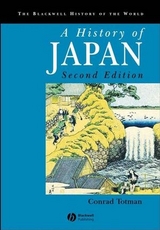
- The first edition was widely praised for combining sophistication and accessibility.
- Covers a wide range of subjects, including geology, climate, agriculture, government and politics, culture, literature, media, foreign relations, imperialism, and industrialism.
- Updated to include an epilogue on Japan today and tomorrow.
- Now includes more on women in history and more on international relations.
- Bibliographical listings have been updated and enlarged.
Part of The Blackwell History of the World Series
The goal of this ambitious series is to provide an accessible source of knowledge about the entire human past, for every curious person in every part of the world. It will comprise some two dozen volumes, of which some provide synoptic views of the history of particular regions while others consider the world as a whole during a particular period of time. The volumes are narrative in form, giving balanced attention to social and cultural history (in the broadest sense) as well as to institutional development and political change. Each provides a systematic account of a very large subject, but they are also both imaginative and interpretative. The Series is intended to be accessible to the widest possible readership, and the accessibility of its volumes is matched by the style of presentation and production.
Conrad Totman is Professor Emeritus at Yale University. He has also taught Japanese history at the University of California, Santa Barbara and at Northwestern University. He is the author of ten previous books, including Japan before Perry: A Short History (1981), Early Modern Japan (1993) and Pre-industrial Korea and Japan in Environmental Perspective (2004).
Conrad Totman is Professor Emeritus at Yale University. He has also taught Japanese history at the University of California, Santa Barbara and at Northwestern University. He is the author of ten previous books, including Japan before Perry: A Short History (1981), Early Modern Japan (1993) and Pre-industrial Korea and Japan in Environmental Perspective (2004).
List of Illustrations.
Conventions Used.
Acknowledgements.
Preface.
Maps.
Introduction.
Part I: Beginnings:.
1. Geology, Climate, and Biota.
2. From Origins to Agriculture.
Part II: The Age of Dispersed Agriculturalists (400 BCE -
1250 CE):.
3. Political Consolidation to 671 CE.
4. Establishing the Ritsuryô Order (672-750).
5. Ritsuryô Adaptation and Decay (750-1250).
6. Classical Higher Culture (750-1250).
Part III: The Age of Intensive Agriculture
(1250-1890):.
7. The Centuries of Disorder (1250-1890).
8. Medieval Higher Culture (1250-1550).
9. Establishing the Bakuhan Order (1550-1700).
10. The Age of Growth (1590-1700).
11. Stasis and Decay (1700-1850).
12. Crisis and Redirection (1800-1890).
Part IV: The Age of Industrialism: Early Decades
(1890-Present):.
13. Early Imperial Triumph (1890-1914).
14. Early Imperial Society and Culture.
15. Later Imperial Politics and Economy (1914-1945).
16. Later Imperial Society and Culture (1914-1945).
17. Drift to Disaster (1914-1945).
18. Entrepreneurial Japan: Politics and Economy (1945-1990).
19. Society and Environment (1945-1990).
20. The Culture of Entrepreneurial Japan (1945-1990).
Epilogue: Japan Today and Tomorrow.
Endnotes.
Appendices.
A. Tables I-X.
B. Chinese Words: Wade-Giles & Pinyin Orthographies.
C. Glossary of Japanese Terms.
D. Supplemental.
Readings.
Index
[1]
GEOLOGY, CLIMATE, AND BIOTA1
CHAPTER SYNOPSIS
Knowledge of geography is essential for all historians, and for none more so than students of Japan, because geographical variables have affected all three facets of its history: production, distribution, and representation. In terms of the last, geography is important because place and season are central referents in a wide array of records and creative works. Place names and ecosystem terms are alive with meaning. Words such as akamatsu (red pine), baiu (rainy season), yuki (snow), and ume (plum) evoke images of season and circumstance as richly as they do poem and painting. And place names – Kyoto, Kantō, Nagasaki, Tosa, or Yoshiwara – resonate at many levels, eliciting layer upon layer of significance and sensibility. Not to know those layers denies one access to much of the history’s richness and means that one cannot know what that history signifies to those who do.
Much of the charm of geography lies, therefore, in its function in the representation of history. Its more essential quality, however, lies in its key role in shaping patterns of production and distribution. Both general characteristics and specific factors – e.g., the depth and distribution of Kantō loam, ruggedness of the Kii peninsula’s coastline, Mt. Asama’s volcanic eruptions, the Inland Sea’s location, or Yodo River silting – all in large or small ways have shaped those facets of history.
The basic physical geography of Japan has changed very little during the centuries of its written history, so describing the island chain as it is today pretty much describes it for the past two thousand years. Over the longer duration of its human habitation, however, Japan has experienced major geographic changes, and because those changes not only affected the experience of all creatures living there at the time but also determined the archipelago’s present-day character, its geological heritage merits examination. Climate and biota also have played important roles in shaping its history.
JAPAN’S GEOGRAPHY TODAY
Today Japan consists of the four major islands of Hokkaido, Honshu, Kyushu, and Shikoku, a few sizable nearby islands, and innumerable islets, most notably those of the southward-running Ryukyu and Bonin island chains. (See map 2.) The country’s gross land area is about 378,000 square kilometers, roughly the size of Germany, Montana, or Zimbabwe. Of that total area, about 56,000 square kilometers are in cultivation while the rest, mostly mountains, are devoted to forest, pasture, or urban uses.
Lying along the eastern edge of Eurasia, Japan extends from about 31° north latitude at the southern tip of Kyushu to 45° near the northern end of Hokkaido. The climate ranges from subtropical to cold temperate, and indigenous forest vegetation ranges similarly from evergreen broadleaf in the south through deciduous broadleaf in much of central Japan to coniferous boreal forest in Hokkaido and at higher elevations in Honshu.
Today, as for the past few thousand years, the bulk of Japan’s human population is situated along an east–west axis that runs from northern Kyushu through the Inland Sea to the Kinai basin and the Nobi and Kantō plains, the last of which is the largest area of flat land and the site of megapolitan Tokyo. This elongated strip of central Japan has dominated the country’s human history because the Inland Sea provided convenient, reasonably safe transportation and was lined with small but productive and comfortable coastal plains and their richly wooded hinterlands. The Kinai, Nobi, and Kantō plains, all endowed with attractive climates, provided agricultural foundations large and fertile enough to support political organizations that ambitious leaders could employ to conquer outlying populations.
The long-term social domination enjoyed by this Inland–Sea-centered axis has helped sustain ill-defined but enduring regional tensions, most notably that between residents of southwest and northeast Japan. The tension was fostered from early times, it appears, by the entry of diverse continental peoples into Japan via the “land bridges” that periodically linked Kyushu and Sakhalin to the continent, the most recent ones being submerged by rising sea levels about 13,000 years ago. In later millennia the regional distinctions were sustained by differences in the floral composition of Japan’s forests. Specifically, the deciduous forests that prevailed from central Japan northeastward enabled that region to sustain a more dense and durable forager culture than could the evergreen stands of the southwest, which proved less supportive and instead encouraged the adoption of rice culture some 2,400 years ago (400 BCE) . In subsequent centuries enduring differences in cultural pretensions and economic conditions nurtured regional hostility and outright warfare, most persistently between the “civilized” west and “barbarian” east. Recently the tension was given harsh expression in civil wars of the 1860s, and it persisted through the twentieth century in the form of political and cultural rivalries and resentments.
THE GEOLOGICAL HERITAGE
From the perspective of the individuals whose passage has produced Japan’s human history, the archipelago was and is a large and variegated place in which to live. From a broader global perspective, however, it is a small realm whose character has been determined by the very tectonic processes that shaped the history of the entire planet.
Like earthlings, after all, the Earth does have a history, and Japan’s place in it can be outlined briefly. Compared to our universe, with its postulated birthing date of some fourteen billion years ago, Earth is a newcomer, taking shape less than half that long ago. By two billion years ago its surface structure of continental and oceanic plates had formed and those plates were embarked on the convoluted journeys that led them eons later, some 250 million years ago, into the great clustered configuration known as Pangaea.
The location in Pangaea of that segment of continental plate that we know today as Japan is not certain, but recent soundings indicate that the northerly half was situated on the northwestern margin of the super continent, at the edge of what geologists identify as the North American Plate. As the Earth’s internal churnings started disassembling Pangaea some 200 million years ago, that plate was propelled westward, overriding the great Panthallasic Ocean (today’s Pacific and Philippine Sea Plates) until its leading edge encountered the northeast section of Pangaea, today’s Eurasian Plate. That plate was making a long, pivoting journey southeastward, which drove it roughshod over the Philippine Sea Plate. The area we know as northeast Japan collided with that descending Eurasian Plate in the vicinity of today’s Korea, and the force of that collision eventually forced a fragment of the latter plate to pivot away to the southeast, where it became the foundation for today’s southwestern Japan. That pivoting movement created a deep marine depression, which we know as the Sea of Japan. The immense pressure of that collision was expressed in folding, faulting, and volcanism, and the record of those processes is preserved today in Japan’s profoundly complicated geology, most strikingly in the Nagano region where the plates collided with particular harshness.
Ever since the post-Pangaea collision started some hundred million years ago, Japan has continued to twist and churn, regions irregularly rising and falling as the balance repeatedly shifted between eruptive tectonic pressure and reductive erosion (see figure 1.1). As that figure suggests, much of present-day Japan was under water some fifteen million years ago, and not until about five million years ago did the area commence its present orogeny, the rapid mountain building that has formed the archipelago we know today. Compared to the Appalachian and Ural mountains, which are a half-billion or so years old, or the Rockies, Himalayas, and Alps, which date back tens of millions, the mountains of Japan are remarkably young, having gained much of their present height during the past two million years.
About two million years ago (for reasons having to do with atmospheric composition, continental and oceanic configuration, or the tilt of Earth’s axis and the shape of Earth’s solar orbit) the planet entered a period of frequent glaciations that is still in progress. By then, the Pleistocene epoch, Japan consisted of an elongated cluster of intersecting mountain ranges and deposition plains that flanked the continent but were separated from it by the Sea of Japan. It was bounded by shallow seas to the southwest, deep oceanic trenches to the south and east, and shallow straits in the north. Depending primarily on the ebb and flow of glaciation and the resulting rise and fall of sea level, Japan was isolated periodically as a set of islands or joined to the continent by stretches of coastal lowland – “land bridges” – that extended westward from Kyushu and Sakhalin.
Figure 1.1 The Miocene archipelago (shaded areas). (A reconstruction of terrestrial areas, ca. 15 million yBP – Middle Miocene.) Much of...
| Erscheint lt. Verlag | 11.9.2014 |
|---|---|
| Reihe/Serie | Blackwell History of the World |
| Blackwell History of the World | Blackwell History of the World |
| Sprache | englisch |
| Themenwelt | Geisteswissenschaften ► Geschichte ► Regional- / Ländergeschichte |
| Schlagworte | accessible • Age • AGEs • Archäologie • archaeology • Archäologie • Asian & Australasian History • Book • centuries • changing • Conrad • considerable • countrys • familiar • foragers • Four • fullest • Geschichte • Geschichte / Asien u. Australasien • History • humanenvironment relations • interplay • Japan • Major • nineteenth • Patterns • Political • present • Realms • Terms • Totman |
| ISBN-10 | 1-119-02235-5 / 1119022355 |
| ISBN-13 | 978-1-119-02235-0 / 9781119022350 |
| Informationen gemäß Produktsicherheitsverordnung (GPSR) | |
| Haben Sie eine Frage zum Produkt? |
 EPUB (Adobe DRM)
Kopierschutz: Adobe-DRM
Adobe-DRM ist ein Kopierschutz, der das eBook vor Mißbrauch schützen soll. Dabei wird das eBook bereits beim Download auf Ihre persönliche Adobe-ID autorisiert. Lesen können Sie das eBook dann nur auf den Geräten, welche ebenfalls auf Ihre Adobe-ID registriert sind.
Details zum Adobe-DRM
Dateiformat: EPUB (Electronic Publication)
EPUB ist ein offener Standard für eBooks und eignet sich besonders zur Darstellung von Belletristik und Sachbüchern. Der Fließtext wird dynamisch an die Display- und Schriftgröße angepasst. Auch für mobile Lesegeräte ist EPUB daher gut geeignet.
Systemvoraussetzungen:
PC/Mac: Mit einem PC oder Mac können Sie dieses eBook lesen. Sie benötigen eine
eReader: Dieses eBook kann mit (fast) allen eBook-Readern gelesen werden. Mit dem amazon-Kindle ist es aber nicht kompatibel.
Smartphone/Tablet: Egal ob Apple oder Android, dieses eBook können Sie lesen. Sie benötigen eine
Geräteliste und zusätzliche Hinweise
Buying eBooks from abroad
For tax law reasons we can sell eBooks just within Germany and Switzerland. Regrettably we cannot fulfill eBook-orders from other countries.
aus dem Bereich