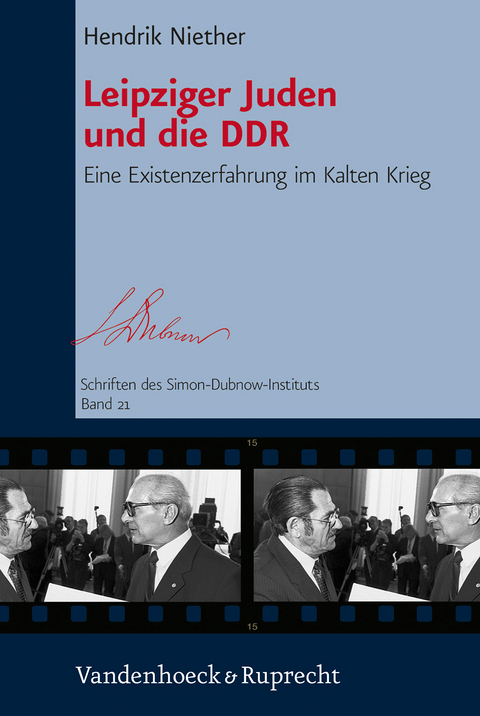
Leipziger Juden und die DDR
Vandenhoeck & Ruprecht (Verlag)
978-3-525-36997-5 (ISBN)
The study seeks to reconstruct the Jewish history of political experience during the period of socialism and the Cold War, as exemplified in Leipzig, the second largest city in the German Democratic Republic. It reveals that Jewish life in East Germany was not shaped solely by the formal Jewish Community (Gemeinde), but also by one's affiliation with religious and political currents, such as Reform, Orthodoxy, Zionism, socialism and communism. The relationship of the SED party to Jewish citizens was not rigidly fixed; rather, it was characterized by a dynamic process and subject to continuous re-negotiation. Hendrik Niether demonstrates that despite the adversities of the Cold War and state repression, there was constant communication between Jews in Leipzig, emigrés from Leipzig and Jewish organizations in Western Europe, Israel and the United States. The experience of the Holocaust constituted an element of mutual understanding between these different groups. Meanwhile, the East German society's interest in Jewish history and culture grew more pronounced as its attraction towards Antifascism ebbed away from the 1970s onward. This trend was tangible not only in ecclesial and oppositional circles, but also among political actors concerned with history and culture within the SED.
Dr. Hendrik Niether ist Historiker und lebt in Hannover.
The study seeks to reconstruct the Jewish history of political experience during the period of socialism and the Cold War, as exemplified in Leipzig, the second largest city in the German Democratic Republic. It reveals that Jewish life in East Germany was not shaped solely by the formal Jewish Community (Gemeinde), but also by one’s affiliation with religious and political currents, such as Reform, Orthodoxy, Zionism, socialism and communism. The relationship of the SED party to Jewish citizens was not rigidly fixed; rather, it was characterized by a dynamic process and subject to continuous re-negotiation. Hendrik Niether demonstrates that despite the adversities of the Cold War and state repression, there was constant communication between Jews in Leipzig, emigrés from Leipzig and Jewish organizations in Western Europe, Israel and the United States. The experience of the Holocaust constituted an element of mutual understanding between these different groups. Meanwhile, the East German society’s interest in Jewish history and culture grew more pronounced as its attraction towards Antifascism ebbed away from the 1970s onward. This trend was tangible not only in ecclesial and oppositional circles, but also among political actors concerned with history and culture within the SED.>
| Erscheint lt. Verlag | 19.11.2014 |
|---|---|
| Reihe/Serie | Schriften des Simon-Dubnow-Instituts ; Band 021 |
| Verlagsort | Göttingen |
| Sprache | deutsch |
| Maße | 160 x 237 mm |
| Gewicht | 725 g |
| Themenwelt | Geschichte ► Allgemeine Geschichte ► Zeitgeschichte |
| Schlagworte | Christlich-jüdische Beziehungen • DDR • Deutsche Demokratische Republik (DDR); Politik/Zeitgeschichte • Deutsche Demokratische Republik; Politik/Zeitgeschichte • Deutsch-jüdische Beziehungen • Deutschland (DDR) /Neuere Geschichte • Deutschland/Zeitgeschichte • Juden • Jüdische Geschichte • Leipzig; Politik/Zeitgesch. |
| ISBN-10 | 3-525-36997-2 / 3525369972 |
| ISBN-13 | 978-3-525-36997-5 / 9783525369975 |
| Zustand | Neuware |
| Informationen gemäß Produktsicherheitsverordnung (GPSR) | |
| Haben Sie eine Frage zum Produkt? |
aus dem Bereich