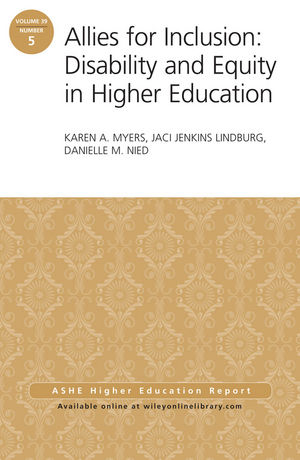
Allies for Inclusion (eBook)
152 Seiten
John Wiley & Sons (Verlag)
978-1-118-84605-6 (ISBN)
This monograph begins with a look into the future of disabilityeducation. How will students create their own identities? Willthere be a need for disability accommodations or will a universallydesigned world eliminate that current necessity? It also looks atthe past, with discussions of disability legislation such as theADA of 1990, the impact of Supreme Court decisions, descriptions ofcollege students with disabilities, and the paradigm shift from themedical "deficit" model of disability to one thatfocuses on the individual's lived experience as a socialconstruct.
Drawing on theoretical frameworks in multiple disciplines,disability identity development is explained, ally development isdefined, and disability services are explored. The monograph endswith a discussion of where disability education is now and howfaculty, staff, and administrators will continue to be allies ofinclusion for students in the years to come.
This is the 5th issue of the 39th volume of the Jossey-Bassseries ASHE Higher Education Report. Each monograph is thedefinitive analysis of a tough higher education issue, based onthorough research of pertinent literature and institutionalexperiences. Topics are identified by a national survey. Notedpractitioners and scholars are then commissioned to write thereports, with experts providing critical reviews of each manuscriptbefore publication.
KAREN A. MYERS, PhD, is an associate professor anddirector of the higher education administration graduate program at Saint Louis Universityand the director of the award-winning international disability educationproject, Allies for Inclusion: The Ability Exhibit. JACI JENKINS LINDBURG, PhD, is the assistant director ofacademic affairs for the Division of Continuing Studies and a member of the faculty inwomen's and gender studies at the University of Nebraska-Omaha. DANIELLE M. NIED, MS, is the assistant director forhousing and residence life for leadership and training and PhD student in the higher educationprogram at Saint Louis University.
Executive Summary ix
Foreword xiii
Acknowledgments xvii
The Future of Equity and Inclusion: Creating Meaningful Change 1
Disability Defined: What Does It Mean? 6
Overview of the Monograph 8
A Historical Overview of the Disability Movement 13
Key Definitions and Early Policies 13
Groundbreaking Legislation: The Rehabilitation Act and ADA 16
Discussion of Key Court Cases 21
Conclusion 28
Disability of College Campuses: An Overview 31
Disability in Higher Education: What Is It? 32
College Students With Disabilities: Who Are They? 35
College Students With Disabilities: What Are They Saying? 38
Perceptions and Preferences of Students and Employees With Disabilities 41
Disability Services in Higher Education: What Is Provided? 43
Students With Disabilities: A Shared Responsibility 46
Conclusion 48
Understanding Campus Complexity: Problems, Challenges, and Marginalization 49
Models of Disability 50
Major Student Development Theories Related to Disability 55
Attitudes Toward Disability 59
Disability Services on Campus 63
Student Veterans With Disabilities 65
Conclusion 66
Increasing Awareness: Allies, Advocacy, and the Campus Community 69
Defining Ally 70
Membership 72
Allies From Majority Identities 73
Allies Within Community 74
Theories of Ally Development 75
Praxis 80
Community of Allies 82
Allies for Disability: A Paradigm for Support 82
Conclusion 84
Increasing Awareness: Language, Communication Strategies, and Universally Designed Environments 85
Language of Disability 86
Communication Strategies 89
Communication Tips 90
Universally Designed Environments 93
Universal Design 93
Universal Instructional Design 94
Universal Design for Student Development 96
Conclusion 98
The New Movement in Disability Education and Advocacy 101
A New Vision for Disability 101
Education Curriculum 104
Inclusion Initiatives 104
The New Look of Disability 106
A Personal Call to Action 106
A Global Call to Action 107
References 109
Name Index 121
Subject Index 125
About the Authors 131
| Reihe/Serie | J-B ASHE-ERIC Report Series (AEHE) |
|---|---|
| Sprache | englisch |
| Themenwelt | Geisteswissenschaften |
| Sozialwissenschaften ► Pädagogik ► Bildungstheorie | |
| Sozialwissenschaften ► Pädagogik ► Didaktik | |
| Schlagworte | Allg. Bildungswesen (Hochschulen) • Bildungswesen • Education • Higher Education General • Hochschulen / Leitung, Verwaltung, Politik • Leadership, Administration & Policy (Higher Education) |
| ISBN-10 | 1-118-84605-2 / 1118846052 |
| ISBN-13 | 978-1-118-84605-6 / 9781118846056 |
| Informationen gemäß Produktsicherheitsverordnung (GPSR) | |
| Haben Sie eine Frage zum Produkt? |
 PDF (Adobe DRM)
Kopierschutz: Adobe-DRM
Adobe-DRM ist ein Kopierschutz, der das eBook vor Mißbrauch schützen soll. Dabei wird das eBook bereits beim Download auf Ihre persönliche Adobe-ID autorisiert. Lesen können Sie das eBook dann nur auf den Geräten, welche ebenfalls auf Ihre Adobe-ID registriert sind.
Details zum Adobe-DRM
Dateiformat: PDF (Portable Document Format)
Mit einem festen Seitenlayout eignet sich die PDF besonders für Fachbücher mit Spalten, Tabellen und Abbildungen. Eine PDF kann auf fast allen Geräten angezeigt werden, ist aber für kleine Displays (Smartphone, eReader) nur eingeschränkt geeignet.
Systemvoraussetzungen:
PC/Mac: Mit einem PC oder Mac können Sie dieses eBook lesen. Sie benötigen eine
eReader: Dieses eBook kann mit (fast) allen eBook-Readern gelesen werden. Mit dem amazon-Kindle ist es aber nicht kompatibel.
Smartphone/Tablet: Egal ob Apple oder Android, dieses eBook können Sie lesen. Sie benötigen eine
Geräteliste und zusätzliche Hinweise
Buying eBooks from abroad
For tax law reasons we can sell eBooks just within Germany and Switzerland. Regrettably we cannot fulfill eBook-orders from other countries.
aus dem Bereich