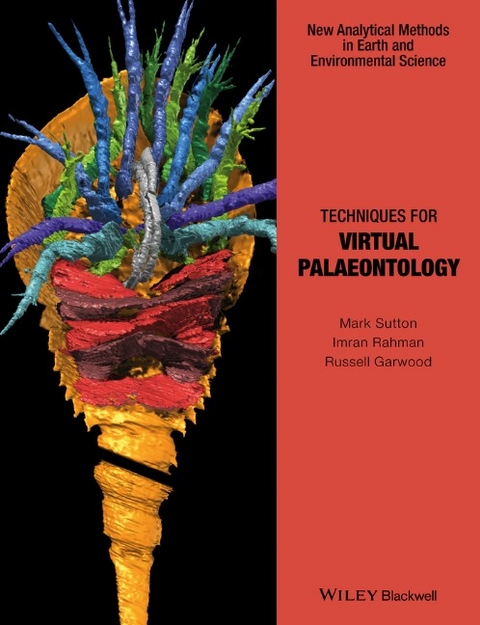
Techniques for Virtual Palaeontology (eBook)
John Wiley & Sons (Verlag)
978-1-118-59125-3 (ISBN)
Virtual palaeontology, the use of interactive three-dimensional digital models as a supplement or alternative to physical specimens for scientific study and communication, is rapidly becoming important to advanced students and researchers. Using non-invasive techniques, the method allows the capture of large quantities of useful data without damaging the fossils being studied
Techniques for Virtual Palaeontology guides palaeontologists through the decisions involved in designing a virtual palaeontology workflow and gives a comprehensive overview, providing discussions of underlying theory, applications, historical development, details of practical methodologies, and case studies. Techniques covered include physical-optical tomography (serial sectioning), focused ion beam tomography, all forms of X-ray CT, neutron tomography, magnetic resonance imaging, optical tomography, laser scanning, and photogrammetry. Visualization techniques and data/file formats are also discussed in detail.
Readership: All palaeontologists and students interested in three-dimensional visualization and analysis.
New Analytical Methods in Earth and Environmental Science
Because of the plethora of analytical techniques now available, and the acceleration of technological advance, many earth scientists find it difficult to know where to turn for reliable information on the latest tools at their disposal, and may lack the expertise to assess the relative strengths or limitations of a particular technique. This new series will address these difficulties by providing accessible introductions to important new techniques, lab and field protocols, suggestions for data handling and interpretation, and useful case studies. The series represents an invaluable and trusted source of information for researchers, advanced students and applied earth scientists wishing to familiarise themselves with emerging techniques in their field.
All titles in this series are available in a variety of full-colour, searchable eBook formats. Titles are also available in an enhanced eBook edition which may include additional features such as DOI linking, high resolution graphics and video.
Mark Sutton is a Senior Lecturer at Imperial College, London, UK specializing in Palaeozoic invertebrate palaeobiology and in three-dimensional visualization techniques. He is the primary author of the SPIERS software suite for palaeontological 3D reconstruction.
Imran Rahman is a Research Fellow at The University of Bristol, UK. He specializes in the origin and early evolution of echinoderms, and uses virtual palaeontology to study the form and function of fossil taxa.
Russell Garwood is an 1851 Royal Commission Research Fellow based at The University of Manchester, UK. He uses X-ray techniques to study fossils, primarily early terrestrial arthropods. He is the secondary author of the SPIERS software suite.
Mark Sutton is a Senior Lecturer at Imperial College, London, UK specializing in Palaeozoic invertebrate palaeobiology and in three-dimensional visualization techniques. He is the primary author of the SPIERS software suite for palaeontological 3D reconstruction. Imran Rahman is a Research Fellow at The University of Bristol, UK. He specializes in the origin and early evolution of echinoderms, and uses virtual palaeontology to study the form and function of fossil taxa. Russell Garwood is an 1851 Royal Commission Research Fellow based at The University of Manchester, UK. He uses X-ray techniques to study fossils, primarily early terrestrial arthropods. He is the secondary author of the SPIERS software suite.
1. Introduction to and History of Virtual Palaeontology (MDS;
2000wds)
2. Destructive Tomography
2.1. Physical-Optical Tomography (MDS; 4000wds)
2.2. Focussed Ion Beam (FIB) Tomography (IR; 1000wds)
3. Non-destructive tomography
3.1. Optical tomography (IR; 2000wds)
3.2. Magnetic Resonance Imaging (IR; 1000wds)
3.3. Neutron Computed Tomography (IR; 1000wds)
3.4. Xray Computed Tomography
3.4.1. Introduction to CT (RG; 2000wds)
3.4.2. Macro-CT (RG; 1000wds)
3.4.3. Micro-CT (RG; 3000wds)
3.4.4. Lab-based Nano-CT (RG; 1000wds)
3.4.5. Sychrotron X-ray Microtomography (RG; 3000wds)
3.4.6. Phase Contrast and Holotomography (RG;
2000wds)
3.4.7. X-ray Laminography (RG; 1000wds)
3.4.8. X-ray techniques for tomographic chemical mapping (RG;
2000wds)
4. Surface techniques
4.1. Laser scanning and LIDAR (IR; 4000wds)
4.2. Photogrammetry (IR; 1000wds)
5. Techniques for Reconstruction and Visualisation
5.1. Approaches to Surfacing and Rendering (MDS;
3000wds)
5.2. Virtual Preparation & Data Processing (MDS;
2000wds)
6. Applications beyond Visualisation (IR; 1000wds)
7. Conclusions and Future Direction (MDS; 1000wds)
"The authors have produced a well-organized volume that is easily accessible to both professionals and nonprofessionals and will likely be cited as an introductory source as virtual technologies in paleontology continue to emerge." (The Quarterly Review of Biology, 1 October 2015)
"Techniques for Virtual Palaeontology thus provides an excellent background for students who are likely to encounter virtual techniques as they embark on a palaeontological career. It also successfully informs more established palaeontologists who either plan to enter the field or, like me, dabble in 3D but would like more background information. It is a valuable addition to the palaeontological bookshelf." (Geological Journal, 1 May 2015)
1 Introduction and History
Abstract: We define virtual palaeontology as the study of three-dimensional fossils through digital visualizations. This approach can be the only practical means of studying certain fossils, and also brings benefits of convenience, ease of dissemination, and amenability to dissection and mark-up. Associated techniques fundamentally divide into surface-based and tomographic; the latter is a more diverse category, sub-divided primarily into destructive and non-destructive approaches. The history of the techniques is outlined. A long history of physical-optical studies throughout the 20th century predates the true origin of virtual palaeontology in the 1980s. Subsequent development was driven primarily by advances in X-ray computed tomography and computational resources, but has also been supplemented by a range of other technologies.
1.1 Introduction
Virtual palaeontology is the study of fossils through interactive digital visualizations, or virtual fossils. This approach involves the use of cutting-edge imaging and computer technologies in order to gain new insights into fossils, thereby enhancing our understanding of the history of life. While virtual palaeontological techniques do exist for handling two-dimensional data (e.g. the virtual lighting approach of Hammer et al. 2002), for most palaeontologists the field is synonymous with the study of three-dimensionally preserved material, and the term is used in this context throughout this book. Note also that the manual construction of idealized virtual models of taxa (e.g. Haug et al. 2012, Fig. 11), while very much a worthwhile undertaking, is not included in the concept of virtual palaeontology followed herein.
The majority of fossils are three-dimensional objects. While compression of fossils onto a genuinely two-dimensional plane does of course occur (Figure 1.1a), it is the exception, and in most preservational scenarios at least an element of the original three-dimensionality is retained (Figure 1.1b). Three-dimensional preservation retains more morphological information than true two-dimensional modes, but typically this information is problematic to extract. Isolation methods, of which several exist, are one solution. Fossils may simply ‘drop out’ or be naturally washed out of rocks; wet-sieving of poorly consolidated sediments mimics this process. Specimens may also be extracted chemically, for example, by dissolving the matrix (e.g. Aldridge 1990). These approaches are effective where applicable, but are prone to losing associations between disarticulated or weakly connected parts of fossils, and to damaging delicate structures. Specimens can also be physically ‘prepared’ out using needles, drills or gas-jet powder abrasive tools (e.g. Whybrow and Lindsay 1990); while usually preserving associations, this approach may also damage delicate structures, scales poorly to small specimens, and cannot always expose all of a specimen. Finally, isolation of a fossil only provides access to its surface.
Figure 1.1 Dimensionality in fossils: (a) Completely two-dimensional graptolite fossils; genuinely two-dimensional fossils such as this are the exception. (b) A three-dimensionally preserved trilobite cephalon; most fossils exhibit at least partial three-dimensional preservation. Scale bars are 10 mm. Both specimens are from Lower Ordovician, Wales.
Correctly chosen, virtual palaeontological techniques can overcome many of the disadvantages of physical isolation methods, and bring many novel advantages too. Virtual specimens are typically more convenient to work with, requiring only a computer rather than expensive and lab-bound microscopes. They allow for virtual dissection and sectioning, where parts of the specimen can be isolated for clarity without fear of damage. They allow for mark-up, typically in the form of colour applied to discrete anatomical elements, which can greatly increase the ease of interpretation. They can be used as the basis for quantitative studies of functional morphology, such as finite-element analysis of stress and strain (e.g. Rayfield 2007), or hydrodynamic flow modelling (e.g. Shiino et al. 2009). Finally, as virtual specimens are simply computer files, they can be easily copied and disseminated to interested parties, facilitating collaborative analysis and publication.
Despite all these advantages, virtual palaeontology is not as widely used as it might be; one possible reason is that the techniques involved are perceived as ‘difficult’, and while there is no lack of technical detail available on individual techniques, no in-depth treatment and comparison of all available techniques exists, which can make the field intimidating to those entering it for the first time. This book aims to overcome this issue. It is intended to provide those interested in doing palaeontology through virtual methods, or in interpreting virtual data provided by other workers, with background theoretical knowledge and practical grounding. In particular, it aims to provide palaeontologists with the information they need to select an appropriate methodology for any particular study, to understand the pitfalls and limitations of each technique, and to provide suggestions for carrying out work with maximal efficiency. Theoretical concepts are covered with the intention of providing scientists with sufficient depth of understanding to develop and modify techniques, where appropriate.
Figure 1.2 Tomography. Three parallel and evenly spaced serial tomograms (1–3) through an idealized gastropod fossil, and the resultant tomographic dataset. Modified from Sutton (2008, Fig. 1). Reproduced with permission of The Royal Society of London.
Virtual palaeontological data-capture techniques can be divided most fundamentally into (a) tomographic (slice-based) approaches, and (b) surface-based approaches. Tomography is the study of three-dimensional structures through a series of two-dimensional parallel ‘slices’ through a specimen (Figure 1.2). In tomography, an individual slice-image is termed a tomogram, and a complete set of tomograms is (herein) termed a tomographic dataset. Any device capable of producing tomograms is a tomography. Note that while the definition of tomography given above is the original one (derivation is from the Greek tomos – section, cut, slice and graphein – writing, imaging, study), in recent years this term has often been restricted to techniques where virtual tomograms are computed indirectly from projections, rather than imaged in a direct way. However, we consider our broader definition to be both more historically accurate and more useful, with all such techniques sharing much in common, especially with regards to reconstruction methodology. The term we prefer for tomographic techniques based on computation of virtual tomograms is computed tomography. Tomography can be divided into (a) destructive and (b) non-destructive (scanning) methodologies. The former include the long-established techniques of serial grinding, sawing, slicing, etc. (here grouped together as physical-optical tomography, Section 2.2), together with focused ion-beam tomography (Section 2.3). Non-destructive tomographic techniques are diverse, and include the many variants of X-ray computed tomography or CT (Section 3.2), neutron tomography (Section 3.3), magnetic resonance imaging (Section 3.4), and optical tomography (serial focusing – Section 3.5). Surface-based techniques are those where the geometry of an external surface is digitized in some fashion; they include laser-scanning (Section 4.2), photogrammetry (Section 4.3) and mechanical digitization (Section 4.4). This book concludes with an examination of the techniques and software available for specimen reconstruction and study (Chapter 5), a review of the applications of virtual models beyond simple visualization (Chapter 6), and a final overview and consideration of possible future developments (Chapter 7).
1.2 Historical Development
Virtual Palaeontology, in the sense used in this book, began in the early 1980s when the emerging medical technology of X-ray computed tomography was first applied to vertebrate fossils. The power of tomography to document and reconstruct three-dimensionally preserved material has, however, long been recognized, and modern techniques have a lengthy prehistory of physical-optical tomography (sensu Section 2.2), combined in some cases with non-computerized visualization techniques.
1.2.1 Physical-Optical Tomography in the 20th Century
Palaeontological tomography was introduced in the first years of the 20th century by the eccentric Oxford polymath William J. Sollas, who noted the utility of serial sectioning in biology and realized that serial grinding could provide similar datasets from palaeontological material. His method (Sollas 1903) utilized a custom-made serial-grinding tomograph capable of operating at 25 µm intervals, photography of exposed surfaces, and manual tracing from glass photographic plates. Sollas applied this approach with considerable zeal to a wide range of fossil material, and was able to demonstrate the fundamental utility and resolving power of tomography to a broad audience. He also described...
| Erscheint lt. Verlag | 23.10.2013 |
|---|---|
| Reihe/Serie | Analytical Methods in Earth and Environmental Science |
| Analytical Methods in Earth and Environmental Science | Analytical Methods in Earth and Environmental Science |
| Sprache | englisch |
| Themenwelt | Geisteswissenschaften ► Archäologie |
| Geschichte ► Allgemeine Geschichte ► Vor- und Frühgeschichte | |
| Naturwissenschaften ► Geowissenschaften ► Mineralogie / Paläontologie | |
| Technik | |
| Schlagworte | Ãkologie / Pflanzen • Alternative • Biowissenschaften • Bodenkunde, Geoarchäologie • Bodenkunde, Geoarchäologie • Capture • Communication • Data • digital • discussions • earth sciences • fossils • Geowissenschaften • important • Interactive • large quantities • Life Sciences • Models • Ökologie / Pflanzen • Paläontologie, Paläobiologie u. Geobiologie • Paläontologie, Paläobiologie u. Geobiologie • Paleontology, Paleobiology & Geobiology • Physical • plant ecology • scientific study • Soil Science & Geoarchaeology • Specimens • Supplement • techniques • theory • Threedimensional • use • useful • virtual |
| ISBN-10 | 1-118-59125-9 / 1118591259 |
| ISBN-13 | 978-1-118-59125-3 / 9781118591253 |
| Informationen gemäß Produktsicherheitsverordnung (GPSR) | |
| Haben Sie eine Frage zum Produkt? |
 EPUB (Adobe DRM)
Kopierschutz: Adobe-DRM
Adobe-DRM ist ein Kopierschutz, der das eBook vor Mißbrauch schützen soll. Dabei wird das eBook bereits beim Download auf Ihre persönliche Adobe-ID autorisiert. Lesen können Sie das eBook dann nur auf den Geräten, welche ebenfalls auf Ihre Adobe-ID registriert sind.
Details zum Adobe-DRM
Dateiformat: EPUB (Electronic Publication)
EPUB ist ein offener Standard für eBooks und eignet sich besonders zur Darstellung von Belletristik und Sachbüchern. Der Fließtext wird dynamisch an die Display- und Schriftgröße angepasst. Auch für mobile Lesegeräte ist EPUB daher gut geeignet.
Systemvoraussetzungen:
PC/Mac: Mit einem PC oder Mac können Sie dieses eBook lesen. Sie benötigen eine
eReader: Dieses eBook kann mit (fast) allen eBook-Readern gelesen werden. Mit dem amazon-Kindle ist es aber nicht kompatibel.
Smartphone/Tablet: Egal ob Apple oder Android, dieses eBook können Sie lesen. Sie benötigen eine
Geräteliste und zusätzliche Hinweise
Buying eBooks from abroad
For tax law reasons we can sell eBooks just within Germany and Switzerland. Regrettably we cannot fulfill eBook-orders from other countries.
aus dem Bereich