Techniques for Virtual Palaeontology (eBook)
John Wiley & Sons (Verlag)
978-1-118-59124-6 (ISBN)
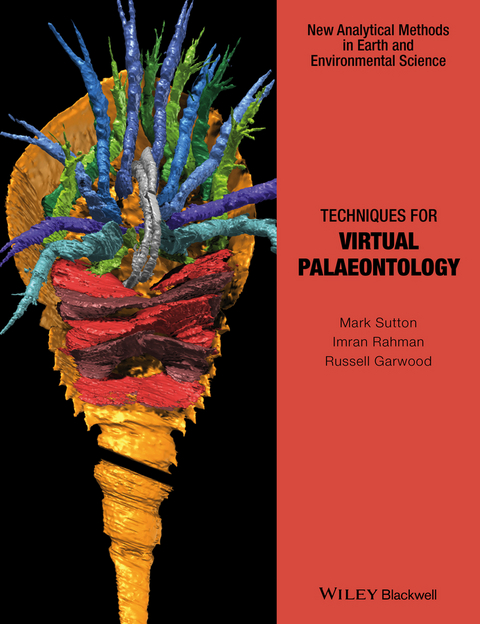
Virtual palaeontology, the use of interactive three-dimensional digital models as a supplement or alternative to physical specimens for scientific study and communication, is rapidly becoming important to advanced students and researchers. Using non-invasive techniques, the method allows the capture of large quantities of useful data without damaging the fossils being studied
Techniques for Virtual Palaeontology guides palaeontologists through the decisions involved in designing a virtual palaeontology workflow and gives a comprehensive overview, providing discussions of underlying theory, applications, historical development, details of practical methodologies, and case studies. Techniques covered include physical-optical tomography (serial sectioning), focused ion beam tomography, all forms of X-ray CT, neutron tomography, magnetic resonance imaging, optical tomography, laser scanning, and photogrammetry. Visualization techniques and data/file formats are also discussed in detail.
Readership: All palaeontologists and students interested in three-dimensional visualization and analysis.
New Analytical Methods in Earth and Environmental Science
Because of the plethora of analytical techniques now available, and the acceleration of technological advance, many earth scientists find it difficult to know where to turn for reliable information on the latest tools at their disposal, and may lack the expertise to assess the relative strengths or limitations of a particular technique. This new series will address these difficulties by providing accessible introductions to important new techniques, lab and field protocols, suggestions for data handling and interpretation, and useful case studies. The series represents an invaluable and trusted source of information for researchers, advanced students and applied earth scientists wishing to familiarise themselves with emerging techniques in their field.
All titles in this series are available in a variety of full-colour, searchable eBook formats. Titles are also available in an enhanced eBook edition which may include additional features such as DOI linking, high resolution graphics and video.
Mark Sutton is a Senior Lecturer at Imperial College, London, UK specializing in Palaeozoic invertebrate palaeobiology and in three-dimensional visualization techniques. He is the primary author of the SPIERS software suite for palaeontological 3D reconstruction.
Imran Rahman is a Research Fellow at The University of Bristol, UK. He specializes in the origin and early evolution of echinoderms, and uses virtual palaeontology to study the form and function of fossil taxa.
Russell Garwood is an 1851 Royal Commission Research Fellow based at The University of Manchester, UK. He uses X-ray techniques to study fossils, primarily early terrestrial arthropods. He is the secondary author of the SPIERS software suite.
Virtual palaeontology, the use of interactive three-dimensional digital models as a supplement or alternative to physical specimens for scientific study and communication, is rapidly becoming important to advanced students and researchers. Using non-invasive techniques, the method allows the capture of large quantities of useful data without damaging the fossils being studied Techniques for Virtual Palaeontology guides palaeontologists through the decisions involved in designing a virtual palaeontology workflow and gives a comprehensive overview, providing discussions of underlying theory, applications, historical development, details of practical methodologies, and case studies. Techniques covered include physical-optical tomography (serial sectioning), focused ion beam tomography, all forms of X-ray CT, neutron tomography, magnetic resonance imaging, optical tomography, laser scanning, and photogrammetry. Visualization techniques and data/file formats are also discussed in detail. Readership: All palaeontologists and students interested in three-dimensional visualization and analysis. New Analytical Methods in Earth and Environmental Science Because of the plethora of analytical techniques now available, and the acceleration of technological advance, many earth scientists find it difficult to know where to turn for reliable information on the latest tools at their disposal, and may lack the expertise to assess the relative strengths or limitations of a particular technique. This new series will address these difficulties by providing accessible introductions to important new techniques, lab and field protocols, suggestions for data handling and interpretation, and useful case studies. The series represents an invaluable and trusted source of information for researchers, advanced students and applied earth scientists wishing to familiarise themselves with emerging techniques in their field. All titles in this series are available in a variety of full-colour, searchable eBook formats. Titles are also available in an enhanced eBook edition which may include additional features such as DOI linking, high resolution graphics and video.
Mark Sutton is a Senior Lecturer at Imperial College, London, UK specializing in Palaeozoic invertebrate palaeobiology and in three-dimensional visualization techniques. He is the primary author of the SPIERS software suite for palaeontological 3D reconstruction. Imran Rahman is a Research Fellow at The University of Bristol, UK. He specializes in the origin and early evolution of echinoderms, and uses virtual palaeontology to study the form and function of fossil taxa. Russell Garwood is an 1851 Royal Commission Research Fellow based at The University of Manchester, UK. He uses X-ray techniques to study fossils, primarily early terrestrial arthropods. He is the secondary author of the SPIERS software suite.
TECHNIQUES FOR VIRTUAL PALAEONTOLOGY 5
Copyright 6
Content 7
Acknowledgements 10
1 Introduction and History 11
1.1 Introduction 11
1.2 Historical Development 14
1.2.1 Physical-Optical Tomography in the 20th Century 14
1.2.2 The CT Revolution 16
1.2.3 Modern Physical-Optical Tomography 17
1.2.4 Other Modern Tomographic Techniques 18
1.2.5 Surface-Based Techniques 19
1.2.6 Historical Summary 20
References 20
Further Reading/Resources 23
2 Destructive Tomography 24
2.1 Introduction 24
2.2 Physical-Optical Tomography 26
2.2.1 Approaches to Surface Exposure 26
2.2.2 Approaches to Imaging 29
2.2.3 Other Considerations for Methodology 33
2.2.4 Case Studies of Methodology 37
2.3 Focused Ion Beam Tomography 44
2.3.1 History 44
2.3.2 Principles and Practicalities 44
2.3.3 Examples in Palaeontology 46
2.3.4 Summary 47
References 47
Further Reading/Resources 50
3 Non-Destructive Tomography 51
3.1 Introduction 51
3.2 X-Ray Computed Tomography 52
3.2.1 Introduction to CT 52
3.2.2 History 53
3.2.3 X-Rays and Matter 56
3.2.4 X-Ray Microtomography 61
3.2.5 Medical Scanners 71
3.2.6 Lab-Based Nanotomography (Nano- CT) 73
3.2.7 Synchrotron Tomography 76
3.2.8 Tomographic Reconstruction 80
3.2.9 Artefacts 84
3.2.10 Phase-Contrast Tomography 88
3.2.11 Scanning Considerations 92
3.2.12 The Future: Three-Dimensional Elemental Mapping 93
3.2.13 Case Studies of Methodology 95
3.3 Neutron Tomography 99
3.3.1 History 100
3.3.2 Principles and Practicalities 100
3.3.3 Examples in Palaeontology 102
3.3.4 Summary 103
3.4 Magnetic Resonance Imaging 104
3.4.1 History 104
3.4.2 Principles and Practicalities 104
3.4.3 Examples in Palaeontology 106
3.4.4 Summary 107
3.5 Optical Tomography: Serial Focusing 108
3.5.1 History 108
3.5.2 Principles and Practicalities 108
3.5.3 Examples in Palaeontology 111
3.5.4 Other Approaches 112
3.5.5 Summary 113
References 114
Further Reading/Resources 123
4 Surface-Based Methods 125
4.1 Introduction 125
4.2 Laser Scanning 126
4.2.1 History 126
4.2.2 Principles and Practicalities 127
4.2.3 Case Studies of Methodology 130
4.3 Photogrammetry 132
4.3.1 History 132
4.3.2 Principles and Practicalities 132
4.3.3 Case Study of Methodology 134
4.4 Mechanical Digitization 135
References 136
Further Reading/Resources 139
5 Digital Visualization 140
5.1 Introduction 140
5.2 Reconstructing Tomographic Data 142
5.2.1 Registered Tomographic Datasets 142
5.2.2 Registration 144
5.2.3 Vector Surfacing 145
5.2.4 Volume Reconstructions 147
5.3 Reconstructing Surface Data 152
5.4 Visualization Methodologies 152
5.4.1 Introduction 152
5.4.2 Visualizing Triangle Meshes 153
5.4.3 Direct Volume Rendering 157
5.4.4 Direct Point-Cloud Rendering 158
5.5 Software and Formats 159
5.5.1 Reconstruction and Visualization Software 159
5.5.2 Data Formats and File Formats 162
5.6 Case Studies 165
5.6.1 The Herefordshire Lagerstätte (Isosurfacing SPIERS
5.6.2 Caecilian Amphibians (Isosurfacing Amira
5.6.3 Neoproterozoic Problematica (Vector Surfacing Scripting
References 172
Further Reading/Resources 174
6 Applications beyond Visualization 175
6.1 Introduction 175
6.2 Geometric Morphometrics 176
6.3 Dental Microwear Texture Analysis 177
6.4 Biomechanical Modelling 178
6.4.1 Finite-Element Analysis 178
6.4.2 Multibody Dynamics Analysis 181
6.4.3 Body-Size Estimation 182
6.4.4 Computational Fluid Dynamics 183
References 183
Further Reading/Resources 186
7 Summary 187
7.1 Introduction 187
7.2 Summary of Data-Capture Methodologies 188
7.3 Recommendations for Method Selection 192
7.4 Developments and Trends 194
7.5 Concluding Remarks 197
Glossary 198
Index
205
| Erscheint lt. Verlag | 22.10.2013 |
|---|---|
| Reihe/Serie | Analytical Methods in Earth and Environmental Science |
| Analytical Methods in Earth and Environmental Science | Analytical Methods in Earth and Environmental Science |
| Sprache | englisch |
| Themenwelt | Geisteswissenschaften ► Archäologie |
| Geschichte ► Allgemeine Geschichte ► Vor- und Frühgeschichte | |
| Naturwissenschaften ► Geowissenschaften ► Mineralogie / Paläontologie | |
| Technik | |
| Schlagworte | Ãkologie / Pflanzen • Alternative • Biowissenschaften • Bodenkunde, Geoarchäologie • Bodenkunde, Geoarchäologie • Capture • Communication • Data • digital • discussions • earth sciences • fossils • Geowissenschaften • important • Interactive • large quantities • Life Sciences • Models • Ökologie / Pflanzen • Paläontologie, Paläobiologie u. Geobiologie • Paläontologie, Paläobiologie u. Geobiologie • Paleontology, Paleobiology & Geobiology • Physical • plant ecology • scientific study • Soil Science & Geoarchaeology • Specimens • Supplement • techniques • theory • Threedimensional • use • useful • virtual |
| ISBN-10 | 1-118-59124-0 / 1118591240 |
| ISBN-13 | 978-1-118-59124-6 / 9781118591246 |
| Informationen gemäß Produktsicherheitsverordnung (GPSR) | |
| Haben Sie eine Frage zum Produkt? |
 PDF (Adobe DRM)
Kopierschutz: Adobe-DRM
Adobe-DRM ist ein Kopierschutz, der das eBook vor Mißbrauch schützen soll. Dabei wird das eBook bereits beim Download auf Ihre persönliche Adobe-ID autorisiert. Lesen können Sie das eBook dann nur auf den Geräten, welche ebenfalls auf Ihre Adobe-ID registriert sind.
Details zum Adobe-DRM
Dateiformat: PDF (Portable Document Format)
Mit einem festen Seitenlayout eignet sich die PDF besonders für Fachbücher mit Spalten, Tabellen und Abbildungen. Eine PDF kann auf fast allen Geräten angezeigt werden, ist aber für kleine Displays (Smartphone, eReader) nur eingeschränkt geeignet.
Systemvoraussetzungen:
PC/Mac: Mit einem PC oder Mac können Sie dieses eBook lesen. Sie benötigen eine
eReader: Dieses eBook kann mit (fast) allen eBook-Readern gelesen werden. Mit dem amazon-Kindle ist es aber nicht kompatibel.
Smartphone/Tablet: Egal ob Apple oder Android, dieses eBook können Sie lesen. Sie benötigen eine
Geräteliste und zusätzliche Hinweise
Buying eBooks from abroad
For tax law reasons we can sell eBooks just within Germany and Switzerland. Regrettably we cannot fulfill eBook-orders from other countries.
aus dem Bereich