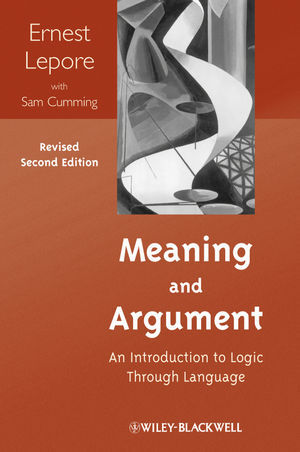
Meaning and Argument (eBook)
John Wiley & Sons (Verlag)
978-1-118-45515-9 (ISBN)
Meaning and Argument is a popular introduction to philosophy of logic and philosophy of language.
- Offers a distinctive philosophical, rather than mathematical, approach to logic
- Concentrates on symbolization and works out all the technical logic with truth tables instead of derivations
- Incorporates the insights of half a century's work in philosophy and linguistics on anaphora by Peter Geach, Gareth Evans, Hans Kamp, and Irene Heim among others
- Contains numerous exercises and a corresponding answer key
- An extensive appendix allows readers to explore subjects that go beyond what is usually covered in an introductory logic course
- Updated edition includes over a dozen new problem sets and revisions throughout
- Features an accompanying website at http://ruccs.rutgers.edu/-logic/MeaningArgument.html
Ernest Lepore is Director of the Center for Cognitive Science at Rutgers University. He is the author of numerous articles in philosophy of mind and is co-author (with Herman Cappelen) of Insensitive Semantics (Blackwell, 2004), co-author (with Jerry Fodor) of Holism (Blackwell, 1991). He is editor of Truth and Interpretation (Blackwell, 1989). He is co-editor (with Zenon Pylyshyn) of What is Cognitive Science? (Blackwell, 1999), and co-editor (with Robert Van Gulick) of John Searle and His Critics (Blackwell, 1992), as well as general editor of the series Philosophers and Their Critics, also published by Wiley-Blackwell.
Sam Cumming is Assistant Professor of Philosophy at the University of California, Los Angeles.
Meaning and Argument is a popular introduction to philosophy of logic and philosophy of language. Offers a distinctive philosophical, rather than mathematical, approach to logic Concentrates on symbolization and works out all the technical logic with truth tables instead of derivations Incorporates the insights of half a century's work in philosophy and linguistics on anaphora by Peter Geach, Gareth Evans, Hans Kamp, and Irene Heim among others Contains numerous exercises and a corresponding answer key An extensive appendix allows readers to explore subjects that go beyond what is usually covered in an introductory logic course Updated edition includes over a dozen new problem sets and revisions throughout Features an accompanying website at http://ruccs.rutgers.edu/~logic/MeaningArgument.html
Ernest Lepore is Director of the Center for Cognitive Science at Rutgers University. He is the author of numerous articles in philosophy of mind and is co-author (with Herman Cappelen) of Insensitive Semantics (Blackwell, 2004), co-author (with Jerry Fodor) of Holism (Blackwell, 1991). He is editor of Truth and Interpretation (Blackwell, 1989). He is co-editor (with Zenon Pylyshyn) of What is Cognitive Science? (Blackwell, 1999), and co-editor (with Robert Van Gulick) of John Searle and His Critics (Blackwell, 1992), as well as general editor of the series Philosophers and Their Critics, also published by Wiley-Blackwell. Sam Cumming is Assistant Professor of Philosophy at the University of California, Los Angeles.
Meaning and Argument 5
Contents 7
Preface to Revised Second Edition 15
Preface to Second Edition 16
Preface to Revised Edition 17
Acknowledgments 18
Introduction to Teacher 21
1 A Brief Introduction to Key Terms 25
1.1 Arguments 25
1.1.1 What is a Statement? 26
1.1.2 Premises and Conclusion 26
1.2 Putting Arguments into a Standard Format 27
1.3 Multiple Conclusions 29
1.4 Deductive Validity 30
1.5 Soundness 33
1.6 Missing Premises and Conclusions 33
2 Argument Forms and Propositional Logic 37
2.1 Formal Validity 37
2.2 Quotation Marks 39
2.3 Metalinguistic Variables 41
2.4 Non-formal Validity 43
2.5 The Need for Propositional Logic 44
2.5.1 Symbolic Notation 45
2.6 The Type/Token Distinction 46
3 Conjunction 51
3.1 Logical Conjunction 51
3.2 Distinguishing Deductive from Non-deductive Aspects of Conjunction 53
3.3 Phrasal Logical Conjunctions 54
3.4 Series Decompounding 54
3.5 Using ‘Respectively’ 55
3.6 Symbolizing Logical Conjunctions 55
4 Negation 62
4.1 Logical Negation 62
4.2 Some Other Negative Expressions 63
4.3 A Point about Methodology 65
4.4 A Point on Ambiguity 65
4.5 Symbolizing Logical Negations 65
4.6 Ambiguity and the Need for Groupers 66
4.7 Review of Symbols 67
4.8 Using ‘Without’ 68
4.9 Argument Forms Continued 68
4.10 Symbolizing Logical Negations Continued 71
5 Truth Tables 76
5.1 Well-formed Formulas 76
5.2 Scope 77
5.3 Main Connective 78
5.4 Truth Tables 79
5.4.1 Truth Table Analyses of Statements 81
5.4.2 Truth Table Analyses of Arguments 84
6 Disjunction 88
6.1 Logical Disjunction 88
6.2 Disjunction and Negation 89
6.3 Iterations and Groupers 91
6.4 Inclusive versus Exclusive ‘Or’ 93
6.5 Symbolizing Logical Disjunctions Continued 96
7 Conditionals 99
7.1 Conditionals with Constituent Statements 99
7.2 Conditionals without Constituent Statements 100
7.3 Logical Conditionals 100
7.4 Symbolizing Conditionals in PL 102
7.5 Necessary and Sufficient Conditions 102
7.6 Only If 104
7.7 Unless 106
7.8 Since, Because 108
7.9 Conditionals and Groupers 109
7.10 If and Only If 110
7.11 A Revised Grammar for Well-formedness in PL 111
7.12 Summarizing Truth Tables 119
7.12.1 Validity 119
7.12.2 Contradiction, Tautology, Contingency 122
7.12.3 Consistency 124
7.12.4 Logical Equivalence 125
8 Truth Trees 129
8.1 Reviewing Validity 129
8.2 Tree Trunks and Compound and Atomic Statements 130
8.3 Truth Tree Rules 131
8.3.1 Non-branching Rules 131
8.3.2 Branching Rules 132
8.4 Strategies 134
8.5 Truth Trees and Invalidity 137
8.6 Propositional Logic and Counter-examples (Counter-models) 141
8.7 Logical Properties and Relations Revisited 143
8.7.1 Consistency 143
8.7.2 Contradiction, Tautology, Contingency 144
8.7.3 Logical Equivalence 146
9 Property Predicate Logic 149
9.1 Limits of Propositional Logic 149
9.2 Singular Terms 150
9.3 Property Predicates 152
9.4 Quantifiers 154
9.4.1 Simple Existential Quantifier Statements 155
9.4.2 Symbolizing Simple Existential Statements 155
9.4.3 Simple Universal Quantifier Statements 157
9.4.4 Negations of Existentials 158
9.5 Complex Predicates 159
9.6 Well-formedness in PPL 162
9.7 Quantifiers Modifying General Terms 165
9.7.1 Existential Quantifiers and General Terms 165
9.7.2 Universal Quantifiers and General Terms 167
10 Evaluating Arguments in Property Predicate Logic 175
10.1 Quantifiers and Scope 176
10.2 The Truth Tree Method Extended 177
10.2.1 Quantifier Exchange Rule (QE) 177
10.2.2 Universal Quantifier Rule (UQ) 178
10.2.3 Existential Quantifier Rule (EQ) 181
10.3 Super Strategy 184
10.4 Property Predicate Logic and Counter-examples (Counter-models) 186
10.5 PPL Logical Equivalences and Non-equivalences 188
10.6 Other Logical Properties and Relations 190
10.6.1 Consistency 190
10.6.2 Logical Equivalence 190
10.6.3 Contradiction, Logical Truth, Contingency 191
11 Property Predicate Logic Refinements 192
11.1 Literal Meaning 192
11.2 ‘Any’ as an Existential 193
11.3 Restrictive Relative Clauses 195
11.4 Pronouns Revisited 196
11.4.1 Deixis and Anaphora 196
11.4.2 Quantification and Anaphora 197
11.5 Only 200
11.6 Restrictive Words in English 202
11.7 Evaluating Symbolizations of English in Logical Notation 205
12 Relational Predicate Logic 211
12.1 Limits of Property Predicate Logic 211
12.2 Convention 1: Number 213
12.3 Convention 2: Order 214
12.4 Convention 3: Active/Passive Voice 215
12.5 Convention 4: Single Quantifiers 217
12.6 Variables 219
12.6.1 Convention 5: Variables and Quantifiers 220
12.6.2 Convention 6: Variables and Property Predicates 220
12.6.3 General Comments about Variables 221
13 Relational Predicate Logic with Nested Quantifiers 227
13.1 Multiply General Statements 229
13.2 Universal Quantifier Procedure 232
13.3 Existential Quantifier Procedure 233
13.4 Double Binding Variables 233
13.4.1 Kicking Out 236
13.5 Systematic and Analytic Procedures 237
13.6 A Grammar for Well-formedness in RPL 238
13.7 Nested Quantifiers, Variables, and Scope 240
13.8 Order and Scope Refinements 241
13.8.1 The Order and Scope Procedure 244
13.9 Summary of the Overall Procedure for Symbolizing English Statements with Nested Quantifiers into RPL 246
14 Extending the Truth Tree Method to RPL 249
14.1 RPL Arguments without Quantifiers 249
14.2 RPL Arguments without Nested Quantifiers 250
14.3 RPL Arguments with Nested Quantifiers 252
14.4 Choosing Singular Terms to Instantiate 253
14.5 Infinite Truth Trees for RPL Arguments 254
14.6 Summary of Truth Tree Strategies 256
14.7 Relational Predicate Logic and Counter-examples (Counter-models) 259
15 Negation, Only, and Restrictive Relative Clauses 264
15.1 Negation 264
15.2 ‘Only’ as a Quantifier 266
15.3 Restrictive Relative Clauses 269
15.3.1 The Quantificational Restrictive Relative Clause Procedure 270
15.4 Quantifiers and Anaphora 272
15.4.1 Repair Algorithm 274
15.5 Anaphora and Restrictive Relative Clauses 277
15.6 Anaphora Across Sentences 282
15.7 Quantification in English 285
16 Relational Predicate Logic with Identity 288
16.1 Limits of Relational Predicate Logic 288
16.2 Extending the Truth Tree Method to RPL= 290
16.2.1 Identity-out Rule 290
16.2.2 Identity-in Rule 291
16.3 Sameness and Distinctness in English 293
16.3.1 ‘Only’ Again 293
16.3.2 Words of Distinction: Except, But, Other (than), Besides, Else 294
16.4 Numerical Adjectives 296
16.4.1 At Least n 296
16.4.2 At Most n (No More than n) 299
16.4.3 Exactly n 301
16.4.4 Counting Pairs 303
16.4.5 Combinatorics (optional) 303
16.5 Definite Descriptions 304
16.5.1 The Definite Description Quantifier Procedure 308
16.5.2 Definite Descriptions as Anaphors 309
16.5.3 Plural Definite Descriptions 309
17 Verbs and their Modifiers 314
17.1 Prepositional Phrases 314
17.2 The Event Approach 316
17.3 Indirect Support of the Event Approach 318
17.3.1 Fixing Referents and Binding Anaphoric Pronouns 318
17.3.2 Quantification over Events 319
17.3.3 Conversational Inferences and Events 320
17.3.4 Methodological Reflections 320
17.4 Adverbial Modification 321
17.5 Problems with the Event Approach 324
Appendix 328
A1 Conjunction 328
A1.1 Prepositional Phrases 328
A1.2 Conversational Inferences and Deductive Validity 329
A1.3 Relative Clauses 331
A2 Negation and Disjunction 334
A2.1 Modalities and Negation 334
A2.2 Disjunction and Conversational Inferences 335
A3 Conditionals 335
A3.1 Explication of the Material Conditional Truth Table 335
A3.1.1 Paradoxes of implication 338
A3.1.2 Conditionals and conversational inferences 338
A3.1.3 Paradoxes of implication revisited 340
A3.2 ‘If ’s and ‘Then’s without Conditionality 341
A4 Property Predicate Logic 341
A4.1 Only 341
A4.2 Conversational Inferences 342
A4.2.1 Existential import 342
A4.2.2 Scalar inferences 343
A4.3 More on Literal Meaning 344
A4.4 Adjectival Modification and Predication 345
A4.5 A Non-standard Quantifier – Most 349
A5 Relational Predicate Logic 350
A5.1 Passive Voice: Another Argument for Variables 350
A5.1.1 Passive voice for nested quantifier procedure 352
A5.2 Properties of Relations 353
A5.2.1 Symmetry, asymmetry, non-symmetry 353
A5.2.2 Transitivity, intransitivity, non-transitivity 354
A5.2.3 Total reflexivity, reflexivity, irreflexivity, and non-reflexivity 355
A6 Relational Predicate Logic with Identity 357
A6.1 ‘Only’ and Existential Import 357
A6.2 Descriptions and Anaphora 358
A6.3 Plural Anaphora 359
A6.3.1 Plural definite descriptions as anaphors 364
A6.3.2 Singular indefinite antecedents of plural pronouns 364
A6.3.3 Partitives 366
A6.4 Existence 367
A6.5 Intensionality 368
A6.6 Properties of the Identity Relationship 368
A6.7 The Superlative 369
A6.8 Identity and Predicative Adjectives 370
A7 Verbs and their Modifiers 370
A7.1 Infinitives and Gerunds 371
A7.2 Reference to Events 373
A7.3 The Logic of Perceptual Verbs 374
Answers for Selected Exercises 376
Chapter 1 376
Chapter 2 377
Chapter 3 378
Chapter 4 381
Chapter 5 383
Chapter 6 384
Chapter 7 386
Chapter 8 393
Chapter 9 398
Chapter 10 401
Chapter 11 412
Chapter 12 417
Chapter 13 418
Chapter 14 420
Chapter 15 433
Chapter 16 439
Chapter 17 446
Appendix 447
Logical Symbols 449
Index 450
| Erscheint lt. Verlag | 14.9.2012 |
|---|---|
| Sprache | englisch |
| Themenwelt | Geisteswissenschaften ► Philosophie ► Allgemeines / Lexika |
| Geisteswissenschaften ► Philosophie ► Logik | |
| Schlagworte | Formal, Semantics, Philosophy, Philosophical, symbol, Proposition, anaphora, Peter Geach, Gareth Evans, Hans Kamp, Irene Heim • Logik • Philosophical Logic • Philosophie • Philosophische Logik • Philosophy |
| ISBN-10 | 1-118-45515-0 / 1118455150 |
| ISBN-13 | 978-1-118-45515-9 / 9781118455159 |
| Informationen gemäß Produktsicherheitsverordnung (GPSR) | |
| Haben Sie eine Frage zum Produkt? |
 PDF (Adobe DRM)
Kopierschutz: Adobe-DRM
Adobe-DRM ist ein Kopierschutz, der das eBook vor Mißbrauch schützen soll. Dabei wird das eBook bereits beim Download auf Ihre persönliche Adobe-ID autorisiert. Lesen können Sie das eBook dann nur auf den Geräten, welche ebenfalls auf Ihre Adobe-ID registriert sind.
Details zum Adobe-DRM
Dateiformat: PDF (Portable Document Format)
Mit einem festen Seitenlayout eignet sich die PDF besonders für Fachbücher mit Spalten, Tabellen und Abbildungen. Eine PDF kann auf fast allen Geräten angezeigt werden, ist aber für kleine Displays (Smartphone, eReader) nur eingeschränkt geeignet.
Systemvoraussetzungen:
PC/Mac: Mit einem PC oder Mac können Sie dieses eBook lesen. Sie benötigen eine
eReader: Dieses eBook kann mit (fast) allen eBook-Readern gelesen werden. Mit dem amazon-Kindle ist es aber nicht kompatibel.
Smartphone/Tablet: Egal ob Apple oder Android, dieses eBook können Sie lesen. Sie benötigen eine
Geräteliste und zusätzliche Hinweise
Buying eBooks from abroad
For tax law reasons we can sell eBooks just within Germany and Switzerland. Regrettably we cannot fulfill eBook-orders from other countries.
aus dem Bereich