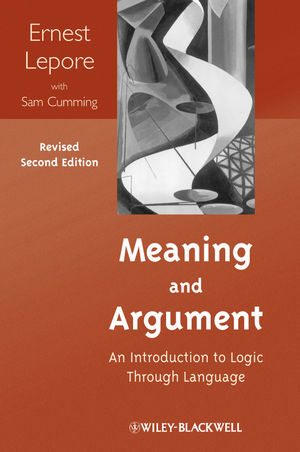
Meaning and Argument (eBook)
John Wiley & Sons (Verlag)
978-1-118-45521-0 (ISBN)
Meaning and Argument is a popular introduction to philosophy of logic and philosophy of language.
- Offers a distinctive philosophical, rather than mathematical, approach to logic
- Concentrates on symbolization and works out all the technical logic with truth tables instead of derivations
- Incorporates the insights of half a century's work in philosophy and linguistics on anaphora by Peter Geach, Gareth Evans, Hans Kamp, and Irene Heim among others
- Contains numerous exercises and a corresponding answer key
- An extensive appendix allows readers to explore subjects that go beyond what is usually covered in an introductory logic course
- Updated edition includes over a dozen new problem sets and revisions throughout
- Features an accompanying website at http://ruccs.rutgers.edu/-logic/MeaningArgument.html
Ernest Lepore is Director of the Center for Cognitive Science at Rutgers University. He is the author of numerous articles in philosophy of mind and is co-author (with Herman Cappelen) of Insensitive Semantics (Blackwell, 2004), co-author (with Jerry Fodor) of Holism (Blackwell, 1991). He is editor of Truth and Interpretation (Blackwell, 1989). He is co-editor (with Zenon Pylyshyn) of What is Cognitive Science? (Blackwell, 1999), and co-editor (with Robert Van Gulick) of John Searle and His Critics (Blackwell, 1992), as well as general editor of the series Philosophers and Their Critics, also published by Wiley-Blackwell.
Sam Cumming is Assistant Professor of Philosophy at the University of California, Los Angeles.
Meaning and Argument is a popular introduction to philosophy of logic and philosophy of language. Offers a distinctive philosophical, rather than mathematical, approach to logic Concentrates on symbolization and works out all the technical logic with truth tables instead of derivations Incorporates the insights of half a century's work in philosophy and linguistics on anaphora by Peter Geach, Gareth Evans, Hans Kamp, and Irene Heim among others Contains numerous exercises and a corresponding answer key An extensive appendix allows readers to explore subjects that go beyond what is usually covered in an introductory logic course Updated edition includes over a dozen new problem sets and revisions throughout Features an accompanying website at http://ruccs.rutgers.edu/~logic/MeaningArgument.html
Ernest Lepore is Director of the Center for Cognitive Science at Rutgers University. He is the author of numerous articles in philosophy of mind and is co-author (with Herman Cappelen) of Insensitive Semantics (Blackwell, 2004), co-author (with Jerry Fodor) of Holism (Blackwell, 1991). He is editor of Truth and Interpretation (Blackwell, 1989). He is co-editor (with Zenon Pylyshyn) of What is Cognitive Science? (Blackwell, 1999), and co-editor (with Robert Van Gulick) of John Searle and His Critics (Blackwell, 1992), as well as general editor of the series Philosophers and Their Critics, also published by Wiley-Blackwell. Sam Cumming is Assistant Professor of Philosophy at the University of California, Los Angeles.
Chapter 1
A Brief Introduction to Key Terms
1.1 Arguments
Arguments crop up in conversations, political debates, lectures, editorials, comic strips, novels, television programs, scriptures, films, graffiti, posters, on the net, and so on. Ordinarily when we argue with others, we try to persuade them of some point. The forms of persuasion are many. We can persuade others by hitting them, by screaming at them, by drugging them, and so on. These kinds of persuasion are, unfortunately, prevalent. However, in this book we will use the term ‘argument’ exclusively to pick out sets of statements of the following sort:
Provided the fetus is a person, a fetus has a right to life. Should a fetus have a right to life, it is false that someone has the right to take its life. However, if abortions are moral, someone does have the right to take the life of a fetus. Consequently, if a fetus is a person, abortions are not moral.
Lung cancer is not caused by smoking, and this is so for the following reasons. Lung cancer is more common among male smokers than among female smokers. If smoking were the cause of lung cancer, this would not be true. The fact that lung cancer is more common among male smokers implies that it is caused by something in the male makeup. But if caused by this, it is not caused by smoking.
Anyone who deliberates about alternative courses of action believes he is free. Since everybody deliberates about alternative courses of action, it follows that we all believe ourselves to be free.
What do these passages have in common in virtue of which each is an argument in our sense? In this book an argument is any set of statements – explicit or implicit – one of which is the conclusion (the statement allegedly being defended) and the others are the premises (statements allegedly providing the defense).1 The relationship between the conclusion and the premises is such that the conclusion purportedly follows from the premises. This description of an argument leads us to ask what statements are, and what it means to say that one statement follows from others.
1.1.1 What is a Statement?
A statement is any declarative sentence that is either true or false.2 The following are statements:
Galileo was an astronomer.
Provided the fetus is a person, a fetus has a right to life.
No one but Nixon knew the truth.
Lung cancer is not caused by smoking.
Everybody deliberates about alternative courses of action.
Martin Van Buren was not the ninth president of the United States.
Interrogatives, imperatives, and exclamations are sentences that are not statements; for example:
Is George Washington president?
Shave yourself!
Wow!
1.1.2 Premises and Conclusion
A main aim in learning logic is to enhance skills in assessing arguments as we find them. But arguments cannot be assessed unless they are first identified as arguments. Although there are no sure signs of whether an argument is present, fairly reliable indicators exist.
Premise indicators: Premise indicators are terms that indicate that a premise will immediately follow. In the second argument in §1.1 above, the first sentence ends with ‘this is so for the following reasons’. This clause indicates that the statements which follow are the premises of this argument. The third argument has a second sentence that begins with the word ‘Since’, indicating that a premise is about to be introduced. Other such expressions include ‘because’, ‘for’, ‘after all’, ‘given’, ‘whereas’, ‘although’, ‘suppose’, ‘assume’, ‘let us presume’, ‘granted’, ‘here are the facts’. When a premise indicator starts a clause, then what follows the premise indicator is usually a premise.
Conclusion indicators: Likewise, when a conclusion indicator starts a clause, then what follows is usually a conclusion. In the first argument in §1.1 above, the last sentence begins with the word ‘Consequently’, indicating that it is the conclusion. Other conclusion indicators include ‘therefore’, ‘so’, ‘hence’, ‘it follows’, ‘…proves’, ‘…shows’, ‘we can now infer’, ‘it cannot fail to be’, ‘let us conclude’, ‘this implies’, ‘these facts indicate’, ‘this supports the view or claim’, ‘let us infer’, ‘as a consequence we can deduce’.
Many passages contain arguments but none of these indicators, and some passages contain one or more of them without stating a premise or a conclusion. Indeed, the indicators seen most frequently are often used as neither conclusion nor premise indicators, as in the following sentences.
How long has it been since you last saw him?
He is so good at what he does.
For two years he has been away.
After all these days, you come home.
Let us go hence.
None of these sentences is being offered as a premise for some conclusion or as a conclusion from some premises. Even though each contains familiar indicator terms, obviously the terms are not being used as indicators in these sentences.
Alternatively, one may simply announce that an argument is forthcoming, and then go on to affirm several statements. In this case, the context makes clear that the last statement is the conclusion and the others are premises. Still, some terms are almost always used as conclusion or premise indicators. It’s hard to imagine a context in which ‘on the assumption that’ is not a premise indicator or ‘as a consequence it follows’ is not a conclusion indicator.
1.2 Putting Arguments into a Standard Format
Having determined that some piece of discourse contains an argument, the next task is to put it into a standard format. This task may involve all of the following:
So standard forms for the above three arguments are:
Provided the fetus is a person, a fetus has a right to life.
Should a fetus have a right to life, it is false that someone has the right to take its life.
If abortions are moral, someone does have the right to take the life of a fetus.
If a fetus is a person, abortions are not moral.
The first three statements are premises, and the fourth is the conclusion.
Lung cancer is more common among male smokers than among female smokers.
If smoking were the cause of lung cancer, this would not be true.
The fact that lung cancer is more common among male smokers implies that it is caused by something in the male makeup.
If it is caused by this, it is not caused by smoking.
Lung cancer is not caused by smoking.
The first four statements are premises, and the fifth is the conclusion.
Anyone who deliberates about alternative courses of action believes he is free.
Everybody deliberates about alternative courses of action.
We all believe ourselves to be free.
The first two statements are the premises, and the third is the conclusion.
In none of the arguments is a premise or a conclusion missing. Nothing said so far explains exactly how we were able to devise these standard forms based on what we were presented with. So far our process has been rather loose, and it cannot be tightened until we say something substantive about when one statement follows from some others.
1.3 Multiple Conclusions
As we have characterized arguments, no argument can have more than one conclusion. Of course, sometimes we do find passages with more than one conclusion. There are two types of cases. The first occurs when more than one conclusion is drawn from the same set of premises. For such a case we adopt the convention that distinct arguments can have the same premises, but different conclusions. So, for example, (1)–(4) below include two distinct arguments. (1)–(2) are premises, and (3)–(4) are conclusions. So (1)–(3) constitute one argument; and (1)–(2) and (4) constitute another distinct argument.
The second case occurs when we chain arguments together so that a single statement serves as both a premise and a conclusion. In this case the conclusion of one argument functions as a premise of another. (5)–(9) include two arguments.
(5)–(6) are premises of an argument with (7) as its conclusion. However, (7) is also the premise of an argument, which along with (5), (6), and (8), has (9) as its conclusion.
Exercise 1.1 Standard form
- Put arguments (1)–(4) into a standard...
| Erscheint lt. Verlag | 14.9.2012 |
|---|---|
| Sprache | englisch |
| Themenwelt | Geisteswissenschaften ► Philosophie ► Allgemeines / Lexika |
| Geisteswissenschaften ► Philosophie ► Logik | |
| Schlagworte | Formal, Semantics, Philosophy, Philosophical, symbol, Proposition, anaphora, Peter Geach, Gareth Evans, Hans Kamp, Irene Heim • Logik • Philosophical Logic • Philosophie • Philosophische Logik • Philosophy |
| ISBN-10 | 1-118-45521-5 / 1118455215 |
| ISBN-13 | 978-1-118-45521-0 / 9781118455210 |
| Informationen gemäß Produktsicherheitsverordnung (GPSR) | |
| Haben Sie eine Frage zum Produkt? |
 EPUB (Adobe DRM)
Kopierschutz: Adobe-DRM
Adobe-DRM ist ein Kopierschutz, der das eBook vor Mißbrauch schützen soll. Dabei wird das eBook bereits beim Download auf Ihre persönliche Adobe-ID autorisiert. Lesen können Sie das eBook dann nur auf den Geräten, welche ebenfalls auf Ihre Adobe-ID registriert sind.
Details zum Adobe-DRM
Dateiformat: EPUB (Electronic Publication)
EPUB ist ein offener Standard für eBooks und eignet sich besonders zur Darstellung von Belletristik und Sachbüchern. Der Fließtext wird dynamisch an die Display- und Schriftgröße angepasst. Auch für mobile Lesegeräte ist EPUB daher gut geeignet.
Systemvoraussetzungen:
PC/Mac: Mit einem PC oder Mac können Sie dieses eBook lesen. Sie benötigen eine
eReader: Dieses eBook kann mit (fast) allen eBook-Readern gelesen werden. Mit dem amazon-Kindle ist es aber nicht kompatibel.
Smartphone/Tablet: Egal ob Apple oder Android, dieses eBook können Sie lesen. Sie benötigen eine
Geräteliste und zusätzliche Hinweise
Buying eBooks from abroad
For tax law reasons we can sell eBooks just within Germany and Switzerland. Regrettably we cannot fulfill eBook-orders from other countries.
aus dem Bereich