


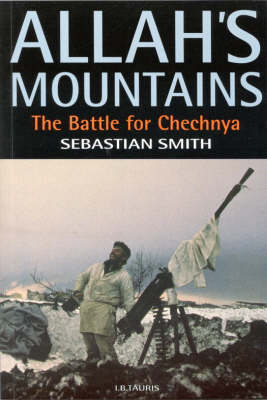
Allah's Mountains
The Battle for Chechnya
Seiten
2001
|
2nd Revised edition
I.B. Tauris (Verlag)
978-1-86064-651-5 (ISBN)
I.B. Tauris (Verlag)
978-1-86064-651-5 (ISBN)
- Titel erscheint in neuer Auflage
- Artikel merken
Zu diesem Artikel existiert eine Nachauflage
This extensively revised paperback edition explores at first-hand the extraordinary defeat of the Russian army in Chechnya. It puts one of the most savage wars of recent years into the context of the predominantly Moslem North Caucasus region - an ethnic and geopolitical tinderbox.
This extensively revised paperback edition explores at first-hand the extraordinary defeat of the Russian army in Chechnya and provides essential reading for all those concerned with current developments in the Caucasus. It puts one of the most savage wars of recent years into the context of the predominantly Moslem North Caucasus region. Fierce resistance meant that Russia took almost three centuries to conquer this mountainous area. And it remains the most turbulent and strategic part of the Russian Federation - an ethnic and geopolitical tinderbox criss-crossed by billion-dollar oil pipelines serving the vast new riches of the Caspian Sea. Using exclusive eyewitness material from his frontline reporting, Smith shows how the Kremlin (which had hoped for a quick, sharp offensive against rebel leader Dzhokhar Dudayev) blundered into a war and then lost against the Chechen guerilla army, despite brutal levels of bombing. Moving beyond Chechnya, Smith examines the rest of the North Caucasus, where around 40 other tiny ethnic groups struggle to preserve their identities.
Over the last ten years, minorities such as the Dagestanis, Adygei and Balkars have rebuilt their national cultures, languages and Moslem religion, which both the tsars and the Soviets tried so hard to wipe out. There has been genuine cultural revival, but also violent nationalism, a danger stoked by the rebirth of the Russian Cossack communities and their dreams of empire. Chechnya's conflict may prove only the tip of an iceberg. The stakes in this long-running struggle are high for the north Caucasians, ethnic pride and even survival as distinct peoples; for the Russians, influence over the huge oil resources of the Caspian Sea and territorial integrity of the state. Ultimately, Russia's entire fragile democratic experiment could hang in the balance.
This extensively revised paperback edition explores at first-hand the extraordinary defeat of the Russian army in Chechnya and provides essential reading for all those concerned with current developments in the Caucasus. It puts one of the most savage wars of recent years into the context of the predominantly Moslem North Caucasus region. Fierce resistance meant that Russia took almost three centuries to conquer this mountainous area. And it remains the most turbulent and strategic part of the Russian Federation - an ethnic and geopolitical tinderbox criss-crossed by billion-dollar oil pipelines serving the vast new riches of the Caspian Sea. Using exclusive eyewitness material from his frontline reporting, Smith shows how the Kremlin (which had hoped for a quick, sharp offensive against rebel leader Dzhokhar Dudayev) blundered into a war and then lost against the Chechen guerilla army, despite brutal levels of bombing. Moving beyond Chechnya, Smith examines the rest of the North Caucasus, where around 40 other tiny ethnic groups struggle to preserve their identities.
Over the last ten years, minorities such as the Dagestanis, Adygei and Balkars have rebuilt their national cultures, languages and Moslem religion, which both the tsars and the Soviets tried so hard to wipe out. There has been genuine cultural revival, but also violent nationalism, a danger stoked by the rebirth of the Russian Cossack communities and their dreams of empire. Chechnya's conflict may prove only the tip of an iceberg. The stakes in this long-running struggle are high for the north Caucasians, ethnic pride and even survival as distinct peoples; for the Russians, influence over the huge oil resources of the Caspian Sea and territorial integrity of the state. Ultimately, Russia's entire fragile democratic experiment could hang in the balance.
Sebastian Smith has been a correspondent in Washington, Moscow and London.
The jigsaw; fires of liberty; the jigsaw in pieces; the Chechen wolf; the fury; chasing paradise.
| Erscheint lt. Verlag | 25.1.2001 |
|---|---|
| Zusatzinfo | maps |
| Sprache | englisch |
| Maße | 156 x 232 mm |
| Themenwelt | Geschichte ► Allgemeine Geschichte ► Zeitgeschichte |
| Geisteswissenschaften ► Geschichte ► Regional- / Ländergeschichte | |
| Sozialwissenschaften ► Politik / Verwaltung ► Europäische / Internationale Politik | |
| Sozialwissenschaften ► Soziologie | |
| ISBN-10 | 1-86064-651-4 / 1860646514 |
| ISBN-13 | 978-1-86064-651-5 / 9781860646515 |
| Zustand | Neuware |
| Informationen gemäß Produktsicherheitsverordnung (GPSR) | |
| Haben Sie eine Frage zum Produkt? |
Mehr entdecken
aus dem Bereich

aus dem Bereich
die großen Jahre der Soziologie 1949-1969
Buch | Hardcover (2025)
Klett-Cotta (Verlag)
CHF 39,20
eine Deutschlandreise im Jahr 1958
Buch | Hardcover (2024)
C.H.Beck (Verlag)
CHF 29,90


