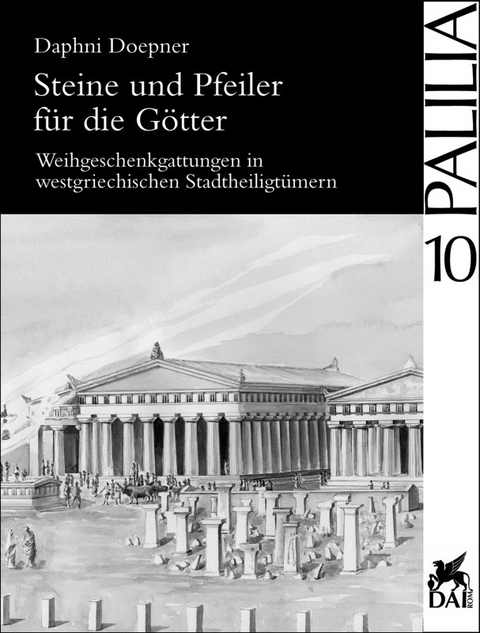
Steine und Pfeiler für die Götter
Due to extraordinarily good find conditions the Greek colony Metapont in Lower Italy gives very clear evidence of the following circumstance: In wide areas of the representative and sacral centre of the polis, in the "urban sanctuary", i.e. at magnificent temples and altars from the 7th to the 3rd century B.C. no luxurious votive offerings had been erected but exclusively plain stones and aniconic pillars. This phenomenon was found in Western Greece also in other places but not, however, in the Greek motherland. This study is supposed to find an explanation. A comprehensive analysis of the findings is aimed at the reconstruction of the entire votive practice in the urban sanctuary of Metapont and in those of Poseidonia (Paestum), Syracuse, Akragas (Agrigent) and Selinunt. In consultation with other archaeological and literary sources it becomes possible to characterize the function of the aniconic anathems and in contrast even of other species of votives. Apart from this the high value of the consecration of stones and pillars in Western Greece becomes obvious and consequently the great importance of collectively keeping up traditions when living abroad.
"More direct archaeological evidence is also needed for a better understanding of the meaning and practical use of the aniconic votives. Where they simply offerings or did they (continue to) act as a focus for (family?) cult. The few test excavation dope by Doepner seem to Support the First hypothesis, but are far from conclusive. Such uncertainties, however, only help to stress the importance of her study as a starting point for further research and an example for those already working in Greek sanctuaries: even the ugly and undecorated finds can be very interesting when they receive their deserved care and contexts."
In: BABesch. 79 (2004). S. 213-214.
"More direct archaeological evidence is also needed for a better understanding of the meaning and practical use of the aniconic votives. Where they simply offerings or did they (continue to) act as a focus for (family?) cult. The few test excavation dope by Doepner seem to Support the First hypothesis, but are far from conclusive. Such uncertainties, however, only help to stress the importance of her study as a starting point for further research and an example for those already working in Greek sanctuaries: even the ugly and undecorated finds can be very interesting when they receive their deserved care and contexts."
In: BABesch. 79 (2004). S. 213-214.
| Erscheint lt. Verlag | 1.5.2002 |
|---|---|
| Reihe/Serie | Palilia |
| Verlagsort | Wiesbaden |
| Sprache | deutsch |
| Maße | 220 x 290 mm |
| Gewicht | 1200 g |
| Themenwelt | Geisteswissenschaften ► Archäologie |
| Geschichte ► Allgemeine Geschichte ► Altertum / Antike | |
| Schlagworte | Altertum • Antike • Archäologie • Geschichte • Geschichte / Altertum; • Geschichte;Altertum; • Heiligtum • Italien; Archäologie • Italien, Geschichte; Geistes-/Kultur-Geschichte • Klassische Archäologie • Kulturelle Heiligtümer • Votivbrauchtum • Westgriechenland, Geschichte; Geistes-/Kultur-G. |
| ISBN-10 | 3-89500-075-2 / 3895000752 |
| ISBN-13 | 978-3-89500-075-1 / 9783895000751 |
| Zustand | Neuware |
| Informationen gemäß Produktsicherheitsverordnung (GPSR) | |
| Haben Sie eine Frage zum Produkt? |
aus dem Bereich