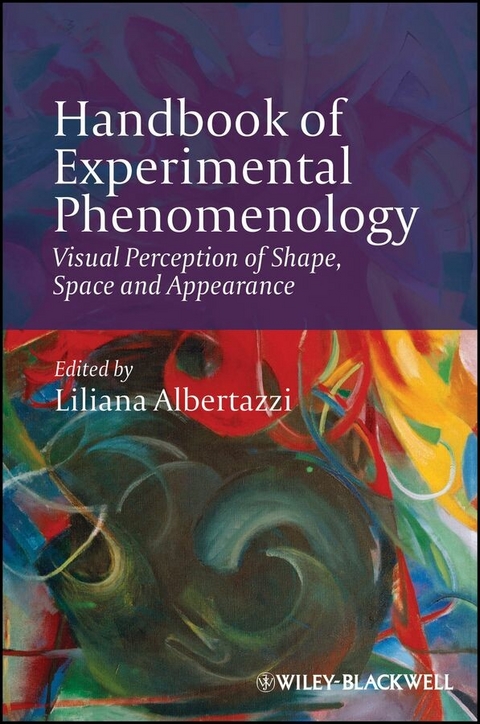
Handbook of Experimental Phenomenology (eBook)
John Wiley & Sons (Verlag)
978-1-118-32907-8 (ISBN)
- Presents and discusses a new perspective in vision science, and formalizes a field of study that will become increasingly significant to researchers in visual science and beyond
- The contributors are outstanding scholars in their fields with impeccable academic credentials, including Jan J. Koenderink, Irving Biederman, Donald Hoffmann, Steven Zucker and Nikos Logothetis
- Divided into five parts: Linking Psychophysics and Qualities; Qualities in Space, Time and Motion; Appearances; Measurement and Qualities; Science and Aesthetics of Appearances
- Each chapter will have the same structure consisting of: topic overview; historical roots; debate; new perspective; methods; results and recent developments
Liliana Albertazzi is a Principal Investigator at the Center for Mind/Brain Sciences (CIMEC), and Professor at the Department of Humanities of Trento University, Italy. Her research investigates phenomenal qualities, and the nature of perceptual space/time and visual operations. She has led a major international project to develop an accurate descriptive theory of appearances on an experimental basis. She is the editor of Perception Beyond Inference: The Information Content of Visual Processes (2011).
Liliana Albertazzi is a Principal Investigator at the Center for Mind/Brain Sciences (CIMEC), and Professor at the Department of Humanities of Trento University, Italy. Her research investigates phenomenal qualities, and the nature of perceptual space/time and visual operations. She has led a major international project to develop an accurate descriptive theory of appearances on an experimental basis. She is the editor of Perception Beyond Inference: The Information Content of Visual Processes (2011).
About the Editor vii
About the Contributors ix
Preface xiii
Experimental Phenomenology: An Introduction 1
Liliana Albertazzi
Part I Linking Psychophysics and Qualities 37
1 Inferential and Ecological Theories of Visual Perception 39
Joseph S. Lappin
2 Public Objects and Private Qualia: The Scope and Limits of
Psychophysics 71
Donald D. Hoffman
3 The Attribute of Realness and the Internal Organization of
Perceptual Reality 91
Rainer Mausfeld
4 Multistable Visual Perception as a Gateway to the Neuronal
Correlates of Phenomenal Consciousness: The Scope and Limits of
Neuroscientifi c Analysis 119
Theofanis I. Panagiotaropoulos and Nikos K. Logothetis
5 Phenomenal Qualities and the Development of Perceptual
Integration 145
Mariann Hudák, Zoltan Jakab, and Ilona Kovács
Part II Qualities in Space, Time, and Motion 163
6 Surface Shape, the Science and the Looks 165
Jan J. Koenderink
7 Experimental Phenomenology of Visual 3D Space: Considerations
from Evolution, Perception, and Philosophy 181
Dhanraj Vishwanath
8 Spatial and Form-Giving Qualities of Light 205
Sylvia C. Pont
9 Image Motion and the Appearance of Objects 223
Katja Dörschner
10 The Role of Stimulus Properties and Cognitive Processes in
the Quality of the Multisensory Perception of Synchrony 243
Argiro Vatakis
Part III Appearances 265
11 Appearances From a Radical Standpoint 267
Liliana Albertazzi
12 How Attention Can Alter Appearances 291
Peter U. Tse, Eric A. Reavis, Peter J. Kohler, Gideon P.
Caplovitz, and Thalia Wheatley
13 Illusion and Illusoriness: New Perceptual Issues and New
Phenomena 317
Baingio Pinna
14 Qualitative Inference Rules for Perceptual Transparency
343
Osvaldo Da Pos and Luigi Burigana
15 The Perceptual Quality of Color 369
Anya Hurlbert
16 The Aesthetic Appeal of Visual Qualities 395
Gert van Tonder and Branka Spehar
Part IV Measurement and Qualities 415
17 Psychophysical and Neural Correlates of the Phenomenology of
Shape 417
Irving Biederman
18 What Are Intermediate-Level Visual Features? 437
Steven W. Zucker
19 Basic Colors and Image Features: The Case for an Analogy
449
Lewis D. Griffin
20 Measuring the Immeasurable: Quantitative Analyses of
Perceptual Experiments 477
Luisa Canal and Rocco Micciolo
21 The Non-Accidentalness Principle for Visual Perception
499
Agnès Desolneux, Lionel Moisan, and Jean-Michel
Morel
Name Index 515
Subject Index 529
Systematic concern with visual appearances is as oldas modern
science but it has not been pursued with the consistency accorded
to visual processing. Galileo interrogated appearances in
contrast to the optical approach heralded in his day by Kepler
and Scheiner. Now the study of appearances is enjoying a
renaissance due in no small part to the novel techniques of
experimental phenomenology so clearly expounded in this book.
Its practitioners are neither unified in their methods nor in their
theories but they do share dissatisfactions with analyses of
perception that sidestep the subjective dimensions which are
fundamental features of our experience.--Nicholas Wade,
Emeritus Professor, University of Dundee.
This Handbook brings together a distinguished collection of
thinkers and researchers who address the subjective nature of
visual perception as a science in its own right and who have
developed a variety of new methods and concepts to investigate it.
This could become an important book that redresses the balance of
discussion and debate about what 'seeing' is, and its role in our
mental lives.--Mark Georgeson, Professor of Vision
Sciences, Aston University, Birmingham.
1
Inferential and Ecological Theories of Visual Perception
Joseph S. Lappin
Visual Phenomena
A basic principle of phenomenology: phenomena vary with the observer’s perspective
Visual phenomena also vary with one’s theoretical perspective. Viewer-dependence plays different roles in inferential and ecological approaches to perceptual theory. Inferences about the environmental causes of sensory data are complicated by viewer-dependent variations; but viewer-dependence has a central and explanatory role in the ecological approach.
Objective and subjective
Intuitively, the world we experience usually seems an objective reality—shaped by what is rather than by the instruments of our senses and technology. We know, of course, that what we see depends on our vantage point, on our eyes being open, whether the TV is turned on, and so forth. But when eyes and doors are opened and when a video receiver is switched on, then we generally regard a revealed scene as having been there all along, independent of our eyes and technology. A belief in the objectivity of observation has seemed essential to the professional practice of many scientists and engineers, as well as to the tacit knowledge of most of us. To be sure, the world we experience is not a fiction of our imagination.
Nevertheless, for painters, poets, musicians, and photographers, perceptual experience is neither deterministic nor the product of an objective world. Artists design objects for purposes of “orchestrating experience”1—to give meaning and emotional significance to both the objects and processes of observation. Making art is obviously creative, but observing art is also creative. Observing and making art both involve active choices of attention to form, context, and meaning. And observing art is strongly influenced by one’s vantage point and knowledge. In the everyday world as well as in museums, what we observe is selected from what might be seen. Attention is guided by context, learning, memory, meaning, and emotional significance.
Our choices of attention and action are also constrained by what our perceived surroundings afford—by walls and hallways, forests and trails, and traffic on the roads we travel. Our lives depend on the compatibility of our choices with changing environmental conditions. Our senses may sample limited patterns in our surroundings, but these perceived patterns must not conflict too often with the available constraints and opportunities.
Thus, visual phenomena are multifaceted. Different perspectives afford different descriptions and different explanations. Scientific experimenters and the observers who serve as subjects have importantly different perspectives. One’s subjective, personal experience looking, as it were, from the inside out is obviously very different from that of a scientist studying vision by looking from the outside at another person’s behavior. Scientific observations about other persons’ visual experiences are obviously limited. If visual experience is not objectively observable by another person, does it belong to science?
In fact, logically rigorous psychophysical methods have been developed to characterize other persons’ perceptual discriminations (e.g., Garner, Hake, & Eriksen, 1956; Green & Swets, 1966). Effective psychophysical methods usually concern subjects’ discriminations among physical objects rather than the subjective experience per se. Does subjective experience belong at all within the domain of science?
The method of introspection, developed in the late 19th century, was designed to observe the characteristics of other persons’ subjective experience. Subjects in an introspective experiment provided verbal descriptions of their phenomenological experiences, thereby offering to the experimental scientist indirect evidence about that experience. In the words of E. B. Titchener:
The first object of the psychologist . . . is to ascertain the nature and number of the mental elements. He takes up mental experience, bit by bit, dividing and subdividing, until the division can go no further. When that point is reached, he has found a conscious element. (1896/1899, p. 16)
Titchener regarded the introspective method as a psychological analog to chemical or anatomical analysis, supposedly revealing the structure of perceptual experience. “Structuralism” and the introspective method both failed to achieve their goals, however.
Structuralism and introspection depended on several important assumptions, including the following two:
From the personal perspective of an observer, visual experiences usually seem to be composed mainly of environmental objects and events. The method of introspection failed partly because subjects found it difficult to describe sensations rather than stimulus objects; they too often made “stimulus errors” by describing stimulus objects rather than the sensations per se. Vision research has progressed more rapidly by focusing on the objects of perception rather than sensory experience as such. Perhaps the objective and subjective aspects of perception cannot even be clearly distinguished.
Psychological structuralism largely disappeared after Titchener’s death. Nevertheless, relatives of the two ideas above have survived, clothed in modern concepts of sensory, perceptual, and cognitive processes. Persisting ideas about the physiological components of perception derive from implicit intuitions about the material and causal bases of visual phenomena. Empirical support for these two ideas is actually very limited. The supporting rationale is mainly just implicit in the conceptual background of many scientific perspectives.
Material objects, immaterial relations, and “the really hard problem”
From the perspectives of most scientists, visual phenomena have properties quite different from those experienced by observers. Vision occurs through the actions of material mechanisms that transfer energy by optical, physiological, chemical, and neural processes. If visual phenomena have meanings and qualities, then these properties must, in the standard scientific view, be immaterial additions produced by inference, memory, cognition, and emotion.
The problem of understanding how material processes of the eye and brain produce meaningful experience, with properties of meaning, quality, and value, is an abiding and fundamental problem in science and philosophy. Flanagan (2007) identifies this as “the really hard problem.”
Properties of meaning, sensory quality, and affective value are seemingly unobservable—to the scientist on the outside at least—and vision scientists typically ignore them for that reason. But what, exactly, is observable? Observables are often thought to be objects and events with spatial and temporal dimensions. Thus, vision scientists manipulate and measure “stimuli” (environmental objects and events or optical patterns on the eyes) and record “responses” (discriminations of stimuli or physiological responses in nerve cells and brain areas).2
Individual stimuli and responses do not have directly observable properties of meaning, quality, or value. Relations among stimuli and among responses, however, certainly can permit inferences about such immaterial properties. Physiological responses in certain brain areas are also found to correlate with certain stimuli that elicit emotional behaviors or judgments. A contemporary example: Mormann et al. (2011) found that neurons in the human amygdala responded selectively and with shorter latency to a stimulus category consisting of (pictures of) animals (both aversive and cute) but not to other categories of persons, landmarks, or inanimate objects; and similarly selective responses were not found in other areas of the brain. Converging evidence from clinical, behavioral, and neurophysiological studies supports the role of the amygdala in emotional responses. We can infer that the human subjects probably perceived affective properties of the animal pictures. Did the experimenters observe such affective properties? Or are affective phenomena necessarily only subjective, and not directly observable?
A broader question is whether immaterial properties are observable. Are observable objects and properties only those things that are measurable on well-defined physical variables such as length, duration, wavelength, mass, and energy? Implicitly if not explicitly, scientists have often represented perceived patterns as composed of sensory elements, specified by individual receptors at given spatial and temporal locations. Patterns as such are sometimes treated as not directly observable. Optical patterns, for example, can be represented as arrays of intensity values at discrete spatial and temporal positions, as in photos and movies recorded by cameras. Much of vision science has proceeded from just such representations directly analogous to the image arrays in cameras.
What, then, is the...
| Erscheint lt. Verlag | 15.3.2013 |
|---|---|
| Sprache | englisch |
| Themenwelt | Geisteswissenschaften ► Philosophie ► Allgemeines / Lexika |
| Geisteswissenschaften ► Philosophie ► Philosophie der Neuzeit | |
| Geisteswissenschaften ► Psychologie ► Allgemeine Psychologie | |
| Schlagworte | appearances • become • call objects • Cognitive • collections • Concepts • Gefühle u. Wahrnehmung • Gefühle u. Wahrnehmung • Integrated • Mind • perceiver • perception • Phänomenologie • Phänomenologie • Psychologie • Psychology • qualitative visual • qualities • scientific study • Secondary • Sensation & Perception • Shape • theory • universally • Vision • Visual |
| ISBN-10 | 1-118-32907-4 / 1118329074 |
| ISBN-13 | 978-1-118-32907-8 / 9781118329078 |
| Informationen gemäß Produktsicherheitsverordnung (GPSR) | |
| Haben Sie eine Frage zum Produkt? |
 EPUB (Adobe DRM)
Kopierschutz: Adobe-DRM
Adobe-DRM ist ein Kopierschutz, der das eBook vor Mißbrauch schützen soll. Dabei wird das eBook bereits beim Download auf Ihre persönliche Adobe-ID autorisiert. Lesen können Sie das eBook dann nur auf den Geräten, welche ebenfalls auf Ihre Adobe-ID registriert sind.
Details zum Adobe-DRM
Dateiformat: EPUB (Electronic Publication)
EPUB ist ein offener Standard für eBooks und eignet sich besonders zur Darstellung von Belletristik und Sachbüchern. Der Fließtext wird dynamisch an die Display- und Schriftgröße angepasst. Auch für mobile Lesegeräte ist EPUB daher gut geeignet.
Systemvoraussetzungen:
PC/Mac: Mit einem PC oder Mac können Sie dieses eBook lesen. Sie benötigen eine
eReader: Dieses eBook kann mit (fast) allen eBook-Readern gelesen werden. Mit dem amazon-Kindle ist es aber nicht kompatibel.
Smartphone/Tablet: Egal ob Apple oder Android, dieses eBook können Sie lesen. Sie benötigen eine
Geräteliste und zusätzliche Hinweise
Buying eBooks from abroad
For tax law reasons we can sell eBooks just within Germany and Switzerland. Regrettably we cannot fulfill eBook-orders from other countries.
aus dem Bereich