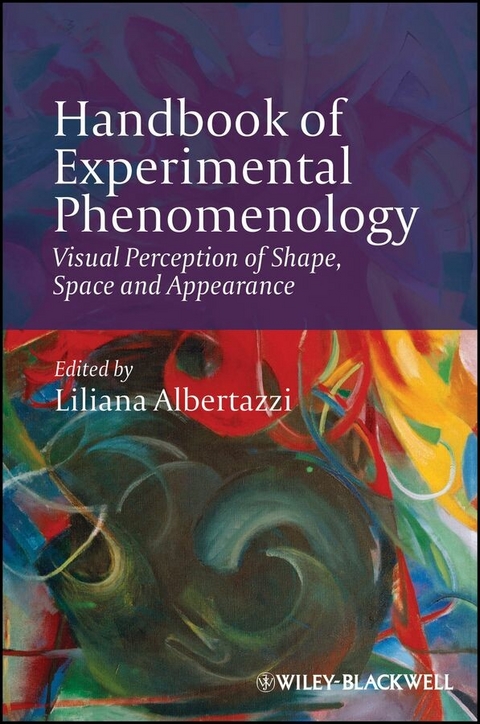
Handbook of Experimental Phenomenology (eBook)
John Wiley & Sons (Verlag)
978-1-118-32906-1 (ISBN)
Liliana Albertazzi is a Principal Investigator at the Center for Mind/Brain Sciences (CIMEC), and Professor at the Department of Humanities of Trento University, Italy. Her research investigates phenomenal qualities, and the nature of perceptual space/time and visual operations. She has led a major international project to develop an accurate descriptive theory of appearances on an experimental basis. She is the editor of Perception Beyond Inference: The Information Content of Visual Processes (2011).
Liliana Albertazzi is a Principal Investigator at the Center for Mind/Brain Sciences (CIMEC), and Professor at the Department of Humanities of Trento University, Italy. Her research investigates phenomenal qualities, and the nature of perceptual space/time and visual operations. She has led a major international project to develop an accurate descriptive theory of appearances on an experimental basis. She is the editor of Perception Beyond Inference: The Information Content of Visual Processes (2011).
Cover 1
Title page 5
Copyright page 6
Contents 7
About the Editor 9
About the Contributors 11
Preface 15
Experimental Phenomenology: An Introduction 17
The Concept 17
The State of the Art 20
Phenomenology and Science 24
Subjective Experiences 25
The Science of Appearances 28
A Perceptual Physics 30
Realness and Its Degrees 33
Conditions of Appearing 33
Measuring Quality 35
Modeling Quality 36
Phenomenology Today and Beyond 38
Acknowledgment 40
References 40
Part I: Linking Psychophysics and Qualities 53
1: Inferential and Ecological Theories of Visual Perception 55
Visual Phenomena 55
A basic principle of phenomenology: phenomena vary with the observer’s perspective 55
Objective and subjective 55
Material objects, immaterial relations, and “the really hard problem” 57
Inferential Theories 60
Logical responses to proximal stimulation 60
Physiological mechanisms 61
Computational theory 63
Selective attention, information processing, and the demise of behaviorism 64
Inferential concepts from phenomenology 66
Ecological Theories 66
An ecological concept of sensory information: (1) spatiotemporal structure 68
An ecological concept of information: (2) optical images constitute information about both environmental structure and the observer’s vantage point 69
An ecological concept of information: (3) perceived environmental properties are specified by retinal variables 72
An ecological concept of sensory information: (4) perception of invariants 73
Ecological theory of observation: direct perception of environmental scenes 74
Ecological theory of observation: interdependence of perception and action 75
Ecological theory of observation: direct perception of meanings and affordances 79
Conclusions 80
Notes 80
References 81
2: Public Objects and Private Qualia 87
The Scope and Limits of Psychophysics 87
The Standard Framework 87
A Problem with the Standard Framework 89
The Interface Theory of Perception 91
Formal Models of Perception 95
No Psychophysical Laws 97
No Reductive Functionalism 99
Illusions and Hallucinations 100
Psychophenomics 101
Acknowledgments 102
Appendix 102
References 103
3: The Attribute of Realness and the Internal Organization of Perceptual Reality 107
Historical Roots of the Problem of Perceptual Realness/Unrealness 108
Experimental Phenomenology 110
Michotte’s Observations on Phenomenal Realness 112
Phenomenal Duplication 116
Structural regularities underlying duplication 117
On the Status of Phenomenological Observations in Perception Theory 119
Explanatory Accounts of Perception: Perception as a Triggering of Conceptual Forms 121
The Attribute “Real” in Explanatory Accounts of Perception 124
References 132
4: Multistable Visual Perception as a Gateway to the Neuronal Correlates of Phenomenal Consciousness 135
The Scope and Limits of Neuroscientific Analysis 135
Early Ideas on Conscious Mental Phenomena 135
The Neuronal Correlates of Conscious Visual Perception 138
Psychophysics 139
Electrophysiology 142
Functional magnetic resonance imaging (fMRI) 146
Cortical dynamics mediating transitions in conscious perception 148
Conclusion 151
Notes 152
References 152
5: Phenomenal Qualities and the Development of Perceptual Integration 161
Introduction 161
Color vision in children 162
Color Vision in Newly Sighted Patients 165
Perception of Form and the Three-Dimensional World in Newly Sighted Patients 166
Development of Form and Visual Context Perception 168
Development of Binocular Vision 170
Other Forms of Bistable Perception 172
Conclusions 173
Acknowledgments 174
Notes 174
References 175
Part II: Qualities in Space, Time, and Motion 179
6: Surface Shape, the Science and the Looks 181
Introduction 181
The Formal Account of Visual Space 182
Psychophysics and the Microgenesis of Visual Awareness 184
The Physics of Surface Shape 185
The Psychology of Surface Shape 188
The Psychophysics of Surface Shape 190
Conclusion 191
Notes 191
References 194
7: Experimental Phenomenology of Visual 3D Space 197
Considerations from Evolution, Perception, and Philosophy 197
Introduction 197
The Story of Color Perception 198
Psychophysics and Phenomenology 200
First Principles: The Evolution of a Sensing Organism 201
Ways of Studying Perception 205
Perception Reconsidered 208
The “Meaning” of Direction and Distance 210
Some Phenomenal Attributes of Space 212
Bringing It all Together 215
Notes 218
References 218
8: Spatial and Form-Giving Qualities of Light 221
Introduction 221
Terms 223
State of the Art 223
Probing the Luminosity Framework 229
Terminology and Semantics 231
References 234
9: Image Motion and the Appearance of Objects 239
Introduction 239
1 Perceptual Grouping 240
Perceptual grouping affects perceived motion direction and speed 240
Motion direction affects perceptual grouping 241
2 Appearance 244
Rigidity 245
Gloss and shininess 250
3 Conclusion 251
Challenge 251
Outlook 253
Acknowledgments 253
References 255
10: The Role of Stimulus Properties and Cognitive Processes in the Quality of the Multisensory Perception of Synchrony 259
The Perception of Synchrony 259
Synchrony Perception: A Historical Sketch 259
The Temporal Window of Integration 261
Factors Modulating the Perception of Synchrony 263
Stimulus intensity 264
Stimulus duration 264
Stimulus location 265
Stimulus type 266
Stimulus orientation and viewing angle 269
Binding of multisensory stimuli 271
Stimulus familiarity/expertise 271
Aging and development 272
Discussion 273
Acknowledgments 274
References 274
Part III: Appearances 281
11: Appearances From a Radical Standpoint 283
Perceiving 283
Qualities 287
Methodology 291
Magnitudes in Subjective Space 293
A World of Values 296
Galilean Science and Beyond 298
References 300
12: How Attention Can Alter Appearances 307
The Class of Attentional Phenomena in Need of an Explanation 307
Current Theories of Attention 312
The Preconscious Buffer 314
Attention Influences Subsequent Preconscious Processes 316
Specifying the Domain of Preconscious Operations 318
Evidence from color constancy 318
Conclusion 324
Notes 325
References 325
13: Illusion and Illusoriness 333
New Perceptual Issues and New Phenomena 333
Introduction 333
What Is a Visual Illusion? On the Mismatch Between Geometrical and Phenomenal Domains 333
Illusory and Non-Illusory Illusions 336
Unnoticed and Plain Illusions 338
Invisible and Visible Illusions 338
What Is Illusoriness? 341
Illusory Antinomies 342
Illusory Impressions 343
Observer-Induced Illusion and Illusoriness 344
The Illusion of Illusoriness 347
Illusoriness Without Illusion 348
Disrupting and Deceiving Illusion Without Illusoriness 352
Conclusions 354
Acknowledgments 355
References 355
14: Qualitative Inference Rules for Perceptual Transparency 359
Introduction 359
Features of Qualitative (vs. Quantitative) Information 364
The Subject of Perceptual Transparency 367
Inferences on the Occurrence of Perceptual Transparency 370
Inferences on Perceptual Properties Relating to Transparency 374
Evaluations and Conclusions 376
Notes 379
References 381
15: The Perceptual Quality of Color 385
What Is Color? 385
Color Subjectivism vs. Color Realism: An Historical Overview 385
Color realism: Naïve and sophisticated 387
The Science of Color Perception 387
The physics of light reflection 387
The physiology of light reception 388
Color constancy 388
The Contemporary Perceptual Realist 390
The psychologist vs. the philosopher 392
Measuring the Quality of Color 392
The unpredictability of color 394
What Is Color for? 395
The computational question: Is surface reflectance recoverable? 397
The physiological question: Is the visual system capable of color constancy? 397
Empirical measurements of color constancy 398
The dependence of color on objects: Memory color, shape and surface 400
Notes 406
References 407
16: The Aesthetic Appeal of Visual Qualities 411
How Is Aesthetic Relevant to the Experimental Study of Visual Appearances? 411
Historical and Contemporary Inquiries Into Aesthetics 412
Object Characteristics as the Foundation of Aesthetics 413
Aesthetics as a Purely Subjective (Emotional) Effect 415
Functional Context: Aesthetics in the Context of Evolution and Ecology 415
Functional Context: Aesthetics, Perception and Brain Function 417
A Change of Perspective: A More Holistic Approach 420
Koffka’s Unique Views on a Phenomenology of Aesthetics: From Physiognomic Qualities to the Ego–Object Relationships 423
References 427
Part IV: Measurement and Qualities 431
17: Psychophysical and Neural Correlates of the Phenomenology of Shape 433
Introduction 433
Two Theoretical Issues: Invariance and the Nature of the Representation 434
Invariance 434
Invariance to surface features: The role of orientation and depth discontinuities 436
Nature of the representation: Feature hierarchies vs. structural descriptions 436
Empirical Research 437
NAPs (geons) vs. MPs 437
Matching depth-rotated objects 437
Observations about bent paper clips as experimental stimuli 440
Spontaneous appeal to nonaccidental properties 440
When GSDs are insufficient 442
Can View-Based Accounts Incorporate Geons as a Unique or Diagnostic Feature? 443
Recent Neural Evidence for GSDs 444
Parts in IT 444
NAPs vs. MPs in IT 444
Recent neural results supporting a geon account of shape representation: Simplicity of parts, coding of independent generalized cylinder dimensions, and sufficiency of orientation and depth discontinuities 445
Familiarity 446
Structural descriptions 447
Conclusion 448
Acknowledgment 449
References 449
18: What Are Intermediate-Level Visual Features? 453
Introduction and Outline 453
Historical Roots 454
The Question 457
Approach 458
Results 460
Conclusions 462
Acknowledgment 463
References 463
19: Basic Colors and Image Features 465
The Case for an Analogy 465
Introduction 465
Analogy at the Sensory Level 466
Color vision 466
Local spatial vision 467
The Truncated Hermite Transform 467
Approximation to the truncated Hermite Transform 470
Analogy at the Invariant Representation level 472
The color solid 473
The local image structure solid 475
Factored jet spaces 477
Analogy at the Category Level 477
Basic colors 477
Basic image features 480
Category systems on factored jet spaces 482
Concluding Remarks 483
Weak points of the analogy 483
Previous work 484
Predictions 485
References 487
20: Measuring the Immeasurable 493
Quantitative Analyses of Perceptual Experiments 493
Outline and Cast of the Topic 493
Outline of the Experiment 493
Are Colors Randomly Chosen? 494
Are Patterns of Color Choice Similar Between Sessions? 496
Given a Figure, Are Colors Randomly Chosen? 498
Are Patterns of Association Similar Between Sessions? 501
Projecting Figures Onto the Color Space 502
Hot/Cool and Light/Dark Figures 512
References 514
21: The Non-Accidentalness Principle for Visual Perception 515
Outline and Cast of the Topic 515
Formulations of the Non-Accidentalness Principle 515
Gestalt Theory and Grouping Laws 517
From Qualitative to Quantitative: The a contrario Approach 518
Three Detailed Examples 520
Alignments in an image 520
Contrasted curves 521
Good continuations 523
Checking the Non-Accidentalness Principle Experimentally 524
Experiment on the detection of squares 524
Experiment on the detection of alignments 527
Conclusion 528
References 529
Name Index 531
Subject Index 545
Systematic concern with visual appearances is as oldas modern
science but it has not been pursued with the consistency accorded
to visual processing. Galileo interrogated appearances in
contrast to the optical approach heralded in his day by Kepler
and Scheiner. Now the study of appearances is enjoying a
renaissance due in no small part to the novel techniques of
experimental phenomenology so clearly expounded in this book.
Its practitioners are neither unified in their methods nor in their
theories but they do share dissatisfactions with analyses of
perception that sidestep the subjective dimensions which are
fundamental features of our experience.--Nicholas Wade,
Emeritus Professor, University of Dundee.
This Handbook brings together a distinguished collection of
thinkers and researchers who address the subjective nature of
visual perception as a science in its own right and who have
developed a variety of new methods and concepts to investigate it.
This could become an important book that redresses the balance of
discussion and debate about what 'seeing' is, and its role in our
mental lives.--Mark Georgeson, Professor of Vision
Sciences, Aston University, Birmingham.
| Erscheint lt. Verlag | 15.3.2013 |
|---|---|
| Sprache | englisch |
| Themenwelt | Geisteswissenschaften ► Philosophie ► Allgemeines / Lexika |
| Geisteswissenschaften ► Philosophie ► Philosophie der Neuzeit | |
| Geisteswissenschaften ► Psychologie ► Allgemeine Psychologie | |
| Schlagworte | appearances • become • call objects • Cognitive • collections • Concepts • Gefühle u. Wahrnehmung • Integrated • Mind • perceiver • perception • Phänomenologie • Psychologie • Psychology • qualitative visual • qualities • scientific study • Secondary • Sensation & Perception • Shape • theory • universally • Vision • Visual |
| ISBN-10 | 1-118-32906-6 / 1118329066 |
| ISBN-13 | 978-1-118-32906-1 / 9781118329061 |
| Informationen gemäß Produktsicherheitsverordnung (GPSR) | |
| Haben Sie eine Frage zum Produkt? |
 PDF (Adobe DRM)
Kopierschutz: Adobe-DRM
Adobe-DRM ist ein Kopierschutz, der das eBook vor Mißbrauch schützen soll. Dabei wird das eBook bereits beim Download auf Ihre persönliche Adobe-ID autorisiert. Lesen können Sie das eBook dann nur auf den Geräten, welche ebenfalls auf Ihre Adobe-ID registriert sind.
Details zum Adobe-DRM
Dateiformat: PDF (Portable Document Format)
Mit einem festen Seitenlayout eignet sich die PDF besonders für Fachbücher mit Spalten, Tabellen und Abbildungen. Eine PDF kann auf fast allen Geräten angezeigt werden, ist aber für kleine Displays (Smartphone, eReader) nur eingeschränkt geeignet.
Systemvoraussetzungen:
PC/Mac: Mit einem PC oder Mac können Sie dieses eBook lesen. Sie benötigen eine
eReader: Dieses eBook kann mit (fast) allen eBook-Readern gelesen werden. Mit dem amazon-Kindle ist es aber nicht kompatibel.
Smartphone/Tablet: Egal ob Apple oder Android, dieses eBook können Sie lesen. Sie benötigen eine
Geräteliste und zusätzliche Hinweise
Buying eBooks from abroad
For tax law reasons we can sell eBooks just within Germany and Switzerland. Regrettably we cannot fulfill eBook-orders from other countries.
aus dem Bereich