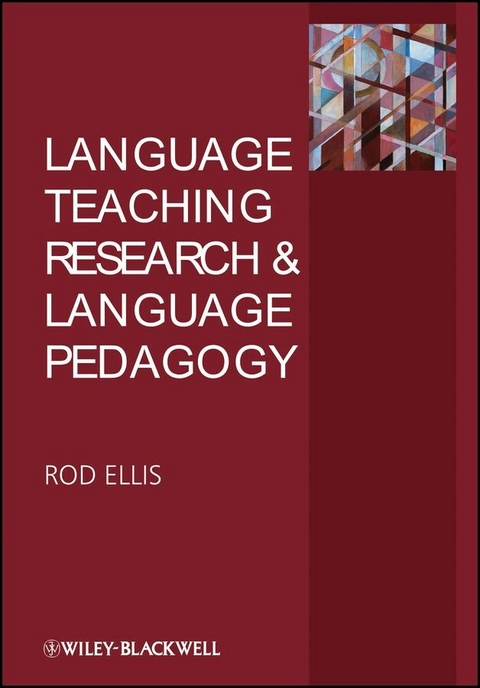
Language Teaching Research and Language Pedagogy (eBook)
John Wiley & Sons (Verlag)
978-1-118-29137-5 (ISBN)
- Offers an accessible overview of a range of research on instruction and learning in the L2 classroom
- Bridges the relationship between research, teachers, and learners
- Helps evolve the practice of dedicated current language teachers with research findings that suggest best practices for language teaching
Rod Ellis is currently Professor in the Department of Applied Language Studies and Linguistics, University of Auckland, where he teaches postgraduate courses on second language acquisition, individual differences in language learning and task-based teaching. His books include Understanding Second Language Acquisition (winner of the BAAL Prize, 1986), The Study of Second Language Acquisition (winner of the Duke of Edinburgh prize, 1995), Task-Based Learning and Teaching (2003), and Analyzing Learner Language (with Gary Barkhuizen, 2005).
Rod Ellis is currently Professor in the Department of Applied Language Studies and Linguistics, University of Auckland, where he teaches postgraduate courses on second language acquisition, individual differences in language learning and task-based teaching. His books include Understanding Second Language Acquisition (winner of the BAAL Prize, 1986), The Study of Second Language Acquisition (winner of the Duke of Edinburgh prize, 1995), Task-Based Learning and Teaching (2003), and Analyzing Learner Language (with Gary Barkhuizen, 2005).
List of Figures vi
List of Tables vii
Preface ix
Acknowledgements xiii
1 Introduction: Developments in Language Teaching
Research 1
2 Methods for Researching the Second Language Classroom
21
3 Comparative Method Studies 51
4 Second Language Classroom Discourse 75
5 Focus on the Teacher 115
6 Focus on the Learner 151
7 Investigating the Performance of Tasks 195
8 Interaction and L2 Learning in the Classroom 237
9 Form-Focused Instruction and Second Language Learning
271
10 Instruction, Individual Differences and L2 Learning
307
11 Conclusion: Research and Language Teaching 337
References 349
Index 385
"Language teaching research and language pedagogy are
complex and dynamic topics with a rich research tradition. Ellis
succeeds in this volume in synthesizing a wide body of research
... providing valuable information about language teaching,
learning, and research. Both language teachers and researchers can
benefit from this informative volume ... The book has several
strengths [offering] a holistic updated picture of diverse topics
in the field ... Insights and suggestions are provided
throughout to make research findings into practical technical
knowledge for language teachers." Linguist List
(29th October, 2013)
"This book provides a comprehensive, state-of-the-art
review of L2 classroom research covering a wide range of issues in
SLA and language education. There are a number of useful tables and
figures that present concise syntheses of complex issues. Although
the volume addresses little about the development of specific
language skills, it should be an essential read for teachers and
researchers who wish to browse the major findings of empirical
studies that inform language classroom practice."
(Studies in Second Language Acquisition, 1 August 2013)
"The discussion of each study is critical but fair, and in
explaining the methodological limitations of each study, Ellis
provides readers with numerous ideas for how they could contribute
to language teaching research in the future." (The
Modern Language Journal, 22 August 2013)
"Rod Ellis synthesizes an extensive body of classroom research
through cognitive-interactionist and sociocultural perspectives in
ways that promise to spark constructive debate about possibilities
for both pedagogy and research." - Roy Lyster, McGill
University
"This book provides an excellent, state of the art review of all
the hot topics in today's second language classroom research
- it's well-written, highly accessible and comprehensive."
- Alison Mackey, Georgetown University
2
Methods for Researching the Second Language Classroom
Introduction
It is useful to make a broad distinction between formal and practitioner research. By formal research I mean research that is conducted by an external researcher drawing on one or more of the established research traditions. Formal classroom research can be motivated by theoretical issues (e.g. whether opportunities to negotiate for meaning facilitate second language – L2 – learning) or by pedagogic issues (e.g. how and to what extent teachers implement a particular approach to language teaching). In many cases, the issues investigated are of both theoretical and pedagogical significance. Practitioner research is research conducted by teachers in their own classrooms drawing on the principles of action research (for example, Wallace, 1998; Burns, 2009) or exploratory practice (Allwright, 2003). It is invariably motivated by pedagogic concerns and is directed at enabling teachers to solve problems they are experiencing with their teaching or develop a deeper understanding of some aspect of the quality of life in the L2 classroom. It should be noted, however, that both types of research have in common the general features of research – that is, there is a problem or question to be addressed, data is collected and analyzed and an interpretation of the findings provided.
This chapter begins with a discussion of formal and practitioner research. It will then move on to examine the main research traditions (i.e. descriptive research and confirmatory research). Both of these traditions can figure in both formal and practitioner research and, increasingly, are combined in the same study. These traditions will be considered in terms of their theoretical underpinnings, their research design, the data collection methods they employ, and methods for analyzing the data.
Table 2.1 Summary of Ellis and He's experimental study (1999)
The intention of this chapter is to provide a general account of the methods used to research the L2 classroom rather than to offer guidelines about how to carry out research. Readers interested in the details of the different research methods should consult a relevant book on research methodology (e.g. Brown and Rodgers, 2002; Dörnyei, 2007; Mackey and Gass, 2005; Nunan and Bailey, 2009).
Formal L2 Classroom Research
It is helpful to begin with some examples of formal classroom research. I will draw on a series of classroom-based studies that my fellow researchers and I conducted in the 1990s, all of which were informed by Long's (1983a) Interaction Hypothesis. This hypothesis claims that L2 acquisition is facilitated when a communication problem arises that causes learners to try to resolve it through the negotiation of meaning. Negotiation potentially aids acquisition in a number of ways – by helping to make input comprehensible, by prompting learners to notice the difference between their own erroneous output and the correct target language form through feedback, and by pushing learners to self-correct. Numerous studies have investigated the Interaction Hypothesis (see, for example, the list in Table 1 in Mackey, 2007). However, many of these were laboratory studies. My own studies, which sought to investigate the effect that negotiation had on comprehension and the acquisition of vocabulary, all took place in a classroom context.
The studies were all experimental in nature. That is, there were one or more experimental groups that received a ‘treatment’ (consisting of either input that had been premodified to facilitate comprehension or input that the students had the opportunity to modify through interaction or an opportunity to use the target items in production). In all the studies there was a pre-test to establish which of the target vocabulary the students already knew, a post-test more or less immediately following the treatment, and a delayed post-test to establish whether any learning that had taken place was durable. Table 2.1 summarizes one of the studies I carried out (Ellis and He, 1999).
Table 2.2 Summary of Lyster and Ranta's study of corrective feedback (1997)
The formal nature of my research is evident in a number of ways. First, as already stated, it was theoretically motivated. I wanted to test the claims of the Interaction Hypothesis. At the time, although a number of studies had shown that modified interaction assisted comprehension, there were few studies that had investigated whether it facilitated acquisition. Thus, there was a conspicuous ‘gap’ between what the Interaction Hypothesis claimed and the supporting evidence. My intention was to try to fill that gap. Second, I wanted to demonstrate a cause-effect relationship (i.e. the relationship between interactionally modified input and output and L2 acquisition). For this reason, I elected to use an experimental design rather than carry out a purely descriptive study. Third, as a university professor I was keen to conduct a study that would lead to publications in academic journals. The articles that resulted from the research were published in Language Learning, Applied Linguistics and Studies in Second Language Acquisition, all leading journals in my field. Nevertheless, even though my research was clearly theoretical in nature, it was also of potential practical significance. If it could be shown that learners could successfully learn vocabulary by performing listen-and-do tasks then I would be in a position to propose that such tasks had a place in language pedagogy. Indeed, I chose to investigate the Interaction Hypothesis precisely because of its pedagogic relevance.
Not all formal research is driven by theory. Much of the L2 classroom research has been descriptive in nature, aimed at understanding a specific aspect of teaching or learning and also at providing information that can ultimately be used to shape a theory. A good example of such research is Lyster and Ranta's (1997) study of how teachers in French immersion classrooms correct students’ linguistic errors when interacting with them. A summary of this study is provided in Table 2.2. Such studies can also be considered formal in that they are carried out by researchers (Lyster and Ranta are both university professors) rather than by teachers and were conducted with a view to publishing an article in an academic journal (Lyster and Ranta's study was published in Studies in Second Language Acquisition). Also, like my experimental studies, this study was intended to contribute to theory. Indeed, Lyster followed up this descriptive research with a number of experimental studies (see Lyster, 2004; Lyster and Mori, 2006) which were informed by the findings of the earlier descriptive study and which sought to investigate theoretically based hypotheses about the relative effectiveness of different types of corrective feedback. Finally, also like my studies, Lyster and Ranta's study aimed to contribute to language pedagogy.
Formal L2 classroom research, then, whether experimental or descriptive, aims to contribute to research-based language pedagogy. That is, it seeks to provide teachers with information that they can use to decide what and how to teach. Its characteristics are as follows:
1. The phenomenon investigated is determined by the researcher.
2. The researcher ‘borrows’ a classroom in order to carry out the study.
3. The researcher may also solicit the help of a classroom teacher to conduct the research.
4. The research is either theoretically driven (as in experimental research) or carried out with a view to developing theory (as in descriptive research).
5. The results of the research are written up in accordance with the requirements of academic articles and with a view to publishing them in academic journals.
6. In many cases the research is intended to contribute to research-based language pedagogy.
Such research is of undoubted value – both for testing and developing theory and for language pedagogy. A limitation, however, is that it may not address the kinds of issues that preoccupy teachers and, in fact, may never reach teachers as they are unlikely to read the journals in which it is published. Thus, if it does have an impact on teachers it will do so in a top-down fashion -- that is, through the mediation of teacher educators who draw implications for teaching from the research and convey these to teachers. In the view of some researchers and teacher educators, teachers would do better to engage in their own practitioner research.
Practitioner Research
Practitioner research is research conducted by practitioners (usually teachers) in their own classrooms either acting independently or in collaboration with others. Stewart (2006), citing Thesen and Kuzel (1999: 27) notes that it is ‘oriented towards reform rather than simply toward description or meaning’. Practitioner research, then, is directed at enabling teachers to become ‘expert knowers about their own students and classrooms’ (Cochran-Smith and Lytle, 1999: 16). In this way it aims to make a direct connection between research and practice. To this end, the research topics are not derived from theory but from teachers’ desire to experiment with some innovation in their classroom, to seek a solution to some problem they have identified with their teaching or their students, or simply to develop a fuller understanding of some aspect of life in their classrooms. Practitioner research, then, is...
| Erscheint lt. Verlag | 17.1.2012 |
|---|---|
| Sprache | englisch |
| Themenwelt | Geisteswissenschaften ► Sprach- / Literaturwissenschaft ► Sprachwissenschaft |
| Schlagworte | Bildungswesen • Education • Erlernen von Fremdsprachen • Language Teaching • Lehrpläne / Sprachen • Lehrpläne / Sprachen • Linguistics • Second, foreign acquisition, learning, L2 classroom, conversation analysis, form-focused instruction • Second Language acquisition • Sprachunterricht • Sprachwissenschaften |
| ISBN-10 | 1-118-29137-9 / 1118291379 |
| ISBN-13 | 978-1-118-29137-5 / 9781118291375 |
| Informationen gemäß Produktsicherheitsverordnung (GPSR) | |
| Haben Sie eine Frage zum Produkt? |
 EPUB (Adobe DRM)
Kopierschutz: Adobe-DRM
Adobe-DRM ist ein Kopierschutz, der das eBook vor Mißbrauch schützen soll. Dabei wird das eBook bereits beim Download auf Ihre persönliche Adobe-ID autorisiert. Lesen können Sie das eBook dann nur auf den Geräten, welche ebenfalls auf Ihre Adobe-ID registriert sind.
Details zum Adobe-DRM
Dateiformat: EPUB (Electronic Publication)
EPUB ist ein offener Standard für eBooks und eignet sich besonders zur Darstellung von Belletristik und Sachbüchern. Der Fließtext wird dynamisch an die Display- und Schriftgröße angepasst. Auch für mobile Lesegeräte ist EPUB daher gut geeignet.
Systemvoraussetzungen:
PC/Mac: Mit einem PC oder Mac können Sie dieses eBook lesen. Sie benötigen eine
eReader: Dieses eBook kann mit (fast) allen eBook-Readern gelesen werden. Mit dem amazon-Kindle ist es aber nicht kompatibel.
Smartphone/Tablet: Egal ob Apple oder Android, dieses eBook können Sie lesen. Sie benötigen eine
Geräteliste und zusätzliche Hinweise
Buying eBooks from abroad
For tax law reasons we can sell eBooks just within Germany and Switzerland. Regrettably we cannot fulfill eBook-orders from other countries.
aus dem Bereich