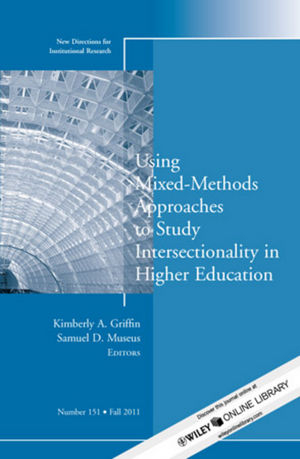
Using Mixed Methods to Study Intersectionality in Higher Education (eBook)
122 Seiten
John Wiley & Sons (Verlag)
978-1-118-18282-6 (ISBN)
The first two chapters provide context for the volume's themewith definitions and overview of the underpinnings of mixtedmethodology. Subsequent chapters illustrate the multiple ways inwhich qualitative and quantitative methods can be integrated tounderstand the complexity of identity and experiences ofmarginalized groups in the academy.
Other chapters focus on students' experiences and demonstratehow mixed-methodology approaches were used to
* explore college access among first-generation Asian Americansand Pacific Islanders
* analyze racial ideology of white males with interview datadriving analysis of longitudinal dataset
* and research and accessment generating accurate understandinghow of race and gender shape students' experiences within thecampus
The final chapter presents findings of a mixed-methods inquiry tochallenge current conceptions about racial categorization andpractices for gathering institutional data on students' identity.
Volume editors Kimberly A Griffin, assistant professor ofeducation policy studies at the Pennsylvania State University, andSamuel D. Museus, assistant professor of educational administrationat University of Hawai?i Manoa, and contributing authors advocatefor intersectionality research and argue that it holds greatpromise for advancing knowledge in higher education. Their book isideal for institutions and institutional researchers who want tounderstand and most effectively serve their students andfaculty.
This is the 151st volume of the Jossey-Bass quarterly reportseries New Directions for Institutional Research.Always timely and comprehensive, New Directions forInstitutional Research provides planners and administratorsin all types of academic institutions with guidelines in such areasas resource coordination, information analysis, program evaluation,and institutional management.
Kimberly A. Griffin is an assistant professor of education policy studies at the Pennsylvania State University and a research associate in the Center for the Study of Higher Education. Samuel D. Museus is an assistant professor of educational administration at the University of Hawai'i Manoa.
Editors' Notes 1
Kimberly A. Griffin, Samuel D. Museus
1. Mapping the Margins in Higher Education: On the Promise ofIntersectionality Frameworks in Research and Discourse 5
Samuel D. Museus, Kimberly A. Griffin
This chapter defines intersectionality and asserts theimportance of considering individuals' experiences as influenced bytheir multiple identities in higher education and institutionalresearch.
2. Application of Mixed-Methods Approaches to Higher Educationand Intersectional Analyses 15
Kimberly A. Griffin, Samuel D. Museus
Perceived methodological incompatibility, emergence ofparadigmatic pragmatism, and basic types of mixed-methods researchare presented in this chapter, along with a discussion of itsusefulness in conducting intersectional analysis.
3. Intersectionality in Context: A Mixed-Methods Approach toResearching the Faculty Experience 27
Meghan J. Pifer
This chapter discusses how social network analysis andinterviews can provide insight into how faculty identify like peersand form relationships with their colleagues.
4. Analyzing Gender Differences in Black Faculty MarginalizationThrough a Sequential Mixed-Methods Design 45
Kimberly A. Griffin, Jessica C. Bennett, Jessica Harris
Interviews and data from a national survey are used to explorehow race and gender intersect and influence faculty experienceswith marginalization in this chapter.
5. An Introductory Mixed-Methods Intersectionality Analysis ofCollege Access and Equity: An Examination of First-Generation AsianAmericans and Pacific Islanders 63
Samuel D. Museus
This chapter challenges the "model minority" myth, illustratinghow a sequential analysis of national data and interviews can beused to understand how race, ethnicity, and generational statusshape access to higher education.
6. Using a Sequential Exploratory Mixed-Method Design to ExamineRacial Hyperprivilege in Higher Education 77
Nolan L. Cabrera
The results of a study of the racial ideologies of white malestudents are explored in this chapter through a sequential analysisof qualitative and quantitative data, highlighting the connectionsbetween privileged identities and the perpetuation of systemicracism.
7. The Utility of Using Mixed-Methods and IntersectionalityApproaches in Conducting Research on Filipino American Students'Experiences with the Campus Climate and on Sense of Belonging93
Dina C. Maramba, Samuel D. Museus
Qualitative and quantitative data are used in this chapter toillustrate how mixed methods promote deeper understanding of genderdifferences in how male and female Filipino students perceive andexperience campus climate.
8. Identity, Intersectionality, and Mixed-Methods Approaches103
Casandra E. Harper
This chapter addresses the challenges of capturing identityamong mixed-race college students and reveals how mixed-methodsstrategies can illuminate change as well as the meaning associatedwith those changes.
Index 117
| Erscheint lt. Verlag | 26.9.2011 |
|---|---|
| Reihe/Serie | J-B IR Single Issue Institutional Research |
| Sprache | englisch |
| Themenwelt | Geisteswissenschaften |
| Sozialwissenschaften ► Pädagogik ► Bildungstheorie | |
| Sozialwissenschaften ► Pädagogik ► Didaktik | |
| Sozialwissenschaften ► Pädagogik ► Erwachsenenbildung | |
| Schlagworte | Allg. Bildungswesen (Hochschulen) • Bildungswesen • Education • Education Special Topics • Higher Education General • Spezialthemen Bildungswesen |
| ISBN-10 | 1-118-18282-0 / 1118182820 |
| ISBN-13 | 978-1-118-18282-6 / 9781118182826 |
| Informationen gemäß Produktsicherheitsverordnung (GPSR) | |
| Haben Sie eine Frage zum Produkt? |
 PDF (Adobe DRM)
Kopierschutz: Adobe-DRM
Adobe-DRM ist ein Kopierschutz, der das eBook vor Mißbrauch schützen soll. Dabei wird das eBook bereits beim Download auf Ihre persönliche Adobe-ID autorisiert. Lesen können Sie das eBook dann nur auf den Geräten, welche ebenfalls auf Ihre Adobe-ID registriert sind.
Details zum Adobe-DRM
Dateiformat: PDF (Portable Document Format)
Mit einem festen Seitenlayout eignet sich die PDF besonders für Fachbücher mit Spalten, Tabellen und Abbildungen. Eine PDF kann auf fast allen Geräten angezeigt werden, ist aber für kleine Displays (Smartphone, eReader) nur eingeschränkt geeignet.
Systemvoraussetzungen:
PC/Mac: Mit einem PC oder Mac können Sie dieses eBook lesen. Sie benötigen eine
eReader: Dieses eBook kann mit (fast) allen eBook-Readern gelesen werden. Mit dem amazon-Kindle ist es aber nicht kompatibel.
Smartphone/Tablet: Egal ob Apple oder Android, dieses eBook können Sie lesen. Sie benötigen eine
Geräteliste und zusätzliche Hinweise
Buying eBooks from abroad
For tax law reasons we can sell eBooks just within Germany and Switzerland. Regrettably we cannot fulfill eBook-orders from other countries.
aus dem Bereich