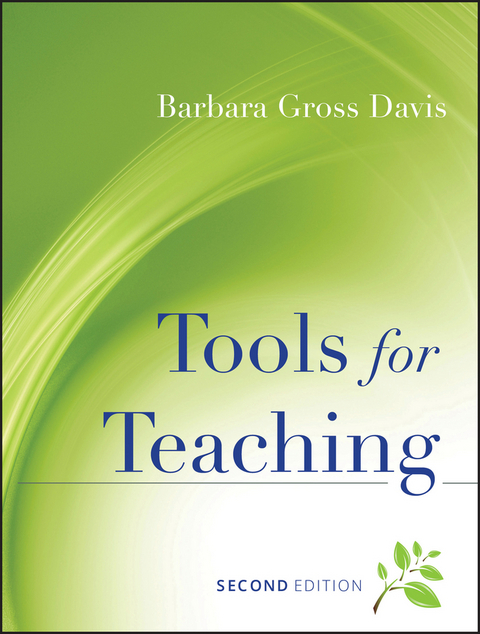
Tools for Teaching (eBook)
608 Seiten
John Wiley & Sons (Verlag)
978-0-470-56945-0 (ISBN)
THE AUTHOR Barbara Gross Davis is assistant vice provost for undergraduate education at the University of California at Berkeley. Her areas of interest include teaching, learning, and evaluation in higher education.
Preface vii
Credits xiv
The Author xv
PART I: GETTING UNDER WAY 1
1 Designing or Revising a Course 3
2 The Comprehensive Course Syllabus 21
3 The First Days of Class 37
4 Classroom Conduct and Decorum 48
PART II: RESPONDING TO A CHANGING STUDENT BODY 55
5 Diversity and Inclusion in the Classroom 57
6 Students with Disabilities 72
7 Reentry and Transfer Students 85
8 Teaching Academically Diverse Students 90
PART III: DISCUSSION STRATEGIES 95
9 Leading a Discussion 97
10 Encouraging Student Participation in Discussion 106
11 Online Discussions 112
12 Asking Questions 118
13 Fielding Students' Questions 127
PART IV: THE LARGE-ENROLLMENT COURSE 133
14 Preparing to Teach the Large-Enrollment Course 135
15 Delivering a Lecture 148
16 Explaining Clearly 157
17 Personalizing the Large-Enrollment Course 162
18 Encouraging Student Participation in the Large-Enrollment Course 168
19 Maintaining Instructional Quality with Limited Resources 174
PART V: ALTERNATIVES AND SUPPLEMENTS TO LECTURES AND DISCUSSION 179
20 Web 2.0 181
21 Learning in Groups 190
22 Informal Group Learning Activities 207
23 Formal Group Learning Activities 214
24 Case Studies 222
25 Simulations: Role Playing, Games, and Virtual Worlds 229
26 Service Learning and Civic Engagement 233
27 Undergraduate Research 244
28 Guest Speakers 251
PART VI: ENHANCING STUDENTS' LEARNING AND MOTIVATION 257
29 Helping Students Learn 259
30 Learning Styles and Preferences 273
31 Motivating Students 278
32 Informally Assessing Students' Learning 290
33 Mobile Learning 298
PART VII: STRENGTHENING STUDENTS' WRITING AND PROBLEM-SOLVING SKILLS 303
34 Helping Students Write Better in All Courses 305
35 Designing Effective Writing Assignments 314
36 Evaluating Students' Written Work 325
37 Homework: Problem Sets 335
PART VIII: TESTING AND GRADING 343
38 Promoting Academic Honesty 345
39 Quizzes, Tests, and Exams 362
40 Allaying Students' Anxieties about Tests 375
41 Multiple-Choice and Matching Tests 390
42 Short-Answer and Essay Tests 401
43 Grading Practices 409
44 Calculating and Assigning Grades 419
PART IX: PRESENTATION TECHNOLOGIES 431
45 Flipcharts 433
46 Chalkboards and Whiteboards 436
47 Interactive Whiteboards 441
48 Overhead Projection 443
49 Slide Shows 447
50 Video Recordings and Clips 450
51 PowerPoint Presentations 453
PART X: EVALUATION TO IMPROVE TEACHING 459
52 Early Feedback to Improve Teaching and Learning 461
53 Video Recordings and Classroom Observations 472
54 The Teaching Portfolio 481
PART XI: TEACHING OUTSIDE THE CLASSROOM 489
55 Holding Office Hours 491
56 E-mail, Text Messages, and Instant Messages 497
57 Academic Advising and Mentoring Undergraduates 504
58 Guiding, Training, Supervising, and Mentoring Graduate Student Instructors 517
PART XII: FINISHING UP 527
59 The Last Days of Class 529
60 Student Rating Forms 534
61 Writing Letters of Recommendation for Students 551
Index 557
"Her advice is well grounded in research and consistently reflects
best practices. Whereas some books in this area reflect the
author's experiences or received wisdom, Davis draws on recent
scholarship of teaching and learning to support her assertions.
There are many strengths to this book. First, it is helpfully
organized as a reference guide. Readers can consult chapters as
needed and do not have to read it from cover to cover. It is easy
to find targeted suggestions to enhance performance or remedy a
problem in a specific area. Moreover, Davis writes concisely and in
very practical terms. Second, Tools for Teaching is
applicable to a wide range of audiences across disciplines and
experience levels.
In sum, this updated edition of Tools for Teaching is a
thorough compendium of effective teaching practices. If I were to
select only one book to give to a colleague or graduate student to
help him or her teach, it would be this text."
--American Psychological Association PsycCritiques Vol 54,
Release 43, Article 9 (October 28, 2009)
| Erscheint lt. Verlag | 22.7.2009 |
|---|---|
| Sprache | englisch |
| Themenwelt | Geisteswissenschaften |
| Sozialwissenschaften ► Pädagogik ► Bildungstheorie | |
| Schlagworte | Bildungswesen • Education • Hochschulen / Lehren u. Lernen • Teaching & Learning (Higher Education) |
| ISBN-10 | 0-470-56945-X / 047056945X |
| ISBN-13 | 978-0-470-56945-0 / 9780470569450 |
| Informationen gemäß Produktsicherheitsverordnung (GPSR) | |
| Haben Sie eine Frage zum Produkt? |
 EPUB (Adobe DRM)
Kopierschutz: Adobe-DRM
Adobe-DRM ist ein Kopierschutz, der das eBook vor Mißbrauch schützen soll. Dabei wird das eBook bereits beim Download auf Ihre persönliche Adobe-ID autorisiert. Lesen können Sie das eBook dann nur auf den Geräten, welche ebenfalls auf Ihre Adobe-ID registriert sind.
Details zum Adobe-DRM
Dateiformat: EPUB (Electronic Publication)
EPUB ist ein offener Standard für eBooks und eignet sich besonders zur Darstellung von Belletristik und Sachbüchern. Der Fließtext wird dynamisch an die Display- und Schriftgröße angepasst. Auch für mobile Lesegeräte ist EPUB daher gut geeignet.
Systemvoraussetzungen:
PC/Mac: Mit einem PC oder Mac können Sie dieses eBook lesen. Sie benötigen eine
eReader: Dieses eBook kann mit (fast) allen eBook-Readern gelesen werden. Mit dem amazon-Kindle ist es aber nicht kompatibel.
Smartphone/Tablet: Egal ob Apple oder Android, dieses eBook können Sie lesen. Sie benötigen eine
Geräteliste und zusätzliche Hinweise
Buying eBooks from abroad
For tax law reasons we can sell eBooks just within Germany and Switzerland. Regrettably we cannot fulfill eBook-orders from other countries.
aus dem Bereich