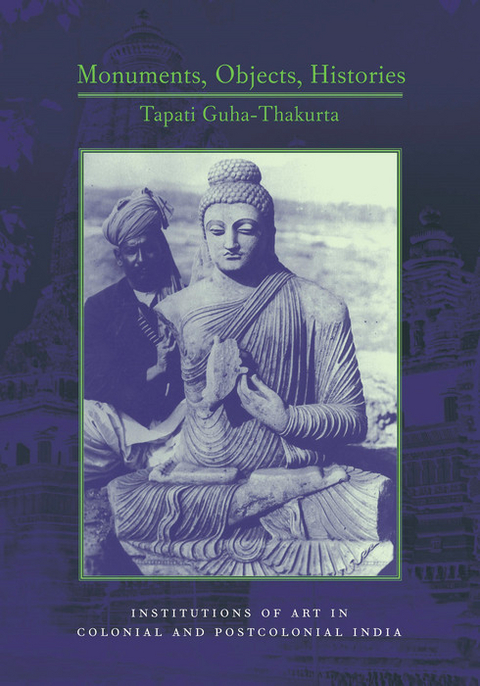
Monuments, Objects, Histories (eBook)
Columbia University Press (Verlag)
978-0-231-50351-8 (ISBN)
Tapati Guha-Thakurta is professor in history at the Centre for Studies in Social Sciences, Calcutta, The author of The Making of a New 'Indian' Art: Artists, Aesthetics, and Nationalism in Bengal, she is a specialist on the art and cultural history of modern and contemporary India.
Art history as it is largely practiced in Asia as well as in the West is a western invention. In India, works of art-sculptures, monuments, paintings-were first viewed under colonial rule as archaeological antiquities, later as architectural relics, and by the mid-20th century as works of art within an elaborate art-historical classification. Tied to these views were narratives in which the works figured, respectively, as sources from which to recover India's history, markers of a lost, antique civilization, and symbols of a nation's unique aesthetic, reflecting the progression from colonialism to nationalism. The nationalist canon continues to dominate the image of Indian art in India and abroad, and yet its uncritical acceptance of the discipline's western orthodoxies remains unquestioned, the original motives and means of creation unexplored. The book examines the role of art and art history from both an insider and outsider point of view, always revealing how the demands of nationalism have shaped the concept and meaning of art in India. The author shows how western custodianship of Indian "e;antiquities"e; structured a historical interpretation of art; how indigenous Bengali scholarship in the late 19th and early 20th centuries attempted to bring Indian art into the nationalist sphere; how the importance of art as a representation of national culture crystallized in the period after Independence; and how cultural and religious clashes in modern India have resulted in conflicting "e;histories"e; and interpretations of Indian art. In particular, the author uses the depiction of Hindu goddesses to elicit conflicting scenarios of condemnation and celebration, both of which have at their core the threat and lure of the female form, which has been constructed and narrativized in art history. Monuments, Objects, Histories is a critical survey of the practices of archaeology, art history, and museums in nineteenth- and twentieth-century India. The essays gathered here look at the processes of the production of lost pasts in modern India: pasts that come to be imagined around a growing corpus of monuments, archaeological relics, and art objects. They map the scholarly and institutional authority that emerged around such structures and artifacts, making of them not only the chosen objects of art and archaeology but also the prime signifiers of the nation's civilization and antiquity. The close imbrication of the "e;colonial"e; and the "e;national"e; in the making of India's archaeological and art historical pasts and their combined legacy for the postcolonial present form one of the key themes of the book. Monuments, Objects, Histories offers both an insider's and an outsider's perspective on the growth of these scholarly fields and their institutional apparatus, analyzing the ways they have constituted and recast their objects of study. The book moves from a period that saw the consolidation of western expertise and custodianship of India's "e;antiquities,"e; to the projection over the twentieth century of varying regional, nativist, and national claims around the country's architectural and artistic inheritance, into a current period that has pitched these objects and fields within a highly contentious politics of nationhood. Monuments, Objects, Histories traces the framing of an official national canon of Indian art through these different periods, showing how the workings of disciplines and institutions have been tied to the pervasive authority of the nation. At the same time, it addresses the radical reconfiguration in recent times of the meaning and scope of the "e;national,"e; leading to the kinds of exclusions and chauvinisms that lie at the root of the current endangerment of these disciplines and the monuments and art objects they encompass.
Tapati Guha-Thakurta is professor in history at the Centre for Studies in Social Sciences, Calcutta, The author of The Making of a New 'Indian' Art: Artists, Aesthetics, and Nationalism in Bengal, she is a specialist on the art and cultural history of modern and contemporary India.
List of IllustrationsAcknowledgmentsIntroductionPart I. The Colonial Past1. The Empire and its Antiquities: Two Pioneers and Their Scholarly Fields2.The Museum in the Colony: Conserving, Collecting, ClassifyingPart II. Regional Frames3. Interlocuting Texts and Monuments: The Coming of Sge of the 'Native' Scholar4. Between the Nation and the Region: The Locations of a Bengali Archaeologist5. Wresting the Nation's Prerogative: Art History and Nationalism in BengalPart III. National Claims6. The Demands of Independence: From a National Exhibition to a National Museum7. 'For the Greater Glory of Indian Art': Travels and Travails of a YakshiPart IV. The Embattled Present8. Art History and the Nude: On art, Obscenity, and Sexuality in Contemporary India9. Archaeology and the Monument: On Two Contentious Sites of Faith and HistoryNotesBibliographyIndex
| Erscheint lt. Verlag | 5.8.2004 |
|---|---|
| Reihe/Serie | Cultures of History | Cultures of History |
| Zusatzinfo | 132 illus |
| Verlagsort | New York |
| Sprache | englisch |
| Themenwelt | Kunst / Musik / Theater ► Allgemeines / Lexika |
| Kunst / Musik / Theater ► Kunstgeschichte / Kunststile | |
| Kunst / Musik / Theater ► Malerei / Plastik | |
| Geisteswissenschaften ► Geschichte ► Regional- / Ländergeschichte | |
| ISBN-10 | 0-231-50351-2 / 0231503512 |
| ISBN-13 | 978-0-231-50351-8 / 9780231503518 |
| Informationen gemäß Produktsicherheitsverordnung (GPSR) | |
| Haben Sie eine Frage zum Produkt? |
 PDF (Wasserzeichen)
Größe: 25,9 MB
DRM: Digitales Wasserzeichen
Dieses eBook enthält ein digitales Wasserzeichen und ist damit für Sie personalisiert. Bei einer missbräuchlichen Weitergabe des eBooks an Dritte ist eine Rückverfolgung an die Quelle möglich.
Dateiformat: PDF (Portable Document Format)
Mit einem festen Seitenlayout eignet sich die PDF besonders für Fachbücher mit Spalten, Tabellen und Abbildungen. Eine PDF kann auf fast allen Geräten angezeigt werden, ist aber für kleine Displays (Smartphone, eReader) nur eingeschränkt geeignet.
Systemvoraussetzungen:
PC/Mac: Mit einem PC oder Mac können Sie dieses eBook lesen. Sie benötigen dafür einen PDF-Viewer - z.B. den Adobe Reader oder Adobe Digital Editions.
eReader: Dieses eBook kann mit (fast) allen eBook-Readern gelesen werden. Mit dem amazon-Kindle ist es aber nicht kompatibel.
Smartphone/Tablet: Egal ob Apple oder Android, dieses eBook können Sie lesen. Sie benötigen dafür einen PDF-Viewer - z.B. die kostenlose Adobe Digital Editions-App.
Buying eBooks from abroad
For tax law reasons we can sell eBooks just within Germany and Switzerland. Regrettably we cannot fulfill eBook-orders from other countries.
 EPUB (Adobe DRM)
Kopierschutz: Adobe-DRM
Adobe-DRM ist ein Kopierschutz, der das eBook vor Mißbrauch schützen soll. Dabei wird das eBook bereits beim Download auf Ihre persönliche Adobe-ID autorisiert. Lesen können Sie das eBook dann nur auf den Geräten, welche ebenfalls auf Ihre Adobe-ID registriert sind.
Details zum Adobe-DRM
Dateiformat: EPUB (Electronic Publication)
EPUB ist ein offener Standard für eBooks und eignet sich besonders zur Darstellung von Belletristik und Sachbüchern. Der Fließtext wird dynamisch an die Display- und Schriftgröße angepasst. Auch für mobile Lesegeräte ist EPUB daher gut geeignet.
Systemvoraussetzungen:
PC/Mac: Mit einem PC oder Mac können Sie dieses eBook lesen. Sie benötigen eine
eReader: Dieses eBook kann mit (fast) allen eBook-Readern gelesen werden. Mit dem amazon-Kindle ist es aber nicht kompatibel.
Smartphone/Tablet: Egal ob Apple oder Android, dieses eBook können Sie lesen. Sie benötigen eine
Geräteliste und zusätzliche Hinweise
Buying eBooks from abroad
For tax law reasons we can sell eBooks just within Germany and Switzerland. Regrettably we cannot fulfill eBook-orders from other countries.
aus dem Bereich