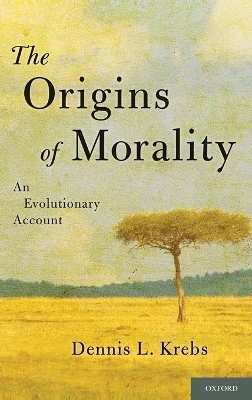
The Origins of Morality
Oxford University Press Inc (Verlag)
978-0-19-977823-2 (ISBN)
Krebs explains why the theory of evolution does not dictate that all animals are selfish and immoral by nature. On the contrary, he argues that moral behaviors and moral judgments evolved to serve certain functions. Krebs examines theory and research on the evolution of primitive forms of prosocial conduct displayed by humans and other animals, then discusses the evolution of uniquely human prosocial behaviors. He describes how a sense of morality originated during the course of human evolution through strategic social interactions among members of small groups, and how it was expanded and refined in modern societies, explaining how this sense gives rise to culturally universal and culturally relative moral norms. Krebs argues that although humans' unique cognitive abilities endow them with the capacity to engage in sophisticated forms of moral reasoning, people rarely live up their potential in their everyday lives. Four conceptions of what it means to be a moral person are identified, with the conclusion that people are naturally inclined to meet the standards of each conception under certain conditions. The key to making the world a more moral place lies in creating environments in which good guys finish first and cheaters fail to prosper.
Dennis Krebs is a Professor of Psychology, a Woodrow Wilson Fellow, and Fellow of Stanford University's Center for Advanced Study in the Behavioral Sciences. He received his MA and PhD from Harvard University, where he also taught for several years before returning to his native British Columbia to teach at Simon Fraser University. He has won university and national teaching awards, and published several books and more than 90 articles, most of which address issues of morality and altruism.
PART I: SETTING THE STAGE ; 1. Introduction and Overview ; 2. What is Morality? ; 3. Bad by Nature? ; 4. Darwin's Theory of the Origin of Morality ; 5. Foundations of a Neo-Darwinian Approach to Morality ; PART II: THE EVOLUTION OF PRIMITIVE PROSOCIAL BEHAVIORS ; 6. The Evolution of Deference ; 7. The Evolution of Self-control ; 8. The Evolution of Altruism though Sexual Selection ; 9. The Evolution of Altruism through Kin Selection ; 10. The Evolution of Altruism through Group Selection and Imperfect Design ; 11. The Evolution of Cooperation ; 12. Psychological and Neurological Sources of Primitive Prosocial Behaviors ; PART III. THE EVOLUTION OF UNIQUELY HUMAN PROSOCIAL BEHAVIORS ; 13. Uniquely Human Prosocial Behaviors ; 14. The Evolution of Uniquely Human Prosocial Behaviors ; 15. Psychological and Neurological Sources of Uniquely Human Forms of Prosocial Conduct ; PART IV. THE EVOLUTION OF THE MORAL SENSES ; 16. The Origin of the Moral Senses ; 17. The Expansion and Refinement of the Moral Senses in the Human Species ; 18. The Evolution of Moral Norms ; PART V. IMPLICATIONS AND APPLICATIONS ; 19. Human Nature and the Nature of Morality ; 20. Reframing Psychological Models of Moral Development
| Erscheint lt. Verlag | 8.9.2011 |
|---|---|
| Verlagsort | New York |
| Sprache | englisch |
| Maße | 236 x 160 mm |
| Gewicht | 612 g |
| Themenwelt | Geisteswissenschaften ► Philosophie ► Ethik |
| Geisteswissenschaften ► Psychologie ► Allgemeine Psychologie | |
| Geisteswissenschaften ► Psychologie ► Entwicklungspsychologie | |
| Geisteswissenschaften ► Psychologie ► Sozialpsychologie | |
| Geisteswissenschaften ► Psychologie ► Verhaltenstherapie | |
| ISBN-10 | 0-19-977823-X / 019977823X |
| ISBN-13 | 978-0-19-977823-2 / 9780199778232 |
| Zustand | Neuware |
| Informationen gemäß Produktsicherheitsverordnung (GPSR) | |
| Haben Sie eine Frage zum Produkt? |
aus dem Bereich