


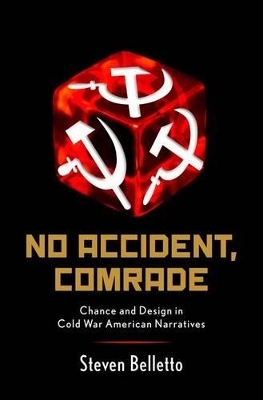
No Accident, Comrade
Chance and Design in Cold War American Narratives
Seiten
2012
Oxford University Press Inc (Verlag)
978-0-19-982688-9 (ISBN)
Oxford University Press Inc (Verlag)
978-0-19-982688-9 (ISBN)
Drawing on novels by Nabokov, Wright, Powers, DeLillo, Didion, and others, No Accident, Comrade examines the shaping influence of the Cold War's obsession with chance on post-World War II fictional form.
No Accident, Comrade argues that chance became a complex yet conflicted cultural signifier during the Cold War, when a range of thinkers--politicians, novelists, historians, biologists, sociologists, and others--contended that totalitarianism denied the very existence and operation of chance in the world. This contention often worked by claiming that the Soviet system perpetrated a vast fiction on its population, a fiction made visible by the Soviet view that there is no such thing as chance or accident, only manifestations of historical law (hence the refrain from which the title is taken: 'It was no accident, Comrade,' which encapsulates a popular American understanding of Marxism).
By reading a wide swath of the era's novels, Steven Belletto explains how the association of chance with democratic freedom and the denial of chance with totalitarianism circulated in Cold War culture. He shows how writers innovated strategies for dealing with and incorporating chance, which allowed them to theorize the ever-changing relationship between the individual and the state during a largely rhetorical conflict. Indeed, by emphasizing the Cold War's narrative quality--that is, by viewing it as a rhetorical field--this book likewise argues that pressure was put on fictional narratives in general, and that if we attune ourselves to the uses of chance in such material, we can understand how the Cold War encouraged new relationships between aesthetics and politics.
No Accident, Comrade argues that chance became a complex yet conflicted cultural signifier during the Cold War, when a range of thinkers--politicians, novelists, historians, biologists, sociologists, and others--contended that totalitarianism denied the very existence and operation of chance in the world. This contention often worked by claiming that the Soviet system perpetrated a vast fiction on its population, a fiction made visible by the Soviet view that there is no such thing as chance or accident, only manifestations of historical law (hence the refrain from which the title is taken: 'It was no accident, Comrade,' which encapsulates a popular American understanding of Marxism).
By reading a wide swath of the era's novels, Steven Belletto explains how the association of chance with democratic freedom and the denial of chance with totalitarianism circulated in Cold War culture. He shows how writers innovated strategies for dealing with and incorporating chance, which allowed them to theorize the ever-changing relationship between the individual and the state during a largely rhetorical conflict. Indeed, by emphasizing the Cold War's narrative quality--that is, by viewing it as a rhetorical field--this book likewise argues that pressure was put on fictional narratives in general, and that if we attune ourselves to the uses of chance in such material, we can understand how the Cold War encouraged new relationships between aesthetics and politics.
Steven Belletto is Assistant Professor of English and chair of the American Studies program at Lafayette College.
Chapter One: Chance, Narrative, and the Logic of the Cold War ; Chapter Two: Aesthetic Responses to Political Fictions: Pynchon and the ; Violence of Narrative Chance ; Chapter Three: The Zemblan Who Came in from the Cold: Nabokov's Cold War ; Chapter Four: Accidents Going Somewhere to Happen: African-American ; Self-Definition at Mid-Century ; Chapter Five: The Game Theory Narrative and the Myth of the ; National Security State ; Chapter Six: Their Country, Our Culture: The Persistence of the Cold War ; Coda: Cold War Meaning ; Bibliography ; Index
| Erscheint lt. Verlag | 26.1.2012 |
|---|---|
| Zusatzinfo | 4 illustrations |
| Verlagsort | New York |
| Sprache | englisch |
| Maße | 239 x 160 mm |
| Gewicht | 431 g |
| Themenwelt | Geschichte ► Allgemeine Geschichte ► Zeitgeschichte |
| Geisteswissenschaften ► Sprach- / Literaturwissenschaft ► Anglistik / Amerikanistik | |
| Geisteswissenschaften ► Sprach- / Literaturwissenschaft ► Literaturwissenschaft | |
| ISBN-10 | 0-19-982688-9 / 0199826889 |
| ISBN-13 | 978-0-19-982688-9 / 9780199826889 |
| Zustand | Neuware |
| Informationen gemäß Produktsicherheitsverordnung (GPSR) | |
| Haben Sie eine Frage zum Produkt? |
Mehr entdecken
aus dem Bereich



aus dem Bereich
eine Deutschlandreise im Jahr 1958
Buch | Hardcover (2024)
C.H.Beck (Verlag)
CHF 29,90
der Osten, der Westen, der Zorn und das Glück
Buch | Hardcover (2024)
S. Fischer (Verlag)
CHF 36,40


