


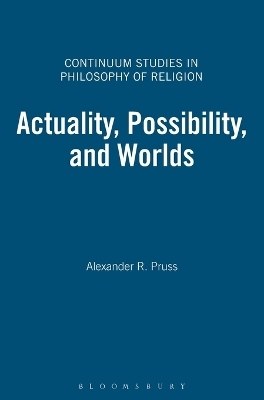
Actuality, Possibility, and Worlds
Seiten
2011
Continuum Publishing Corporation (Verlag)
9781441145161 (ISBN)
Continuum Publishing Corporation (Verlag)
9781441145161 (ISBN)
An exploration of the Aristotelian account that sees possibilities as grounded in causal powers. It surveys a number of historical approaches and argues that logicist approaches to possibility are implausible.
This is an original exploration of the philosophical arguments for and against the possibility of other worlds. "Actuality, Possibility and Worlds" is an exploration of the Aristotelian account that sees possibilities as grounded in causal powers. On his way to that account, Pruss surveys a number of historical approaches and argues that logicist approaches to possibility are implausible. The notion of possible worlds appears to be useful for many purposes, such as the analysis of counterfactuals or elucidating the nature of propositions and properties. This usefulness of possible worlds makes for a second general question: Are there any possible worlds and, if so, what are they? Are they concrete universes as David Lewis thinks, Platonic abstracta as per Robert M. Adams and Alvin Plantinga, or maybe linguistic or mathematical constructs such as Heller thinks? Or is perhaps Leibniz right in thinking that possibilia are not on par with actualities and that abstracta can only exist in a mind, so that possible worlds are ideas in the mind of God?
"Continuum Studies in Philosophy of Religion" presents scholarly monographs offering cutting-edge research and debate to students and scholars in philosophy of religion. The series engages with the central questions and issues within the field, including the problem of evil, the cosmological, teleological, moral, and ontological arguments for the existence of God, divine foreknowledge, and the coherence of theism. It also incorporates volumes on the following metaphysical issues as and when they directly impact on the philosophy of religion: the existence and nature of the soul, the existence and nature of free will, natural law, the meaning of life, and science and religion.
This is an original exploration of the philosophical arguments for and against the possibility of other worlds. "Actuality, Possibility and Worlds" is an exploration of the Aristotelian account that sees possibilities as grounded in causal powers. On his way to that account, Pruss surveys a number of historical approaches and argues that logicist approaches to possibility are implausible. The notion of possible worlds appears to be useful for many purposes, such as the analysis of counterfactuals or elucidating the nature of propositions and properties. This usefulness of possible worlds makes for a second general question: Are there any possible worlds and, if so, what are they? Are they concrete universes as David Lewis thinks, Platonic abstracta as per Robert M. Adams and Alvin Plantinga, or maybe linguistic or mathematical constructs such as Heller thinks? Or is perhaps Leibniz right in thinking that possibilia are not on par with actualities and that abstracta can only exist in a mind, so that possible worlds are ideas in the mind of God?
"Continuum Studies in Philosophy of Religion" presents scholarly monographs offering cutting-edge research and debate to students and scholars in philosophy of religion. The series engages with the central questions and issues within the field, including the problem of evil, the cosmological, teleological, moral, and ontological arguments for the existence of God, divine foreknowledge, and the coherence of theism. It also incorporates volumes on the following metaphysical issues as and when they directly impact on the philosophy of religion: the existence and nature of the soul, the existence and nature of free will, natural law, the meaning of life, and science and religion.
Alexander R. Pruss is Associate Professor of Philosophy at Baylor University, TX, USA. He has PhDs in both Philosophy as well as Mathematics and is the author of The Principle of Sufficient Reason: A Reassessment (CUP, 2006) and co-editor, with Richard M. Gale, of The Existence of God (Ashgate, 2003).
Preface; Part I. Introduction; Part II. Applications and pseudo-applications; Part III. The Lewisian ontology of extreme modal realism; Part IV. Platonic ersatz ontologies; Part V. Sketches towards a Spinozistic-Tractarian account of modality. Part VI. Aristotelian-Leibnizian ontology; Part VII. Final conclusions; Bibliography.
| Erscheint lt. Verlag | 21.7.2011 |
|---|---|
| Reihe/Serie | Continuum Studies in Philosophy of Religion |
| Verlagsort | New York |
| Sprache | englisch |
| Maße | 156 x 234 mm |
| Themenwelt | Geisteswissenschaften ► Philosophie ► Metaphysik / Ontologie |
| Geisteswissenschaften ► Religion / Theologie | |
| ISBN-13 | 9781441145161 / 9781441145161 |
| Zustand | Neuware |
| Informationen gemäß Produktsicherheitsverordnung (GPSR) | |
| Haben Sie eine Frage zum Produkt? |
Mehr entdecken
aus dem Bereich


aus dem Bereich
eine philosophische Reise
Buch | Softcover (2024)
Goldmann (Verlag)
CHF 21,90


