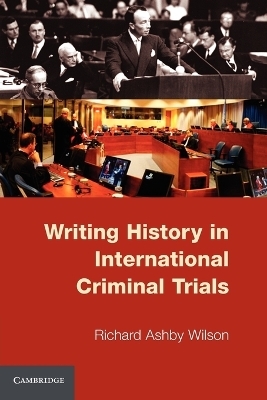
Writing History in International Criminal Trials
Cambridge University Press (Verlag)
978-0-521-13831-4 (ISBN)
Why do international criminal tribunals write histories of the origins and causes of armed conflicts? Richard Ashby Wilson conducted research with judges, prosecutors, defense attorneys and expert witnesses in three international criminal tribunals to understand how law and history are combined in the courtroom. Historical testimony is now an integral part of international trials, with prosecutors and defense teams using background testimony to pursue decidedly legal objectives. In the Slobodan Milošević trial, the prosecution sought to demonstrate special intent to commit genocide by reference to a long-standing animus, nurtured within a nationalist mindset. For their part, the defense called historical witnesses to undermine charges of superior responsibility, and to mitigate the sentence by representing crimes as reprisals. Although legal ways of knowing are distinct from those of history, the two are effectively combined in international trials in a way that challenges us to rethink the relationship between law and history.
Richard Ashby Wilson is Gladstein Distinguished Chair of Human Rights, Professor of Anthropology and Law, and Director of the Human Rights Institute, at the University of Connecticut. He is the author of The Politics of Truth and Reconciliation in South Africa (2001) and editor or co-editor of six books, including Culture and Rights, Human Rights and the 'War on Terror' and Humanitarianism and Suffering. He has held a fellowship from the National Endowment for the Humanities (2009–10) and has been a Visiting Professor at the University of Oslo, the New School for Social Research and the University of the Witwatersrand. Presently he serves as Chair of the State Advisory Committee for the US Civil Rights Commission.
1. Assessing court histories of mass crimes; 2. What does the 'international' actually mean for international criminal trials?; 3. Contrasting evidence: international and common law approaches to expert testimony; 4. Does history have any legal relevance in international criminal trials?; 5. From monumental history to micro-histories; 6. Exoneration and mitigation in defense histories; 7. Misjudging Rwandan society and history at the international criminal tribunal for Rwanda; 8. Permanent justice: the international criminal court; 9. Conclusion: new directions in international criminal trials.
| Zusatzinfo | 2 Tables, unspecified; 8 Line drawings, unspecified |
|---|---|
| Verlagsort | Cambridge |
| Sprache | englisch |
| Maße | 152 x 229 mm |
| Gewicht | 490 g |
| Themenwelt | Geschichte ► Allgemeine Geschichte ► Zeitgeschichte |
| Recht / Steuern ► EU / Internationales Recht | |
| Recht / Steuern ► Öffentliches Recht ► Völkerrecht | |
| Schlagworte | UN-Kriegsverbrechertribunal Den Haag |
| ISBN-10 | 0-521-13831-0 / 0521138310 |
| ISBN-13 | 978-0-521-13831-4 / 9780521138314 |
| Zustand | Neuware |
| Informationen gemäß Produktsicherheitsverordnung (GPSR) | |
| Haben Sie eine Frage zum Produkt? |
aus dem Bereich