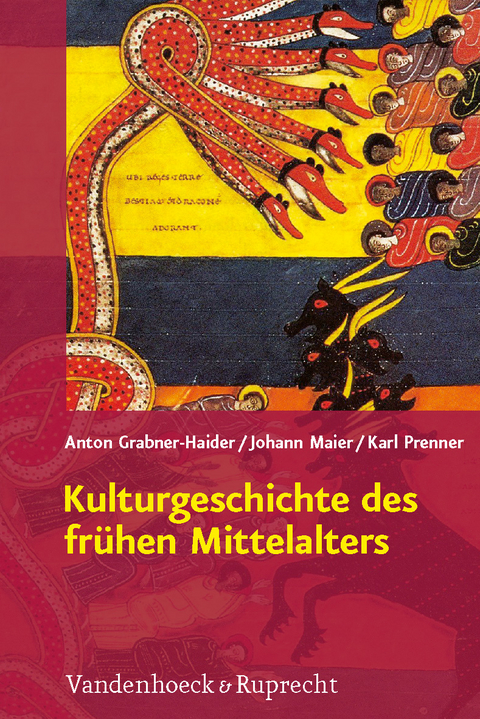
Kulturgeschichte des frühen Mittelalters
Vandenhoeck & Ruprecht (Verlag)
978-3-525-54006-0 (ISBN)
The authors provide a broad overview of the culture and world of the Late Middle Ages (1200-1500 AD) throughout all of Europe. To this end they lean on the pragmatic philosophy of W. James to R. Rorty, who provide many models and interpretations in the context of concrete "ways of life" and "living environment."Grabner-Haider introduces the reader to the world and social processes of this era, including matters of trade relations, worklife, economics and the gender relationships of that time. Besides the political developments in Middle Europe, in England and France as well as in Northern, Southern and Eastern Europe, he also takes a closer look at the religious beliefs of the day, the lives of the mendicant orders, clerical power, the teachings of the Church Councils and the religious beliefs of the day.On the other hand, we also learn about the teachings of the theologians and philosophers at the universities, the concepts of the humanists and the renaissance of ancient thought. Grabner-Haider describes the conflicts between Jews, Christians and Moslems, the development of the natural sciences, medicine, mathematics and astronomy.The volume deals extensively with life under Byzantine rule, the expansion the Ottoman Empire, the role of the Greek-Orthodox Church in Southern Italy and the developments occurring in Russia of that day. It recalls the dark sides of Christianity, the persecution of the "heretics," the many forms of inquisition and the resistance to church reform.Johann Maier is concerned with the culture and world of the Jews in Europe and in the Islamic countries, their religious and cult teachings and theological tenets. Karl Prenner looks at the culture and life of the Moslems in the Arab and Persian worlds, their exchange with the Jews and Chrisians in Spain, their theological and philosophical teachings, the schools of laws as well as the forms of rule they established. There is also an informative timeline, a list of important secondary literature as well as a person index at the end of the volume.
Dr. theol. Dr. phil. Anton Grabner-Haider ist Professor für Religionsphilosophie an der Universität Graz.
Dr. phil. Johann Maier ist Professor em. für Judaistik an der Universität Köln.
Dr. theol. Karl Prenner ist Professor für Religionswissenschaft an der Universität Graz.
Anton Grabner-Haider, geb. 1940, Studium der katholischen und der evangelischen Theologie und der Philosophie in Graz, Tübingen, Bonn, Wien
This volume discloses new approaches to former eras of history. The authors bring out the multiple cultural phenomena, the economical conditions and the structures of social and common life in the times from 500 to 1200 B.C. Grabner-Haider, Maier and Prenner trace not only the former time religious ideas and orientations, the moral goals and destinations but the theological and the philosophical teachings, the knowledge of nature, life and death.Reading about the life of monastery, the life of warriors and knights, the encounter with the moslemic and the Jewish culture, the remainder of celtic, german and slavic mythology a former period of history becomes visible and intelligible for us today.>
| Erscheint lt. Verlag | 18.2.2010 |
|---|---|
| Verlagsort | Göttingen |
| Sprache | deutsch |
| Maße | 200 x 237 mm |
| Gewicht | 625 g |
| Themenwelt | Religion / Theologie ► Christentum ► Kirchengeschichte |
| Schlagworte | Christentum • Frühmittelalter; Geistes-/Kultur-Geschichte • Geistes- und Kulturgeschichte • Kulturgeschichte |
| ISBN-10 | 3-525-54006-X / 352554006X |
| ISBN-13 | 978-3-525-54006-0 / 9783525540060 |
| Zustand | Neuware |
| Informationen gemäß Produktsicherheitsverordnung (GPSR) | |
| Haben Sie eine Frage zum Produkt? |
aus dem Bereich