


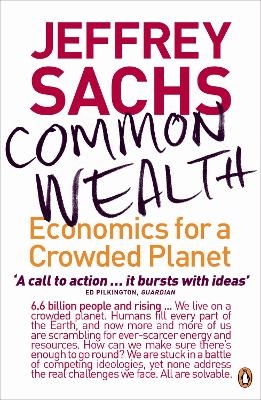
Common Wealth
Economics for a Crowded Planet
Seiten
2009
Penguin Books Ltd (Verlag)
978-0-14-102615-2 (ISBN)
Penguin Books Ltd (Verlag)
978-0-14-102615-2 (ISBN)
Tells about how we should address the great, and interconnected, global challenges of the twenty-first century. This book shows that there are different ways of managing the world's technology, resources and politics from those being followed.
This is a book about how we should address the great, and interconnected, global challenges of the twenty-first century. Our task, Sachs argues, is to achieve truly sustainable development, by which he means finding a global course which enables the world to benefit from the spread of prosperity while ensuring that we don't destroy the eco-systems which keep us alive and our place in nature which helps sustain our values. How do we move forward together, benefitting from our increasing technological mastery, avoiding the terrible dangers of climate change, mass famines, violent conflicts, population explosions in some parts of the world and collapses in others, and world-wide pandemic diseases?
In answering these questions, Sachs shows that there are different ways of managing the world's technology, resources and politics from those currently being followed, and that it should be possible to adopt policies which reflect long-term and co-operative thinking instead of, as currently, disregard for others and ever-increasing barriers to solving the problems which we collectively face. It is a book which appeals equally to both head and heart, and one which no globally thinking person can ignore.
This is a book about how we should address the great, and interconnected, global challenges of the twenty-first century. Our task, Sachs argues, is to achieve truly sustainable development, by which he means finding a global course which enables the world to benefit from the spread of prosperity while ensuring that we don't destroy the eco-systems which keep us alive and our place in nature which helps sustain our values. How do we move forward together, benefitting from our increasing technological mastery, avoiding the terrible dangers of climate change, mass famines, violent conflicts, population explosions in some parts of the world and collapses in others, and world-wide pandemic diseases?
In answering these questions, Sachs shows that there are different ways of managing the world's technology, resources and politics from those currently being followed, and that it should be possible to adopt policies which reflect long-term and co-operative thinking instead of, as currently, disregard for others and ever-increasing barriers to solving the problems which we collectively face. It is a book which appeals equally to both head and heart, and one which no globally thinking person can ignore.
Jeffrey D. Sachs is Director of the Earth Institute at Columbia University, the Quetelet Professor of Sustainable Development and the global best-selling author of The End of Poverty. He is also the BBC's Reith Lecturer for 2007 and is internationally renowned for his work as an economic advisor to governments around the world.
| Erscheint lt. Verlag | 26.3.2009 |
|---|---|
| Verlagsort | London |
| Sprache | englisch |
| Maße | 129 x 198 mm |
| Gewicht | 307 g |
| Themenwelt | Sozialwissenschaften ► Politik / Verwaltung |
| Wirtschaft ► Volkswirtschaftslehre ► Makroökonomie | |
| ISBN-10 | 0-14-102615-4 / 0141026154 |
| ISBN-13 | 978-0-14-102615-2 / 9780141026152 |
| Zustand | Neuware |
| Informationen gemäß Produktsicherheitsverordnung (GPSR) | |
| Haben Sie eine Frage zum Produkt? |
Mehr entdecken
aus dem Bereich

aus dem Bereich
Buch | Softcover (2024)
Schäffer-Poeschel (Verlag)
CHF 48,95
Makroökonomie, Wirtschaftspolitik und nachhaltige Entwicklung
Buch | Hardcover (2022)
Vahlen (Verlag)
CHF 69,70
Kontroversen, Daten und Fakten zur Nachhaltigkeit
Buch | Softcover (2025)
Kohlhammer (Verlag)
CHF 54,60


