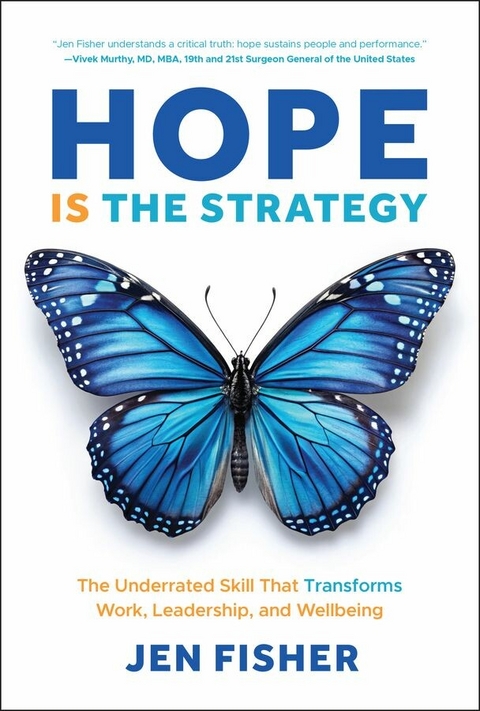
Hope Is the Strategy (eBook)
197 Seiten
Wiley (Verlag)
978-1-394-36298-1 (ISBN)
'Too many workplaces are filled with fear, sadness, and exhaustion. Jen Fisher is here to change that-her book is full of actionable ideas for fighting burnout, restoring energy, and building hope.'
-Adam Grant, #1 New York Times bestselling author of HIDDEN POTENTIAL and THINK AGAIN, and host of the podcast Re:Thinking
A new approach for organizations to structure and support human flourishing in the workplace
In Hope Is the Strategy: The Underrated Skill That Transforms Work, Leadership, and Wellbeing, bestselling author and leader in the corporate wellbeing movement Jen Fisher shows how the future of work demands a fundamentally new approach to how we think about, structure, and support human flourishing in the workplace.
Drawing on Fisher's personal experience with burnout and the resulting insights that fueled a corporate shift, her conversations with thought leaders across different industries, and the research, frameworks, and methodologies she put into place as one of the world's first Chief Wellbeing Officers, this book delivers exclusive, hard-won insights to understand what truly needs to change in how we work and demonstrates how we will all benefit from this new paradigm. Fisher reveals how hope-not as wishful thinking but as a practical, learnable skill-provides the foundation for sustainable performance, meaningful innovation, and authentic leadership in an uncertain world.
In this book, readers will learn about:
- Wellness programs that treat symptoms rather than causes
- Leadership practices that prioritize short-term performance over long-term sustainability
- Organizational systems that unintentionally create burnout while trying to prevent it
Hope Is the Strategy is an inspirational call to action for all individuals, leaders, and organizations to reimagine every aspect of work with human wellbeing at the center.
JEN FISHER is a global authority on workplace wellbeing, bestselling author, and founder and CEO of The Wellbeing Team. As Deloitte's first Chief Wellbeing Officer, she pioneered groundbreaking approaches to human-centered work that gained national recognition. She hosts The WorkWell Podcast, is a TEDx speaker, and has contributed to Harvard Business Review, Fortune, and CNN.
Chapter 1
Perfect on Paper
There I was again—face illuminated by the blue glow of my laptop screen in the darkness of my living room. The house was silent, my husband asleep. I wasn't working because of a deadline or crisis. I was working because I didn't know how not to. In that ordinary moment, the truth presented itself: I was addicted to work.
For much of my career, I chased the high of “inbox zero” like others might chase their next fix. The euphoria of clearing my task list, the surge of meeting an impossible deadline, the warm glow of another late‐night “great work” email from my boss—these were my drugs of choice.
The withdrawal symptoms were real. Empty calendar blocks would trigger anxiety that I couldn't explain. Vacation days bred a restlessness that no amount of beach time could soothe. Even sleep became a productivity metric—how little could I get by on and still function? I tracked my sleep efficiency the way I tracked my project milestones.
Like any powerful drug, work had become both my high and my alibi. It had legitimate social currency, with the glossy veneer of “hustle culture” and “dedication.” It was an addiction I proudly displayed on my résumé—the one that earned me promotions and LinkedIn endorsements. It made my parents proud and my peers envious. (It's not lost on me now that society celebrates work addiction while ostracizing those with substance dependencies. Both addictions can wreck relationships, as well as physical and emotional health, but substance addiction escalates further—often pushing people to the margins of society.)
And like any addict, I needed increasingly larger doses to feel the same satisfaction. Last quarter's achievements became this quarter's baseline. Goals that once seemed ambitious became merely acceptable. I was running faster just to feel like I wasn't falling behind.
The language of legitimacy became my native tongue. I wasn't addicted—I was “passionate.” I wasn't compulsive—I was “committed.” I wasn't running from my fears—I was “driven.” Each rationalization was reinforced by a culture that confused busyness with importance and output with worth.
But all the while, my identity slowly merged with my output. I became what I produced, measured in deliverables and metrics and quarterly reviews. The space for creativity shrank. Play became inefficient. Spontaneity felt like a productivity leak to be patched.
The true price of my addiction revealed itself in the quiet moments—the few that remained. It was in the missed dinners with friends, explained away with “deadlines.” In the vacations spent half‐present, with one eye always on my phone. In the conversations where I nodded along, my mind already drafting tomorrow's to‐do list.
The Language of Burnout
The World Health Organization (WHO) recognizes burnout as an “occupational phenomenon.” While we often casually use “burnout” to describe temporary fatigue or decision overload, this book addresses the specific, severe experience of work burnout: the condition that develops when you've repeatedly ignored physical and emotional warning signs that something serious is wrong. If burnout is the condition, depletion is a key symptom, and languishing describes the process of becoming depleted. Importantly, burnout reflects your relationship with work, while rock bottom reveals your relationship with yourself. Throughout this book, I'll help you recognize these experiences in yourself and others and offer practical strategies to eliminate them from your life.
This Isn't Just Another Burnout Story
This book isn't about how I crashed and burned (though I did) and then picked myself up and got right back to the grind, fully recovered and ready to conquer the same world that wore me down. This isn't a memoir of personal restoration or a guide to bouncing back stronger. It's a manifesto for transformation—of how we think about work, how we structure organizations, and how we measure success. The old models are breaking down not because we're failing them but because they're failing us. It's time to build something better.
Our current system of work reinforces and celebrates the wrong things. It rewards you for staying up until 4 a.m. working on a project. Yesterday's high performance becomes today's expectation—and now we need you to stay up every night. The more you go over the top to get the job done, the more it is expected. C‐suite leaders brag about sleeping under their desks, declare the 80‐hour workweek a reasonable goal, and assert that every person and every organization can (and should) do more and achieve more.
Traditional leadership still operates from an industrial‐era playbook: hierarchical structures, command‐and‐control mentalities, and success measured primarily through productivity and growth metrics. We talk about “human resources” as if people were raw materials to be utilized rather than living systems to be nurtured. When problems arise, we respond with more management, more metrics, more pressure.
Work breeds competition, not collaboration. Society tells us that success is defined by your title, your salary, how many people you manage, and how much money you make for your company. We live in a society of “more:” if I'm making more money, I can get a better car, a bigger house, nicer vacations… . All of that feels really good—until you see someone else who has even more.
The underlying message is that what we have is never enough. Who we are is never enough. When we meet new people, we introduce ourselves by sharing what we do for a living. That's not who we are; it's what we do. We represent as if we are our jobs.
When I hit bottom, it wasn't a failure—it was my first moment of seeing clearly. And what I saw is that real strength doesn't come from an abundance of resilience or grit or pushing through…it comes from hope.
We think burnout is about exhaustion, but again and again, research shows it's actually about hopelessness. Researchers have examined the association between hopelessness and job burnout among nurses,1 in police officers,2 and in public school teachers.3
As hopelessness increases, so does the chance of burnout.4 When we measure burnout, we're really measuring the absence of hope. This means the solution isn't rest (though that matters, a lot)—it's learning to build sustainable hope as a practical, measurable skill set.
And while hope can help with individual burnout, the bigger problem is our collective “gray zone.” It's a term coined by sociologist Corey Keyes5 to describe the space between functioning and flourishing, between “fine” and fully alive. Traditional wellbeing approaches remain largely individualized and reactive. We offer meditation apps and wellness programs while maintaining the very systems that cause the distress. We teach resilience techniques that help people endure broken structures rather than transforming those structures. We treat burnout as a personal failing rather than a systemic inevitability. We prescribe self‐care while demanding self‐sacrifice.
In a world of polycrisis—where every challenge compounds every other challenge—traditional approaches to both leadership and wellbeing are like bringing matches to a flood. Hope isn't just nice to have; it's the lifeboat we need to navigate what's coming.
Here's the real takeaway of my burnout story and every other one you've ever heard about or lived through: we need to move away from this system of work that creates burnout and fundamentally transform how we think about leadership, wellbeing, and hope.
Breakdown in the Corner Office
My experience with corporate burnout earned me both the scars and firsthand insights to understand what truly needs to change in how we work. It led me to my role as the first chief wellbeing officer (CWBO) in the professional services industry—if not the corporate world in general—where I built my organization's wellbeing strategy from the ground up, embedding it in a culture not typically known to prioritize workplace wellness.
Along the way, I witnessed the limitations of traditional approaches to workplace wellbeing. The wellness programs that treat symptoms rather than causes, the leadership practices that prioritize short‐term performance over long‐term sustainability, the organizational systems that unintentionally create burnout while trying to prevent it—none of those things are serving us as individuals, as organizations, or as communities.
The metaphorical race to the corner office is a false start. The competition of success and traditional thinking around what's important cause the breakdown of work, rather than increasing productivity or creating sustainable success.
It's time to rethink the idea that the corner office—and all the “perks” that come with it—is the ultimate marker of success. This symbol of achievement doesn't elevate us; it depletes us. And when enough individuals falter under the weight, entire organizations and industries eventually...
| Erscheint lt. Verlag | 13.1.2026 |
|---|---|
| Sprache | englisch |
| Themenwelt | Wirtschaft ► Betriebswirtschaft / Management |
| Schlagworte | Employee burnout • employee happiness • Employee Retention • Employee Satisfaction • employee wellbeing • employee wellness • Hope • leadership development • work leadership • workplace culture • workplace satisfaction • workplace transformation |
| ISBN-10 | 1-394-36298-6 / 1394362986 |
| ISBN-13 | 978-1-394-36298-1 / 9781394362981 |
| Informationen gemäß Produktsicherheitsverordnung (GPSR) | |
| Haben Sie eine Frage zum Produkt? |
 EPUB (Adobe DRM)
Kopierschutz: Adobe-DRM
Adobe-DRM ist ein Kopierschutz, der das eBook vor Mißbrauch schützen soll. Dabei wird das eBook bereits beim Download auf Ihre persönliche Adobe-ID autorisiert. Lesen können Sie das eBook dann nur auf den Geräten, welche ebenfalls auf Ihre Adobe-ID registriert sind.
Details zum Adobe-DRM
Dateiformat: EPUB (Electronic Publication)
EPUB ist ein offener Standard für eBooks und eignet sich besonders zur Darstellung von Belletristik und Sachbüchern. Der Fließtext wird dynamisch an die Display- und Schriftgröße angepasst. Auch für mobile Lesegeräte ist EPUB daher gut geeignet.
Systemvoraussetzungen:
PC/Mac: Mit einem PC oder Mac können Sie dieses eBook lesen. Sie benötigen eine
eReader: Dieses eBook kann mit (fast) allen eBook-Readern gelesen werden. Mit dem amazon-Kindle ist es aber nicht kompatibel.
Smartphone/Tablet: Egal ob Apple oder Android, dieses eBook können Sie lesen. Sie benötigen eine
Geräteliste und zusätzliche Hinweise
Buying eBooks from abroad
For tax law reasons we can sell eBooks just within Germany and Switzerland. Regrettably we cannot fulfill eBook-orders from other countries.
aus dem Bereich