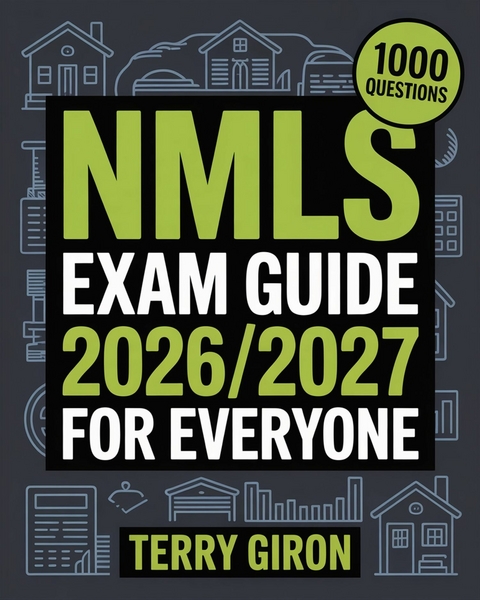
NMLS Exam Guide 2026/2027 for Everyone (eBook)
235 Seiten
Publishdrive (Verlag)
978-0-00-113810-0 (ISBN)
The NMLS Exam Guide 2026/2027 for Everyone is a structured study resource designed to support individuals preparing for the Nationwide Multistate Licensing System (NMLS) Mortgage Loan Originator examination. This guide presents essential mortgage lending concepts and exam-relevant material in a clear, organized format suitable for learners at all levels of experience.
The content focuses on key subject areas commonly tested on the NMLS exam, including federal mortgage-related laws, general mortgage knowledge, ethics, fraud prevention, consumer protection, loan origination activities, underwriting basics, and professional standards of conduct. Explanations emphasize comprehension, regulatory awareness, and practical application to help candidates understand both the legal framework and day-to-day responsibilities of a mortgage loan originator.
Designed for Everyone-including aspiring mortgage loan originators, finance professionals, real estate practitioners, and individuals entering the mortgage industry-this guide serves as a comprehensive review and structured reference to help learners organize their study, reinforce foundational knowledge, and approach the NMLS exam with confidence and clarity.
Disclaimer: This exam guide is an independent educational resource created for general exam preparation purposes. It is not affiliated with, endorsed by, or sponsored by the Nationwide Multistate Licensing System (NMLS), the Conference of State Bank Supervisors (CSBS), the American Association of Residential Mortgage Regulators (AARMR), or any regulatory authority. All references are used solely for educational purposes.
Chapter 2 — Federal Mortgage-Related Laws (Exam Topic Area)
Key federal statutes and regulations (RESPA, TILA/TRID, ECOA, HMDA, SAFE Act foundations)
- Explain how RESPA’s definition of “affiliated business arrangement” affects required disclosures when a lender refers a borrower to an affiliated settlement service provider, and describe the timing and content of the disclosure obligations.
- Discuss the tolerance categories under TILA/TRID for disclosed charges on a closed-end consumer mortgage and analyze how an originator should handle a discovered tolerance violation after closing.
- Describe the circumstances under which a creditor must re-disclose a Loan Estimate under TRID, and explain the legal consequences if re-disclosure deadlines are not met.
- Compare and contrast ECOA’s rules on permissible inquiries about marital status and the limitations imposed on spousal liabilities, including the effect on underwriting deliberations.
- Outline HMDA’s reporting obligations for a bank with both covered and exempt branches, including how to determine which loans must be reported and how to treat loans originated by partnerships.
- Explain how the SAFE Act’s licensing standard for background checks and education interact with state-specific testing or continuing education requirements, including potential conflicts.
- Analyze a scenario where multiple payments to a mortgage broker could constitute a kickback under RESPA Section 8, and describe what facts would support a prosecution or enforcement action.
- Define the “finance charge” under TILA and explain how packaging of fees (e.g., points, origination fees, third-party charges) can change the APR calculation and the disclosure obligations.
- Explain how HMDA’s race, ethnicity, and sex data collection rules interact with ECOA’s prohibition on discriminatory treatment; discuss permitted uses and prohibited uses of the collected data.
- Discuss how the tolerance and accuracy rules for the Closing Disclosure operate when a seller credit reduces borrower costs, including timing of adjustments and who bears responsibility for reconciling differences.
- Describe the “kickback” and “split fee” prohibitions of RESPA and evaluate whether a paying arrangement for marketing services between a title company and a real estate agent violates RESPA.
- Explain the rescission rights under TILA for a refinance of a primary dwelling secured by a consumer’s principal dwelling, detailing who has rescission rights, how they are exercised, and exceptions to rescission.
- Analyze the safe-harbor and timing rules for the initial Loan Estimate delivery under TRID when an application is received with incomplete information and multiple creditor offices are involved.
- Describe how ECOA’s appraisal notice requirements and valuation disclosure obligations protect applicants, and explain what corrective measures a creditor must take after discovering a discriminatory appraisal.
- Explain the limitations that HMDA imposes on the timing and content of public disclosure of loan application registers (LARs), and how institutions should handle inaccuracies discovered after public disclosure.
- Discuss the role of consent orders and informal enforcement mechanisms under the SAFE Act when a licensee has minor violations versus willful misconduct.
- Evaluate the legal treatment of assumed mortgages under RESPA and TILA, focusing on disclosure requirements and when a new Loan Estimate or Closing Disclosure is required.
- Explain how creditors must treat state escrow and impound requirements under TRID when calculating loan disclosure items for the Loan Estimate and Closing Disclosure.
- Analyze how ECOA’s adverse action notice requirements operate when a credit decision is based in part on information obtained from a third-party automated underwriting system.
- Discuss HMDA’s coverage thresholds for small-volume lenders and how a de novo bank should determine whether it meets the threshold for reporting in the first two years.
- Explain the interplay between RESPA Section 6 (escrow accounts) and state law limitations on escrow amounts, including annual accounting and the 2-month cushion rules.
- Describe the conditions under which a creditor must provide a revised Closing Disclosure that cures an inaccurate disclosure of APR and explain the borrower's remedies.
- Analyze whether a creditor’s use of a shared-services model across several affiliated institutions affects SAFE Act recordkeeping and supervision requirements.
- Explain how TILA’s “ability-to-repay” provisions (as implemented in the ATR/QM rules) influence underwriting for higher-priced mortgage loans and the evidentiary requirements for compliance.
- Discuss the HMDA requirement to report pricing data (e.g., rate spread) and explain how lenders should calculate and document the rate spread for adjustable-rate and hybrid loans.
- Evaluate the legal issues when a mortgage servicer charges a borrower a deficiency-related fee that may not have been properly disclosed under RESPA’s servicer provisions.
- Explain TRID’s treatment of optional products and third-party services that a borrower may choose after application, including when those costs may be excluded from the Loan Estimate.
- Describe ECOA’s rules regarding providing written notice of action taken when credit for joint applicants is approved for one applicant but denied for the other.
- Analyze the compliance steps a lender must follow to avoid a “changed circumstances” dispute under TRID when a borrower requests changes to the deal prior to consummation.
- Explain how HMDA’s coverage applies to manufactured-home chattel loans and what reporting differences may exist compared to real property-secured loans.
- Describe the elements of a valid "good-faith" determination under RESPA for settlement-service fees and how regulators evaluate good-faith in enforcement actions.
- Explain how creditors must treat seller concessions that exceed customary amounts under TRID and how such concessions affect the borrower’s Loan Estimate and Closing Disclosure.
- Discuss the SAFE Act’s requirements regarding the permissible use of non-public personal information collected by mortgage loan originators and how state licensing examiners evaluate compliance.
- Analyze how TILA’s right to receive periodic statements for HELOCs applies to draw and repayment periods, and what triggers required disclosures.
- Explain the procedures a creditor must follow under ECOA and its implementing regulation when it decides to consider an applicant’s income from public assistance or alimony.
- Describe the interplay between HMDA’s reporting of action taken and the ECOA adverse action requirements when an application is withdrawn before underwriting is complete.
- Evaluate the applicability of RESPA to affiliate-marketing fees paid to a real estate brokerage that is partially owned by a lender’s parent company.
- Explain how TRID addresses the treatment of government-imposed charges (e.g., recording fees, transfer taxes) and who must estimate and disclose those charges on the Loan Estimate.
- Discuss the SAFE Act’s authority to require fingerprinting and national criminal database checks for licensees, including scope, retention, and state variance.
- Analyze the timing requirements for providing the Early Escrow Account Disclosure under RESPA and the content it must include.
- Explain how creditors must disclose yield spread premiums (YSP) historically and how current law treats broker compensation with respect to TILA disclosures.
- Discuss the HMDA reporting requirements for open-end lines of credit versus closed-end mortgages, including field coverage differences and data points.
- Analyze the regulatory treatment under TILA of negative amortization loan features and the disclosure requirements necessary to ensure consumer comprehension.
- Explain how ECOA treats requests for a reasonable accommodation based on disability during the application process, and what documentation a creditor may request.
- Describe how TRID requires creditors to disclose prepayment penalties, including timing, content, and the impact on re-disclosure requirements.
- Explain how HMDA’s Home Mortgage Disclosure regulations interact with consumer privacy laws and restrictions on publishing certain fields that could identify an applicant.
- Discuss the compliance and supervisory responsibilities that a state agency may impose on an MLO under the SAFE Act when supervising loan officers with remote work arrangements.
- Analyze how RESPA Section 8’s prohibition on unearned fees applies to referral payments disguised as “administrative fees” between settlement service providers.
- Explain the creditor’s obligations under TILA and Regulation Z when advertising teaser rates and how disclosures must be presented to avoid deceptive advertising claims.
- Discuss how HMDA handles loans originated by banks for sale to a purchaser (e.g., GSEs), including whether the purchaser’s underwriting affects reporting.
- Explain the concept of “constructive knowledge” in TRID when a creditor uses a third-party to prepare a Loan Estimate and whether the creditor can rely on that third-party's accuracy.
- Analyze how ECOA’s prohibited practices extend to the use of criminal-history information in certain jurisdictions and how creditors should adjust screening policies.
- Describe how the SAFE Act and state...
| Erscheint lt. Verlag | 12.1.2026 |
|---|---|
| Sprache | englisch |
| Themenwelt | Betriebswirtschaft / Management ► Spezielle Betriebswirtschaftslehre ► Immobilienwirtschaft |
| ISBN-10 | 0-00-113810-3 / 0001138103 |
| ISBN-13 | 978-0-00-113810-0 / 9780001138100 |
| Informationen gemäß Produktsicherheitsverordnung (GPSR) | |
| Haben Sie eine Frage zum Produkt? |
 EPUB (Adobe DRM)
Größe: 988 KB
Kopierschutz: Adobe-DRM
Adobe-DRM ist ein Kopierschutz, der das eBook vor Mißbrauch schützen soll. Dabei wird das eBook bereits beim Download auf Ihre persönliche Adobe-ID autorisiert. Lesen können Sie das eBook dann nur auf den Geräten, welche ebenfalls auf Ihre Adobe-ID registriert sind.
Details zum Adobe-DRM
Dateiformat: EPUB (Electronic Publication)
EPUB ist ein offener Standard für eBooks und eignet sich besonders zur Darstellung von Belletristik und Sachbüchern. Der Fließtext wird dynamisch an die Display- und Schriftgröße angepasst. Auch für mobile Lesegeräte ist EPUB daher gut geeignet.
Systemvoraussetzungen:
PC/Mac: Mit einem PC oder Mac können Sie dieses eBook lesen. Sie benötigen eine
eReader: Dieses eBook kann mit (fast) allen eBook-Readern gelesen werden. Mit dem amazon-Kindle ist es aber nicht kompatibel.
Smartphone/Tablet: Egal ob Apple oder Android, dieses eBook können Sie lesen. Sie benötigen eine
Geräteliste und zusätzliche Hinweise
Buying eBooks from abroad
For tax law reasons we can sell eBooks just within Germany and Switzerland. Regrettably we cannot fulfill eBook-orders from other countries.
aus dem Bereich