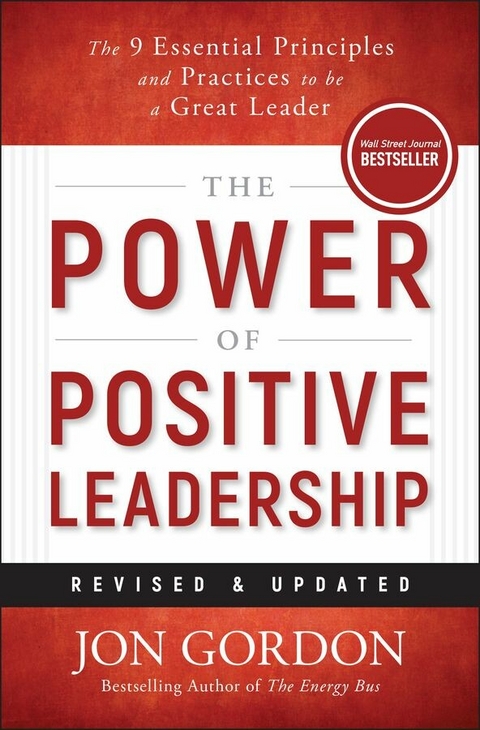
The Power of Positive Leadership, Revised & Updated (eBook)
142 Seiten
Wiley (Verlag)
978-1-394-36212-7 (ISBN)
More than 250,000 sold
In his bestselling book The Power of Positive Leadership, 18x bestselling author Jon Gordon teaches readers that we are not positive because life is easy; we are positive because life can be hard! Leaders are bound to face numerous obstacles, negativity, and tests, and there will be times when it seems as if everything in the world is conspiring against you-which is why positive leadership is essential.
In the revised and updated Second Edition, Gordon reminds readers that the research is clear: being a positive leader is not just a nice way to lead. It's the only way to lead if you want to build a great culture, unite your organization in the face of adversity, develop a connected and committed team, and achieve excellence and superior results.
This book teaches readers to:
- Use love as the greatest leadership principle on the planet
- Pursue excellence by being humble and hungry
- Develop grit, embrace failure, ignore the critics, and do the work
The Power of Positive Leadership earns a well-deserved spot on the bookshelves of all leaders in business and beyond seeking to get the best out of themselves and others.
JON GORDON is an 18-time bestselling author, top leadership speaker, and consultant who has worked with many of the top leaders and organizations on the planet. He impacts millions of people each year with his books, talks, podcasts, and messages.
Visit him at JonGordon.com
Chapter 3
Positive Leaders Drive Positive Cultures
Culture is not just one thing. It's everything.
Positive leaders drive positive cultures. I use the word drive here because as a leader you are the driver of your bus and you have a big role and responsibility in creating the kind of journey you and your team will experience. One year I spoke at a school district and talked with all their leaders, mostly school principals. I shared the same principles and strategies with everyone. At the end of the year, I heard from two principals from the district. One principal had given every member of her staff The Energy Bus to read and followed up with staff meetings where she discussed and reinforced the principles each month. She focused all of her energy on creating a positive culture—one meeting, one conversation, one interaction, one positive message, one teacher, and one student at a time. She completely transformed the morale, engagement, energy, and culture of her school. The other principal I heard from was very disappointed and told me that she had handed a copy of The Energy Bus to all her teachers, encouraged them to read it, and wondered why it didn't have much of an impact on her school and culture. I realized in that moment that you can give a team a bus, but unless you have drivers, it doesn't move. It's not a book that makes a difference. It's not a lecture or a keynote. It's the actions of the leader that make the difference. It's the leader who must drive the culture.
Your Most Important Job
Your most important job as a leader is to drive the culture—and not just any culture. You must create a positive culture that energizes and encourages people, fosters connected relationships and great teamwork, empowers and enables people to learn and grow, and provides an opportunity for people to do their best work. Culture is not just one thing; it's everything. Culture drives expectation and beliefs. Expectations and beliefs drive behaviors. Behaviors drive habits. And habits create the future. It all starts with the culture you create and drive throughout the organization. That's where all success and great results begin.
Driving your culture is not something you can delegate. You are the leader and you must spend your time, energy, and effort creating and building the culture of your team and organization. Nancy Koeper, the retired president of UPS for the Northwest Region, made culture her number‐one priority as she drove a positive culture through an organization that was, literally, full of drivers. She wanted to improve engagement and morale, so she rolled out The Energy Bus to the 1,000 leaders she led with the intent of enhancing positive leadership, positive interactions, and improved relationships with the UPS drivers. Her leaders all read the book, then discussed ways to implement the ideas. They then rolled out The Energy Bus to their 11,000 drivers in the district by simply focusing on positivity, positive interactions, and improved relationships. I had yet to have a company measure results after utilizing The Energy Bus, so it was exciting to hear from Nancy a year later. She reported that engagement, morale, and performance had risen while disengagement and absenteeism had fallen. Nancy drove the UPS bus and it made all the difference.
Alan Mulally, the former CEO of Ford, led one of the most incredible corporate turnarounds in history. In 2006, when he stepped into the CEO role, the automaker had just suffered an annual loss of $12.7 billion and was on the verge of bankruptcy. In just a few short years under his leadership, Ford was back in the black and the company has seen an annual profit every year since 2009. Mulally credited this improbable feat on the organization's focus on driving and building a “One Ford” culture that was centered on the idea of “One Team” where everyone in the organization was committed to the enterprise and to each other. A cultural shift like this doesn't happen by accident. Mulally shared with me his management system, a simple but powerful set of principles, philosophies, behaviors, and processes he designed to create a culture at Ford that fosters unity, teamwork, appreciation, transparency, safety, and even joy. Mulally defines his approach as positive leadership, and throughout the book I'll share more of what I learned from him because he's one of history's greatest examples of positive leadership, and he demonstrates that great cultures happen when positive leaders know their most important job is to drive the culture.
Culture Beats Strategy
When Apple was just the two Steves (Jobs and Wozniak), they knew the culture they wanted to create. They would be the culture that challenged the status quo. Everything they did, including hiring people, running campaigns, and creating products, was influenced by this culture. Even after Steve Jobs's death, the culture continues to influence everything they do. It's why Apple is famous for stating the maxim “Culture beats strategy.” You have to have the right strategy, of course, but it is your culture that will determine whether your strategy is successful. I believe Apple will be successful as long as they innovate and create from the strength of their culture. If they lose their culture, they will lose their way and, like many of the mighty who have come before them, they will fall.
Very few people understand the importance of culture better than Rick Hendrick, the owner and founder of Hendrick Automotive Group and Hendrick Motorsports. In a world where there are thousands of car dealerships and many NASCAR racing teams, Hendrick Automotive is the largest privately owned dealer group in the United States, and Hendrick Motorsports is the winningest racing organization in the modern NASCAR era. Through speaking to the leaders of Hendrick Automotive and Hendrick Motorsports, I have witnessed the incredible culture in both organizations. It's clear that they're driven by the same person. Rick Hendrick's signature leadership and drive are ingrained in everything they do. His people are humble, hungry, thankful, kind, and appreciative. They're on a quest for greatness. Their buildings are spotless. Their energy is always positive and contagious. Everyone wants to be the best and win. When you spend time with two companies—when you see the success of his automotive dealerships and the racing teams—you realize that culture not only beats strategy, but it also fuels it and drives people and organizations to record growth and performance.
Know What You Stand For
You might be wondering where to start when driving and building a culture. I believe it starts with two questions: (1) What do we stand for? (2) What do we want to be known for? While visiting Hendrick Automotive, I asked several of Rick's leaders what they stood for, and they all said servant leadership. They told me that Rick leads the way and, in doing so, puts himself last in every decision he makes for his organization. He is very focused on making sure everyone's voice is heard because it is the team that shapes the company today, tomorrow, and in the future. His executive staff knows that Rick expects them to serve the people they lead in the same way. Teamwork through trust and respect is also one of Hendrick's core organizational values. One of Rick's mantras is None of us is as smart as all of us. He constantly states, “People are our biggest asset! If we take care of our people, they will take care of our customers, and if we work together we will all accomplish more.” This principle comes to life through weekly and monthly meetings where employees share best practices. Having the high performers share how they win in the market lifts the whole company.
As you would expect, Rick is all about integrity and doing the right thing, doing what you say you will do, and being honest and telling the truth regardless of the situation. Leaders at Hendrick Automotive and Hendrick Motorsports also told me they have a passion for winning and don't give up until they do so. Accountability and commitment to continuous improvement help them improve individually and collectively as a team and organization. They want to be known for their culture and winning ways. They celebrate their past success and make it very clear they expect future success. Yet, despite all their success, they are a culture that believes in developing champions who serve others. They want to be known for making a difference in the lives of others and their community.
Hendrick leaders are extremely selective in whom they hire. Only people who fit their culture, embrace the same values, and possess a high level of professionalism are added to the team. Because, as an organization, Hendrick knows what their culture stands for, they're able to choose the right people who fit their culture and who stand for the same things. They also invest heavily to train and develop their people in order to sustain success and retain their talent. Rick Hendrick says, “Everything speaks,” meaning that everything you do matters and tells the world what matters to you. Your culture is a group of people who knows what matters and shares what matters through words and actions. Brad Stevens, general manager of the Boston Celtics, once told me that your culture is not only your tradition, but also the people in the locker room who carry it on....
| Erscheint lt. Verlag | 5.1.2026 |
|---|---|
| Reihe/Serie | Jon Gordon |
| Sprache | englisch |
| Themenwelt | Wirtschaft ► Betriebswirtschaft / Management ► Unternehmensführung / Management |
| Schlagworte | business culture • Business Leadership • Leadership Communication • leadership culture • leadership development • Leadership inspiration • leadership strategies • Leadership Training • Transformational Leadership |
| ISBN-10 | 1-394-36212-9 / 1394362129 |
| ISBN-13 | 978-1-394-36212-7 / 9781394362127 |
| Informationen gemäß Produktsicherheitsverordnung (GPSR) | |
| Haben Sie eine Frage zum Produkt? |
 EPUB (Adobe DRM)
Kopierschutz: Adobe-DRM
Adobe-DRM ist ein Kopierschutz, der das eBook vor Mißbrauch schützen soll. Dabei wird das eBook bereits beim Download auf Ihre persönliche Adobe-ID autorisiert. Lesen können Sie das eBook dann nur auf den Geräten, welche ebenfalls auf Ihre Adobe-ID registriert sind.
Details zum Adobe-DRM
Dateiformat: EPUB (Electronic Publication)
EPUB ist ein offener Standard für eBooks und eignet sich besonders zur Darstellung von Belletristik und Sachbüchern. Der Fließtext wird dynamisch an die Display- und Schriftgröße angepasst. Auch für mobile Lesegeräte ist EPUB daher gut geeignet.
Systemvoraussetzungen:
PC/Mac: Mit einem PC oder Mac können Sie dieses eBook lesen. Sie benötigen eine
eReader: Dieses eBook kann mit (fast) allen eBook-Readern gelesen werden. Mit dem amazon-Kindle ist es aber nicht kompatibel.
Smartphone/Tablet: Egal ob Apple oder Android, dieses eBook können Sie lesen. Sie benötigen eine
Geräteliste und zusätzliche Hinweise
Buying eBooks from abroad
For tax law reasons we can sell eBooks just within Germany and Switzerland. Regrettably we cannot fulfill eBook-orders from other countries.
aus dem Bereich