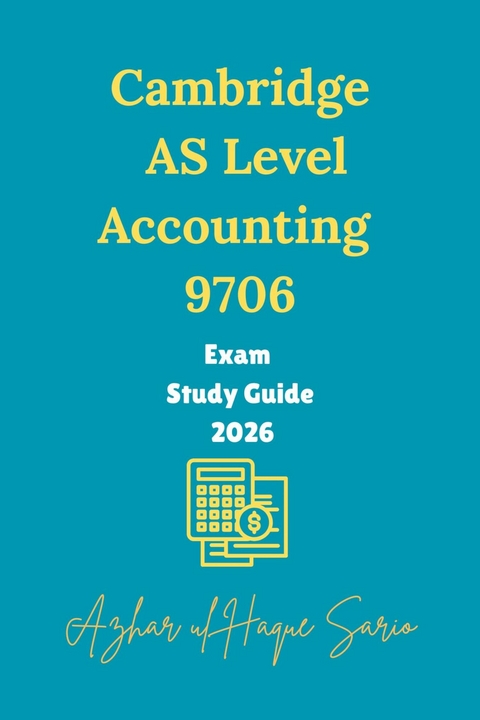
Cambridge AS Level Accounting 9706 (eBook)
276 Seiten
Azhar Sario Hungary (Verlag)
978-3-384-79033-0 (ISBN)
Unlock the secrets of the 2026 Cambridge AS Level Accounting syllabus with a guide that transforms complex theory into clear, modern business logic.
This comprehensive study guide covers every corner of the 9706 syllabus. It begins with the essentials of Financial Accounting. You will explore the structure of business entities. It details the specific rules for sole traders and partnerships. You will understand the legal nuances of limited companies. The book breaks down the entire accounting system. It explains the double-entry method and the accounting equation. You will learn how to prepare and correct ledgers. It covers the books of prime entry in detail. You will master the treatment of non-current assets. It explains depreciation methods like straight-line and reducing balance. The guide teaches you how to handle asset disposals and revaluations. You will learn to perform bank reconciliations. It shows you how to manage control accounts and fix errors. You will prepare complete financial statements for all business types. It covers year-end adjustments for accruals and prepayments. You will also learn to analyze performance using profitability and liquidity ratios. The second section dives into Cost and Management Accounting. It explains the behavior of variable and fixed costs. You will master material and labor costing. It details traditional methods like absorption costing. You will also learn marginal costing and break-even analysis.
This book provides value where others often fail by grounding accounting in the reality of 2026. While standard textbooks recite old rules, this guide contextualizes them within the modern digital economy. It integrates the impact of Artificial Intelligence and automation on bookkeeping. It explains the relevance of 'Making Tax Digital' and real-time reporting. It discusses the critical rise of Environmental, Social, and Governance (ESG) metrics in financial reports. It uses contemporary examples, from the gig economy to blockchain verification, to make abstract concepts concrete. This approach ensures you do not just memorize formulas but understand the economic logic behind them. It prepares you for the analytical demands of the A-Level exam by connecting coursework to the actual technology and regulations shaping the future of finance.
Copyright Disclaimer: This book is an independent publication by Azhar ul Haque Sario. It is not affiliated with, endorsed by, or connected to Cambridge University Press & Assessment or the Cambridge Assessment International Education board. All trademarks and brand names mentioned within this book are the property of their respective owners and are used here under the principles of nominative fair use for educational and descriptive purposes only. This work is an independently produced study resource designed to support students.
Accounting for non-current assets
1. Introduction to Financial Classification
In the landscape of 2026 financial reporting, the distinction between capital and revenue is more critical than ever. As businesses shift from purely physical operations to hybrid models involving digital assets, AI infrastructure, and sustainable technologies, the "classification" of money becomes the bedrock of truth in accounting.
Accounting is not just about counting money. It is about categorizing it to tell a story. If a business spends one million dollars, does that spending build a future (Capital) or just survive the present (Revenue)? This section explores that vital difference.
2. Capital vs. Revenue: The Core Distinction
To prepare accurate financial statements under International Financial Reporting Standards (IFRS), specifically IAS 16 and IAS 38, we must distinguish between expenditure that benefits the current period and expenditure that benefits future periods.
2.1 Capital Expenditure (CapEx)
Capital expenditure is money spent by a business to acquire, upgrade, or maintain physical assets such as property, plants, buildings, technology, or equipment. In 2026, this definition has expanded significantly to include substantial intangible assets.
Key Characteristics:
Long-term Benefit: The benefit of the spending lasts for more than one accounting period (usually more than 12 months).
Asset Creation: It results in a non-current asset appearing on the Statement of Financial Position (Balance Sheet).
Earning Capacity: It increases the earning capacity of the business, rather than just maintaining it.
Modern Examples (2026 Context):
Acquisition: A logistics company purchasing a fleet of autonomous delivery drones. This is a new asset that will generate revenue for 5-7 years.
Improvement: Installing a new quantum-cooling system in a data center. This upgrades the existing asset, allowing it to process data faster and increasing its potential output.
Legal Costs: Paying legal fees to acquire the title deeds for a new "Gigafactory." Since this is necessary to own the asset, it is part of the capital cost.
Installation: The cost of coding and integrating a bespoke ERP (Enterprise Resource Planning) AI system. The coding cost is capitalized because it creates a long-term digital tool.
2.2 Revenue Expenditure (OpEx)
Revenue expenditure is money spent on the day-to-day running of the business. These are short-term expenses used up within the accounting year.
Key Characteristics:
Short-term Benefit: The benefit is consumed immediately or within the current financial year.
Maintenance: It maintains the existing earning capacity but does not increase it.
Recurrence: These costs happen frequently (monthly, quarterly, annually).
Modern Examples (2026 Context):
Repairs: Replacing the battery cells in an electric delivery van. This simply restores the van to working order; it does not make the van "better" than it was when new.
Consumables: The cost of liquid nitrogen used daily to cool server farms.
Wages: Salaries paid to the staff who operate the machinery.
Cloud Subscriptions: Monthly fees paid for "Software as a Service" (SaaS). Even though the software is used long-term, the payment is for access this month, making it revenue expenditure.
2.3 Capital Income vs. Revenue Income
Just as we categorize spending, we must categorize money coming in (receipts).
Capital Income: This is income derived from a source other than the normal trading activities of the business. It usually comes from selling non-current assets or raising finance.
Example: Selling an old robotic assembly arm for scrap. The cash received is capital income.
Example: A bank loan received to build a new warehouse.
Revenue Income: This is income derived from the day-to-day trading activities.
Example: Cash received from selling goods to customers.
Example: Rent received from a tenant if the business is a property management firm.
Example: Commission fees earned.
2.4 The "Grey Areas" and The Materiality Concept
Sometimes, an item looks like Capital Expenditure but is treated as Revenue. This is due to the Concept of Materiality.
If a company buys a stapler for $10, that stapler will last 5 years. Technically, it is a non-current asset. However, recording a $10 asset and depreciating it by $2 a year is a waste of accounting effort. Therefore, small capital items are often written off as revenue expenditure (stationery expense) for simplicity. In 2026, automated accounting AI often handles these thresholds automatically, flagging items under $500 as OpEx instantly.
3. The Effect of Incorrect Treatment
If an accountant confuses Capital and Revenue expenditure, the financial statements will be fundamentally wrong. This is not just a clerical error; it distorts the "True and Fair View" required by auditors.
3.1 Treating Capital Expenditure as Revenue Expenditure
Scenario: A company builds a new $100,000 extension to its factory but records it as "Repairs Expense" (Revenue) instead of "Building Cost" (Capital).
Effect on Statement of Profit or Loss:
Expenses are Overstated: The $100,000 is deducted from profit immediately as an expense.
Profit is Understated: Because expenses are too high, the Net Profit for the year will be lower than it essentially is.
Effect on Statement of Financial Position:
Assets are Understated: The new building extension does not appear on the balance sheet. The value of non-current assets is lower than reality.
Equity is Understated: Since profit is added to retained earnings, a lower profit means lower total equity.
3.2 Treating Revenue Expenditure as Capital Expenditure
Scenario: A company spends $50,000 on regular machine maintenance but records it as an "Upgrade" (Capital) to the machine's value. This is a common fraud technique (similar to the WorldCom scandal of the early 2000s) used to hide expenses.
Effect on Statement of Profit or Loss:
Expenses are Understated: The $50,000 is removed from the expense list.
Profit is Overstated: With fewer expenses, the company looks more profitable than it really is. This misleads shareholders and tax authorities.
Effect on Statement of Financial Position:
Assets are Overstated: The machine is recorded at a value higher than its true worth. The balance sheet shows a "bloated" asset base.
Equity is Overstated: Higher fake profit leads to higher retained earnings.
Summary Table of Errors:
Error Type Profit Impact Non-Current Asset Value
CapEx treated as OpEx Understated (Too Low) Understated (Too Low)
OpEx treated as CapEx Overstated (Too High) Overstated (Too High)
4. Depreciation of Non-Current Assets
Depreciation is the systematic allocation of the depreciable amount of an asset over its useful life. In simpler terms, it is how we expense the cost of an asset over the years we use it.
By 2026, the definition of "asset" has evolved, but the reasons they lose value remain rooted in physical and economic reality.
4.1 Factors Causing Depreciation
Why does an asset lose value? We categorize these causes into four main areas.
A. Physical Deterioration (Wear and Tear)
This is the most visible form of depreciation. As assets are used, they physically break down.
Friction and Heat: Manufacturing robots have moving parts. Over 5 years, gears grind down, and motors burn out.
Exposure: A delivery truck is exposed to rain, salt, and road debris, causing rust and chassis fatigue.
Erosion: Pipelines or agricultural land may suffer from physical erosion over time.
B. Economic Factors (Obsolescence)
This is the primary driver of depreciation in the 2026 technology-driven economy. An asset might still work perfectly, but it is effectively worthless because better technology exists.
Technological Obsolescence: A computer purchased in 2023 works fine in 2026, but it cannot run the latest AI models or neural rendering software. It has lost value not because it is broken, but...
| Erscheint lt. Verlag | 1.1.2026 |
|---|---|
| Sprache | englisch |
| Themenwelt | Wirtschaft ► Betriebswirtschaft / Management |
| ISBN-10 | 3-384-79033-2 / 3384790332 |
| ISBN-13 | 978-3-384-79033-0 / 9783384790330 |
| Informationen gemäß Produktsicherheitsverordnung (GPSR) | |
| Haben Sie eine Frage zum Produkt? |
 EPUB (Adobe DRM)
Größe: 286 KB
Kopierschutz: Adobe-DRM
Adobe-DRM ist ein Kopierschutz, der das eBook vor Mißbrauch schützen soll. Dabei wird das eBook bereits beim Download auf Ihre persönliche Adobe-ID autorisiert. Lesen können Sie das eBook dann nur auf den Geräten, welche ebenfalls auf Ihre Adobe-ID registriert sind.
Details zum Adobe-DRM
Dateiformat: EPUB (Electronic Publication)
EPUB ist ein offener Standard für eBooks und eignet sich besonders zur Darstellung von Belletristik und Sachbüchern. Der Fließtext wird dynamisch an die Display- und Schriftgröße angepasst. Auch für mobile Lesegeräte ist EPUB daher gut geeignet.
Systemvoraussetzungen:
PC/Mac: Mit einem PC oder Mac können Sie dieses eBook lesen. Sie benötigen eine
eReader: Dieses eBook kann mit (fast) allen eBook-Readern gelesen werden. Mit dem amazon-Kindle ist es aber nicht kompatibel.
Smartphone/Tablet: Egal ob Apple oder Android, dieses eBook können Sie lesen. Sie benötigen eine
Geräteliste und zusätzliche Hinweise
Buying eBooks from abroad
For tax law reasons we can sell eBooks just within Germany and Switzerland. Regrettably we cannot fulfill eBook-orders from other countries.
aus dem Bereich