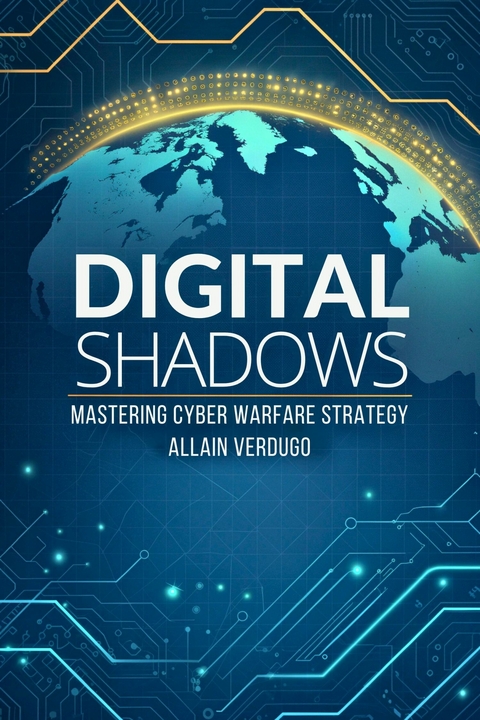
Digital Shadows (eBook)
130 Seiten
JNR Publishing (Verlag)
978-0-00-113095-1 (ISBN)
Unmask the Digital Battlefield-Then Win on It
If The Art of Cyberwarfare and Cyber War opened your eyes to the threat, Digital Shadows: Mastering Cyber Warfare Strategy hands you the battle plan. From zero-day exploits to information-ops that topple trust, Allain Verdugo translates nation-state tradecraft into repeatable defensive moves any security leader can deploy today.
Inside you'll discover:
A blow-by-blow anatomy of headline breaches-learn the attacker's script before they run it on youPlug-and-play frameworks that map directly to MITRE ATT&CK, NIST CSF and ISO 27001'Defend-Forward' playbooks to neutralize threats inside enemy territoryBoard-ready risk metrics: convert packet captures to ROI-saving decisions in minutesQuantum-era encryption survival kit
What you'll be able to DO after reading:
Harden supply-chain pipelines so a SolarWinds-class backdoor dies on arrivalOrchestrate red-vs-blue threat-hunting drills that slash mean-time-to-detectCraft persuasive executive briefs that unlock budget without FUDLead crisis comms when the headlines hit-while competitors scramble
Ready to turn cyber chaos into competitive advantage? Secure your org before the next breach secures you.
1
Chapter 1: Introduction to Cyber Warfare
Welcome to the shadows, recruit. Not the murky back alleys of old-school espionage, though those still exist, mind you. No, we’re talking about a different kind of shadow – the ones cast by flickering screens, humming servers, and the invisible streams of data that now encircle the globe like a digital nervous system. This is the realm of cyber warfare, a domain where conflict has evolved beyond bullets and bombs into the ethereal yet devastatingly real world of bits and bytes. Forget trench foot; worry about zero-day exploits. Forget physical borders; the front lines are now anywhere with an internet connection. As a veteran of… let’s just say various fields where information is power and security is paramount, and having built ventures where digital infrastructure was the bedrock, I can tell you this: understanding this new battlefield isn’t optional. It’s survival. This book is your initial briefing, your field guide to navigating this complex, dangerous, and utterly fascinating landscape. Pay attention. There might be a test later, and failure isn’t graded on a curve.
Defining Digital Conflict and Its Scope
So, what exactly is cyber warfare? Ask ten different “experts,” and you might get ten different answers, often wrapped in jargon thicker than a Moscow winter coat. Let’s cut through the noise. At its core, cyber warfare involves actions by a nation-state or its proxies to penetrate another nation’s computers or networks for the purposes of causing damage or disruption. Think of it as espionage, sabotage, and propaganda all rolled into one, conducted through digital means.
But that definition, while neat, barely scratches the surface. The scope is vast, amorphous, and constantly shifting. It’s not just about governments hacking governments anymore. The players include:
- Nation-States: The big leagues. Countries with dedicated cyber commands, intelligence agencies pouring resources into offensive and defensive capabilities. Think US Cyber Command, Russia’s FSB/GRU units, China’s PLA Strategic Support Force, and others playing in the geopolitical sandbox. Their motives range from traditional espionage (stealing secrets) and intellectual property theft (economic advantage) to disrupting critical infrastructure (sabotage) and influencing foreign populations (information operations).
- State-Sponsored Groups (Proxies): Governments often prefer plausible deniability. Why get your own hands dirty when you can fund, train, and direct a group of skilled hackers to do your bidding? These groups operate in a grey zone, often blurring the lines between state directive and independent action. Attribution becomes a nightmare – just the way their sponsors like it. Think of them as digital privateers or mercenaries.
- Cybercriminals: While often motivated by profit (ransomware, bank theft, data breaches), their actions can have national security implications. Large-scale ransomware attacks can cripple essential services, and stolen data can find its way into the hands of state actors. Sometimes, the line between cybercrime and state-sponsored activity is deliberately blurred.
- Hacktivists: Groups using hacking skills to promote a political or social agenda. Think Anonymous or similar collectives. While often less sophisticated than state actors, they can cause significant disruption, embarrassment, and serve as a catalyst for wider events. Their actions can sometimes be co-opted or manipulated by state intelligence services.
- Terrorist Organizations: Increasingly looking to leverage cyberspace for recruitment, propaganda, communication, fundraising, and potentially, disruptive attacks. While their capabilities for large-scale cyber warfare have been debated, the intent is often there.
The scope of operations is equally broad:
- Espionage: Stealing classified government documents, military plans, diplomatic communications, sensitive corporate data, intellectual property. Classic spycraft, digitized.
- Sabotage: Disrupting, degrading, or destroying critical infrastructure. Power grids, financial systems, transportation networks, water treatment plants, communication networks – all potential targets. Think Stuxnet targeting Iranian nuclear centrifuges. This is where digital actions have kinetic effects.
- Information Operations (IO) / Psychological Operations (PsyOps): Spreading disinformation, propaganda, and manipulating social media to sow discord, influence elections, erode trust in institutions, and shape public perception. The weaponization of information itself.
- Economic Warfare: Targeting financial institutions, stealing intellectual property on a massive scale to undermine a competitor’s economy, disrupting trade.
- Degradation of Military Capabilities: Interfering with command and control systems, disabling weapons platforms, blinding surveillance systems. Integrating cyber effects into traditional military operations.
Defining the scope is like trying to map fog. It shifts, it coalesces, it dissipates. An attack might start as espionage and escalate to sabotage. A criminal group might unwittingly serve state interests. The key takeaway is that cyber warfare isn’t a single thing. It’s a spectrum of activities, conducted by diverse actors, with objectives ranging from nuisance to existential threat. It operates across borders, often instantaneously, and challenges traditional notions of sovereignty, deterrence, and armed conflict. As analysts, entrepreneurs, and strategists, our first job is to appreciate this complexity, to understand the myriad ways the digital domain can be contested.
Historical Background of Cyber Operations
This didn’t just spring up overnight with the invention of TikTok dances and online shopping. The roots of cyber conflict stretch back further than many realize, evolving alongside computing and networking technology. Think of it as a shadow history running parallel to the public story of the internet.
- The Early Days (1970s-1980s): Even in the nascent days of ARPANET (the precursor to the internet), security wasn’t the primary concern. Early “hacks” were often exploratory or mischievous. However, the potential for malicious use was recognized. The famous “Creeper” and “Reaper” programs on ARPANET demonstrated self-replicating and deleting code – primitive worms. Cold War tensions also spurred interest. The KGB was famously accused of recruiting hackers to steal technology secrets from the West, like the case involving Markus Hess (documented in Clifford Stoll’s “The Cuckoo’s Egg”). This was espionage adapting to the new digital frontier.
- The Rise of Worms and Viruses (Late 1980s-1990s): The Morris Worm (1988) wasn’t intentionally malicious, but it spread rapidly, causing significant internet disruption and highlighting the vulnerability of networked systems. This era saw the proliferation of viruses spread via floppy disks and later, email. While mostly criminal or nuisance-ware, it demonstrated the potential for widespread digital disruption. Early government cyber units began to form, often within signals intelligence agencies.
- The Dot-Com Boom and Early State Activity (Late 1990s-Early 2000s): As the internet became commercialized and globally interconnected, the stakes rose. The 1998 “Solar Sunrise” intrusions into US military networks (initially thought to be Iraq, later traced to teenagers) caused panic and highlighted defense vulnerabilities. The 1999 Kosovo conflict saw early examples of patriotic hacking and cyber skirmishes alongside the physical conflict (“Titan Rain” investigations beginning around 2003 revealed extensive probing of US defense contractor networks, often attributed to China). Espionage was going digital in a big way.
- The Era of Sophistication and Critical Infrastructure Concerns (Mid-2000s-Present): This period marks a significant escalation.
- Estonia (2007): Widely considered a watershed moment. A massive wave of Distributed Denial-of-Service (DDoS) attacks crippled Estonian government, banking, and media websites following a dispute with Russia over the relocation of a Soviet war memorial. While attribution was debated, it demonstrated how cyber attacks could paralyze a modern, digitally reliant nation.
- Georgia (2008): Cyber attacks coincided with the Russo-Georgian War, targeting government and news websites. This demonstrated the potential integration of cyber operations with conventional military campaigns.
- Stuxnet (Discovered 2010): A highly sophisticated worm, believed to be a joint US-Israeli project, designed to sabotage Iran’s nuclear program by targeting specific industrial control systems (ICS) managing centrifuges. Stuxnet proved that cyber weapons could cause physical destruction, crossing a significant threshold.
- Rise of Advanced Persistent Threats (APTs): Recognition of sophisticated, well-funded groups (often state-sponsored) conducting long-term espionage and intrusion campaigns. Groups like APT1 (linked to China), Fancy Bear/APT28 (linked to Russia), and Lazarus Group (linked to North Korea) became infamous.
- Information Operations Mature: Interference in elections (e.g., 2016...
| Erscheint lt. Verlag | 27.12.2025 |
|---|---|
| Sprache | englisch |
| Themenwelt | Wirtschaft ► Betriebswirtschaft / Management ► Wirtschaftsinformatik |
| ISBN-10 | 0-00-113095-1 / 0001130951 |
| ISBN-13 | 978-0-00-113095-1 / 9780001130951 |
| Informationen gemäß Produktsicherheitsverordnung (GPSR) | |
| Haben Sie eine Frage zum Produkt? |
 EPUB (Adobe DRM)
Größe: 2,0 MB
Kopierschutz: Adobe-DRM
Adobe-DRM ist ein Kopierschutz, der das eBook vor Mißbrauch schützen soll. Dabei wird das eBook bereits beim Download auf Ihre persönliche Adobe-ID autorisiert. Lesen können Sie das eBook dann nur auf den Geräten, welche ebenfalls auf Ihre Adobe-ID registriert sind.
Details zum Adobe-DRM
Dateiformat: EPUB (Electronic Publication)
EPUB ist ein offener Standard für eBooks und eignet sich besonders zur Darstellung von Belletristik und Sachbüchern. Der Fließtext wird dynamisch an die Display- und Schriftgröße angepasst. Auch für mobile Lesegeräte ist EPUB daher gut geeignet.
Systemvoraussetzungen:
PC/Mac: Mit einem PC oder Mac können Sie dieses eBook lesen. Sie benötigen eine
eReader: Dieses eBook kann mit (fast) allen eBook-Readern gelesen werden. Mit dem amazon-Kindle ist es aber nicht kompatibel.
Smartphone/Tablet: Egal ob Apple oder Android, dieses eBook können Sie lesen. Sie benötigen eine
Geräteliste und zusätzliche Hinweise
Buying eBooks from abroad
For tax law reasons we can sell eBooks just within Germany and Switzerland. Regrettably we cannot fulfill eBook-orders from other countries.
aus dem Bereich