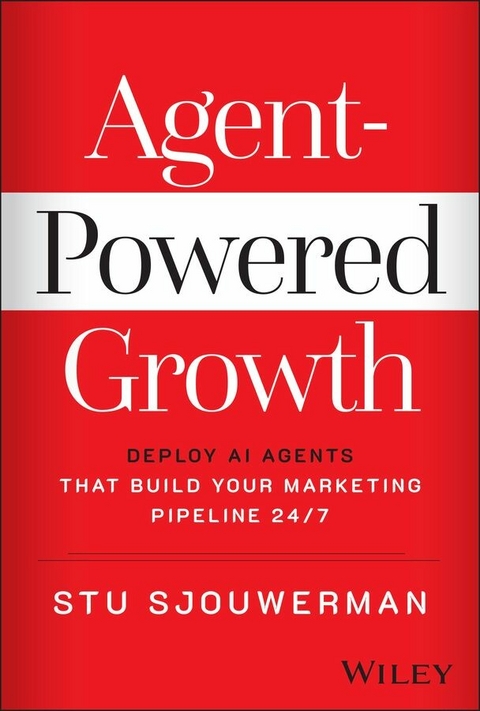
Agent-Powered Growth (eBook)
219 Seiten
Wiley (Verlag)
978-1-394-40758-3 (ISBN)
Master AI-powered marketing before autonomous agents replace your role entirely
In Agent-Powered Growth, Stu Sjouwerman, founder and executive chairman of KnowBe4 (the world's largest security awareness platform) addresses the existential threat facing hundreds of thousands of marketing professionals as autonomous AI agents reshape their industry. He is also the founder of ReadingMinds.ai, an AI-native research platform that conducts emotionally intelligent voice interviews at scale-turning hours of calls and weeks of waiting into overnight insights. That work reflects his broader thesis: when agents can sense context, reason with memory, and act across channels, marketers stop firefighting and start compounding.
Drawing from three decades of experience building billion-dollar technology companies and navigating industry disruptions, Sjouwerman transforms the anxiety of potential job displacement into a strategic competitive advantage by showing marketers how to evolve from replaceable tacticians into indispensable orchestrators of AI-powered marketing ecosystems. This comprehensive guide moves beyond superficial AI overviews to deliver practical, actionable strategies for deploying autonomous marketing agents across content creation, campaign optimization, lead nurturing, and market research. Using detailed case studies spanning B2B SaaS, retail, and healthcare industries, you'll learn to leverage cutting-edge platforms like Salesforce Agentforce, AutoGPT, and CrewAI while implementing essential governance frameworks that ensure responsible AI deployment. You'll also discover:
- Platform mastery strategies for implementing enterprise-grade AI agent platforms including step-by-step deployment guides for Salesforce Agentforce and emerging autonomous marketing tools
- Industry-specific case studies demonstrating real-world applications of marketing agents across B2B SaaS, retail, and healthcare sectors with measurable ROI outcomes
- Career transformation roadmaps that position marketing professionals as strategic AI orchestrators rather than obsolete tacticians in the age of autonomous agents
- Governance and risk management frameworks ensuring ethical AI deployment while maintaining human oversight, brand integrity, and regulatory compliance
- Revenue funnel optimization through AI agents that seamlessly bridge marketing and sales operations for enhanced lead conversion and customer acquisition
Perfect for front-line marketing professionals, CMOs, and managers facing AI-driven industry disruption, Agent-Powered Growth is an essential guide for securing your career and personal competitive positioning. It's also a must-read for business leaders and entrepreneurs who want to understand how autonomous marketing agents can transform their revenue operations and how to implement new agentic tools in their companies.
STU SJOUWERMAN is the founder and executive chairman of KnowBe4, Inc., the world's largest security awareness training platform serving over 70,000 organizations globally. A serial entrepreneur with more than 30 years in the IT industry, he was a co-founder of Sunbelt Software and was named the 2023 Excellence in Customer Service Award Executive of the Year. He currently leads Cyberheist News, delivering cybersecurity insights to IT professionals worldwide. He is also the founder of ReadingMinds.ai, an AI-native research platform that conducts emotionally intelligent voice interviews at scale-turning hours of calls and weeks of waiting into overnight insights. That work reflects his broader thesis: when agents can sense context, reason with memory, and act across channels, marketers stop firefighting and start compounding.
CHAPTER 1
The Fatal Flaw in Modern Marketing AI
During a 2024 podcast interview, Chris Koehler recalled a moment that was revelatory of the marketing industry’s most expensive misunderstanding. The CMO of Twilio had stood before his 200-person marketing team at the company’s San Francisco headquarters. The man who once helped Box surpass $1 billion in annual revenue, and who brought 25 years of experience across Adobe, E*TRADE, and multiple disciplines—from customer success to product management—delivered what he thought would be an energizing message: “Hey, I think there’s a massive opportunity for AI in marketing. Everyone should use it!”
The room fell silent. Then came the tentative questions that would reshape his understanding: “Okay, well, some of us are. What do you mean? What are the use cases?”1
Koehler’s internal realization arrived with uncomfortable clarity. “I was guilty of this,” he would later admit. His team had been using AI—Jasper for content creation, ChatGPT for copywriting, and automated email tools for campaigns. Yet none of these represented the transformative AI he envisioned. The gap between using AI-powered tools and deploying AI intelligence suddenly became painfully apparent. For someone whose philosophy centered on “getting comfortable being uncomfortable” and who prided himself on continuous learning, this moment of confusion proved particularly unsettling.2
That moment in front of his 200-person team encapsulates a misunderstanding plaguing marketing departments worldwide. If the CMO of a company, one whose entire business model revolves around APIs and automation, struggles to articulate AI’s role in marketing, the confusion extends far beyond traditional industries. The irony deepened: Twilio already deployed AI agents for customer engagement, yet Koehler himself hadn’t fully grasped what made these different from their other AI tools.
The statistics confirm this universal challenge: while 88 percent of marketers claim to use AI daily, only 1 percent of organizations have achieved mature AI implementations.3 The knowledge gap continues to widen even as adoption accelerates—71.7 percent of AI non-adopters cite lack of understanding as their main barrier, nearly doubling from 41.9 percent in 2023.4
Benjamin Royce, Head of Strategy & Innovation at AKQA—a global agency working with brands like BMW, Audi, and American Express—articulated the enterprise blind spot that compounds this confusion: “Marketers, and especially ad agencies, have an under-appreciation for enterprise-level tools. Consumers aren’t talking about them. Journalists aren’t talking about them.” He explained the critical distinction most miss: “If your organization has non-disclosure agreements or client conflict issues, you need to go enterprise. They treat your data more seriously in terms of privacy and security.” This enterprise-consumer divide creates a dangerous vulnerability—marketers celebrate their ChatGPT deployments while missing the security, indemnity, and reliability that enterprise platforms provide.
The AI adoption paradox reveals itself in the numbers. Marketing AI usage jumped from 29 percent to 66 percent in two years, yet 85 percent of this usage focuses on basic content creation—writing tools, image generation, and simple chatbots.5 Only 12 percent of companies have deployed autonomous AI agents at a large scale.6 Marketers believe they’re implementing AI because they use Jasper, Copy.ai, or ChatGPT, but these are only generative AI tools, which require human operation for every task. Their chatbots use natural language but follow limited prompts rather than making autonomous decisions.
Modern marketers are driving cars with cruise control while believing they have self-driving vehicles. They possess tools that enhance individual actions but lack the sensing and reasoning capabilities that create autonomous operation. The distinction between enhancement and autonomy defines the fatal flaw in modern marketing AI implementation: marketers are investing millions in tools that make human workers marginally faster when they could be deploying AI agents that operate independently.
This evolution from enhancement to autonomy was anticipated years before the current confusion took hold. In 2019, Davenport and colleagues predicted that “AI will take over simple marketing tasks first, then move to more complex ones requiring judgment.” Their framework identified three stages: task automation (handling repetitive activities), task augmentation (assisting human decision-making), and eventually full autonomy (independent operation). Today’s fatal flaw—mistaking the first two stages for the third—validates their warning that organizations would struggle to recognize when AI capabilities crossed the threshold from assistance to autonomy.7
The Stakes Are Worse Than You Think
The confusion about AI’s role in marketing creates consequences far beyond missed opportunities. While companies struggle to distinguish between AI tools and autonomous agents, their competitors build insurmountable advantages. The gap widens daily between organizations deploying genuine agentic AI transformation and those mistaking incremental improvements for innovation. Marketing leaders face a brutal reality: resource constraints intensify while competitive pressures accelerate, creating an environment where understanding this distinction will determine survival.
Koehler’s vulnerability in his 2024 interview extended beyond Twilio’s walls. “I think because AI technology is rapidly evolving every week, that as a leader, I feel like—and I’ve talked to a lot of other CMOs—we’re all feeling behind. We’re all feeling like we’re not doing enough,” he confessed.8 The admission carried extra weight coming from someone known for his no-nonsense style and hands-on approach. His anxiety reflected concrete pressures. Boards expected AI strategy while budgets hit their lowest levels since pre-pandemic. High performers were leaving for companies with clearer AI vision. Competitors announced AI wins while Twilio struggled with basic implementation questions.
Even personal experiments highlighted the disconnect. Koehler had used ChatGPT to create a social post about business clichés that garnered 50,000 views in days—a five-second effort that outperformed carefully crafted campaigns. Yet he couldn’t translate these individual wins into organizational transformation. Meanwhile, in the podcast, he revealed a striking observation about the future of marketing: AI agents were beginning to visit websites and make purchasing decisions autonomously. The future had already arrived, but they weren’t prepared for it.9
The resource reality compounds these challenges. Marketing leaders reported that 64 percent lacked resources to execute their 2024 strategies, with marketing budgets dropping to 7.7 percent of company revenue—the lowest in over a decade.10 At the same time, 75 percent of marketers feel AI provides a competitive advantage.11 This disconnect between aspiration and capability creates a staggering amount of organizational paralysis. It was this paralysis that Koehler had to overcome, but he didn’t have much time.
While Koehler grappled with use cases, competitors transformed their operations. EcomPlus, working with SuperAGI, reduced their sales team’s manual lead qualification time from 64 percent to nearly zero through autonomous agents that achieved 95 percent accuracy. This resulted in 25 percent higher conversion rates and 40 percent better conversion from AI-driven nurturing. Their innovation surpassed the premise of automating individual touchpoints, as their AI agents handled the entire customer journey autonomously.12
Salesforce deployed Agentforce internally. Since its launch, it has handled over 100,000 visitor conversations. The platform delivers 40 percent faster lead qualification and a 21.5 percent increase in conversion rates while reducing response times from hours to seconds for qualified leads. The system operates 24/7 across all time zones without human intervention.13
Lumen Technologies achieved a $50 million annual impact by implementing Microsoft Copilot agents. Sales representatives who previously spent four hours daily on prep work now complete the same tasks in 15 minutes. The freed capacity enables sellers to close 20 percent more deals.14 These aren’t marginal gains from optimization—they represent transformational returns that redefine competitive dynamics. Companies achieving these results operate in a different league from those still fine-tuning their email subject lines with AI.
The market reality demands attention. Industry projections show 82 percent of organizations plan to integrate autonomous agents within three years.15 Enterprise software containing agentic AI will grow from less than 1 percent in 2024 to 33 percent by 2028.16 Work decisions made autonomously will increase from 0 percent in 2024 to 15 percent by 2028. And the AI marketing market will expand from $58 billion in 2025 to $240.58 billion by 2030.17
Even now, companies using AI report 15.8 percent average revenue increases, with early adopters seeing 22.6 percent productivity improvements while...
| Erscheint lt. Verlag | 30.12.2025 |
|---|---|
| Sprache | englisch |
| Themenwelt | Wirtschaft ► Betriebswirtschaft / Management ► Marketing / Vertrieb |
| Schlagworte | ai content creation marketing • ai marketing agents • ai powered lead generation • autonomous ai marketing • autonomous marketing campaigns • marketing ai platforms • marketing automation revolution • marketing career ai transformation • salesforce agentforce guide |
| ISBN-10 | 1-394-40758-0 / 1394407580 |
| ISBN-13 | 978-1-394-40758-3 / 9781394407583 |
| Informationen gemäß Produktsicherheitsverordnung (GPSR) | |
| Haben Sie eine Frage zum Produkt? |
 EPUB (Adobe DRM)
Kopierschutz: Adobe-DRM
Adobe-DRM ist ein Kopierschutz, der das eBook vor Mißbrauch schützen soll. Dabei wird das eBook bereits beim Download auf Ihre persönliche Adobe-ID autorisiert. Lesen können Sie das eBook dann nur auf den Geräten, welche ebenfalls auf Ihre Adobe-ID registriert sind.
Details zum Adobe-DRM
Dateiformat: EPUB (Electronic Publication)
EPUB ist ein offener Standard für eBooks und eignet sich besonders zur Darstellung von Belletristik und Sachbüchern. Der Fließtext wird dynamisch an die Display- und Schriftgröße angepasst. Auch für mobile Lesegeräte ist EPUB daher gut geeignet.
Systemvoraussetzungen:
PC/Mac: Mit einem PC oder Mac können Sie dieses eBook lesen. Sie benötigen eine
eReader: Dieses eBook kann mit (fast) allen eBook-Readern gelesen werden. Mit dem amazon-Kindle ist es aber nicht kompatibel.
Smartphone/Tablet: Egal ob Apple oder Android, dieses eBook können Sie lesen. Sie benötigen eine
Geräteliste und zusätzliche Hinweise
Buying eBooks from abroad
For tax law reasons we can sell eBooks just within Germany and Switzerland. Regrettably we cannot fulfill eBook-orders from other countries.
aus dem Bereich