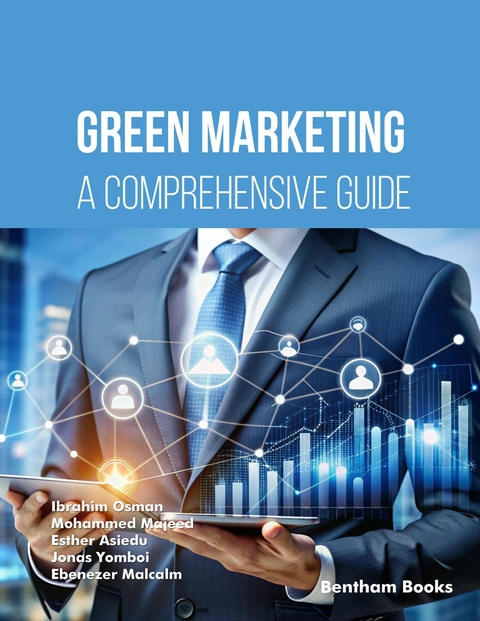
Green Marketing: A Comprehensive Guide (eBook)
140 Seiten
Bentham Science Publishers (Verlag)
979-8-89881-165-5 (ISBN)
An exploration of how environmental consciousness and sustainable practices are reshaping modern marketing strategies. It examines the evolution of green marketing, key principles, and actionable tactics that align ecological responsibility with brand competitiveness. Covering topics such as the green marketing mix, adoption factors, green packaging, and authentic communication strategies, the book shows how businesses can avoid greenwashing, build trust, and leverage digital platforms to strengthen sustainability messaging. By linking theory with real-world application, it positions green marketing as an essential pillar of ethical and future-ready business practice.-Key Features Traces the evolution and core principles of green marketing. Designs sustainable strategies across product, price, place, and promotion. Adopts authentic communication methods to avoid greenwashing. Applies green packaging and other eco-friendly initiatives effectively. Leverages digital platforms to amplify sustainability messages.
Navigating Green Marketing: Strategies, Benefits, and Challenges
Ibrahim Osman, Mohammed Majeed, Esther Asiedu, Jonas Yomboi, Ebenezer Malcalm
Abstract
Green marketing (GM) can be viewed as a method of preserving both the environment and a means of ensuring a sustainable future across all sectors. The goal of this chapter is to lay the groundwork for green marketing within the context of this book. Green marketing, in general, helps firms achieve their environmental goals while also attracting and retaining customers, and encourages them to make more eco-friendly purchasing decisions. However, it faces several challenges, including high prices, a lack of standardization, and high operational costs. All stakeholders concerned (consumers, industrial purchasers, and suppliers) should be required to use GM. Additionally, to safeguard the planet from pollution and its effects, governments should implement stricter environmental regulations.
Introduction
The 21st century has witnessed an escalating awareness of environmental issues, including climate change, biodiversity loss, pollution, and the depletion of non-renewable resources. These issues have prompted global discussions and actions toward achieving sustainable development goals (SDGs), as outlined by the United Nations. In response, both consumers and businesses are increasingly re-evaluating their roles and responsibilities in mitigating environmental degradation and promoting ecological balance (Kotler, Kartajaya, & Setiawan, 2017). In this context, green marketing, the process of developing and promoting products and services based on their environmental benefits, has gained significant traction in both academic discourse and managerial practice.
Green marketing is often considered a strategic and ethical response to mounting environmental concerns and shifting consumer values (Peattie & Crane, 2005). It seeks to address the demand for sustainability by emphasizing eco-friendly production, packaging, distribution, and post-consumption disposal. According to Polonsky (1994), green marketing goes beyond selling environmentally safe products; it encompasses a holistic approach to business operations that reduces environmental harm while providing economic and social value. As such, it serves
as a key component of corporate social responsibility (CSR) and sustainability-oriented innovation (Chen, 2010).
The increased environmental consciousness among consumers has further accelerated the growth of green markets. Research indicates that consumers are more inclined to purchase products from companies perceived as environmentally responsible (Leonidou et al., 2011). Nielsen (2020) study found that 73% of global consumers would definitely or probably change their consumption habits to reduce their environmental impact. This shift in consumer behavior has created market pressure on firms to adopt green marketing practices and visibly align their brand identities with environmental values (Delmas & Burbano, 2011).
Despite these positive trends, the integrity of green marketing has been questioned due to the prevalence of greenwashing, which involves the practice of conveying a false impression or providing misleading information about how a company’s products are environmentally sound (Laufer, 2003). Companies engaging in greenwashing often capitalize on consumer environmental concerns without making substantial efforts to reduce their ecological footprint. This not only undermines consumer trust but also jeopardizes the legitimacy of truly sustainable businesses. TerraChoice (2010), in its “Sins of Greenwashing” report, found that over 95% of consumer products claiming to be green committed at least one form of greenwashing. Consequently, the rise of deceptive environmental marketing practices has led to a demand for greater transparency, third-party certification, and regulatory oversight.
Green marketing is not merely a promotional tactic; it is a comprehensive business philosophy rooted in the principles of sustainability, ethics, and stakeholder engagement (Ottman, Stafford, & Hartman, 2006). It requires a fundamental rethinking of product design, supply chain management, and consumer communication strategies. This chapter explores green marketing from both theoretical and practical perspectives, drawing on models, such as the Triple Bottom Line (Elkington, 1997), Stakeholder Theory (Freeman, 1984), and the Theory of Planned Behavior (Ajzen, 1991). It examines how businesses integrate green principles into strategic operations, the benefits and challenges associated with green marketing, and the evolving expectations of eco-conscious consumers. Special attention is given to the role of authenticity and innovation in building sustainable brand equity.
Theoretical Framework
Understanding the foundations of green marketing requires a multidimensional approach that draws from established theories in business ethics, consumer behavior, and sustainability. The intersection of these disciplines provides both explanatory power and strategic direction for firms seeking to integrate environmental considerations into their marketing practices. This section presents three key theoretical frameworks that underpin green marketing: the Triple Bottom Line, Stakeholder Theory, and the Theory of Planned Behavior. Together, these frameworks provide insight into how businesses can align ecological responsibility with market performance and how consumer behavior is influenced by psychological and social factors within the context of sustainability.
Triple Bottom Line (Elkington, 1997)
The Triple Bottom Line (TBL) concept, introduced by John Elkington, shifts the performance evaluation of businesses beyond financial profit to include social equity and environmental sustainability. It proposes that companies should simultaneously focus on three key dimensions: People (social equity), Planet (environmental protection), and Profit (economic viability) (Elkington, 1997). In the context of green marketing, this framework encourages companies to develop strategies that do not merely aim for short-term gains but also prioritize long-term ecological and societal well-being.
Green marketing operationalizes the TBL framework by embedding environmental sustainability into product design, pricing strategies, supply chain management, and promotional campaigns. For example, using biodegradable packaging, reducing carbon emissions in logistics, and communicating authentic green credentials align with the “Planet” component, while fair labor practices and community engagement correspond with the “People” aspect. Ultimately, green marketing under the TBL paradigm seeks a holistic balance that ensures market competitiveness while addressing the urgent need for environmental stewardship and social responsibility (Savitz & Weber, 2006).
The TBL framework thus serves as a guiding philosophy for companies transitioning from traditional marketing to sustainability-oriented marketing. It helps align organizational mission statements, operational goals, and consumer expectations in a manner that contributes to global efforts toward sustainable development.
Stakeholder Theory
First proposed by R. Edward Freeman (1984), Stakeholder Theory emphasizes that the success of an organization depends on its ability to manage relationships with a wide array of stakeholders, not just shareholders. These stakeholders include customers, employees, suppliers, communities, regulators, environmental advocacy groups, and even future generations. In the realm of green marketing, this theory is crucial because sustainability-related decisions often have complex implications for multiple parties (Freeman, Harrison, & Wicks, 2007).
Green marketing responds to this pluralistic accountability by actively addressing the environmental concerns of diverse stakeholders. For instance, eco-labelling and transparency in green advertising cater to informed consumers, while compliance with environmental regulations ensures alignment with governmental expectations. Likewise, socially responsible practices, such as supporting local suppliers and community-based environmental programs, bolster stakeholder trust and loyalty.
Importantly, Stakeholder Theory shifts the motivation for green marketing from mere compliance or profit maximization to ethical obligation and relational sustainability. Firms are encouraged to engage in continuous...
| Erscheint lt. Verlag | 21.11.2025 |
|---|---|
| Sprache | englisch |
| Themenwelt | Wirtschaft ► Betriebswirtschaft / Management ► Unternehmensführung / Management |
| ISBN-13 | 979-8-89881-165-5 / 9798898811655 |
| Informationen gemäß Produktsicherheitsverordnung (GPSR) | |
| Haben Sie eine Frage zum Produkt? |
 EPUB (Adobe DRM)
Größe: 1,6 MB
Kopierschutz: Adobe-DRM
Adobe-DRM ist ein Kopierschutz, der das eBook vor Mißbrauch schützen soll. Dabei wird das eBook bereits beim Download auf Ihre persönliche Adobe-ID autorisiert. Lesen können Sie das eBook dann nur auf den Geräten, welche ebenfalls auf Ihre Adobe-ID registriert sind.
Details zum Adobe-DRM
Dateiformat: EPUB (Electronic Publication)
EPUB ist ein offener Standard für eBooks und eignet sich besonders zur Darstellung von Belletristik und Sachbüchern. Der Fließtext wird dynamisch an die Display- und Schriftgröße angepasst. Auch für mobile Lesegeräte ist EPUB daher gut geeignet.
Systemvoraussetzungen:
PC/Mac: Mit einem PC oder Mac können Sie dieses eBook lesen. Sie benötigen eine
eReader: Dieses eBook kann mit (fast) allen eBook-Readern gelesen werden. Mit dem amazon-Kindle ist es aber nicht kompatibel.
Smartphone/Tablet: Egal ob Apple oder Android, dieses eBook können Sie lesen. Sie benötigen eine
Geräteliste und zusätzliche Hinweise
Buying eBooks from abroad
For tax law reasons we can sell eBooks just within Germany and Switzerland. Regrettably we cannot fulfill eBook-orders from other countries.
EPUB (Ohne DRM)Digital Rights Management: ohne DRM
Dieses eBook enthält kein DRM oder Kopierschutz. Eine Weitergabe an Dritte ist jedoch rechtlich nicht zulässig, weil Sie beim Kauf nur die Rechte an der persönlichen Nutzung erwerben.
Dateiformat: EPUB (Electronic Publication)
EPUB ist ein offener Standard für eBooks und eignet sich besonders zur Darstellung von Belletristik und Sachbüchern. Der Fließtext wird dynamisch an die Display- und Schriftgröße angepasst. Auch für mobile Lesegeräte ist EPUB daher gut geeignet.
Systemvoraussetzungen:
PC/Mac: Mit einem PC oder Mac können Sie dieses eBook lesen. Sie benötigen dafür die kostenlose Software Adobe Digital Editions.
eReader: Dieses eBook kann mit (fast) allen eBook-Readern gelesen werden. Mit dem amazon-Kindle ist es aber nicht kompatibel.
Smartphone/Tablet: Egal ob Apple oder Android, dieses eBook können Sie lesen. Sie benötigen dafür eine kostenlose App.
Geräteliste und zusätzliche Hinweise
Buying eBooks from abroad
For tax law reasons we can sell eBooks just within Germany and Switzerland. Regrettably we cannot fulfill eBook-orders from other countries.
aus dem Bereich