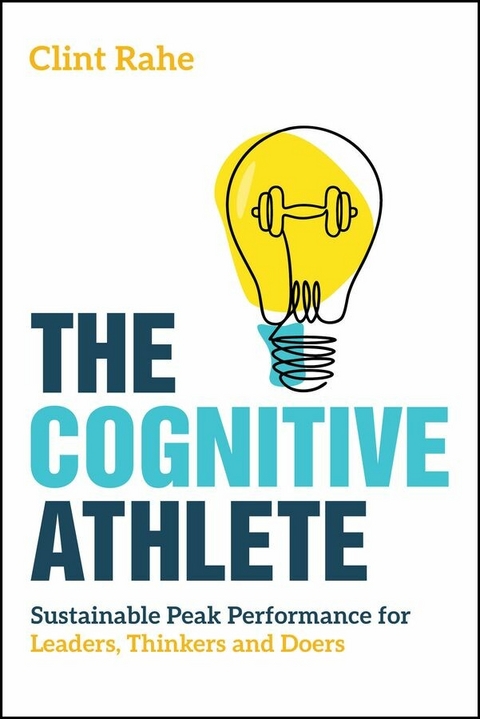
The Cognitive Athlete (eBook)
200 Seiten
Wiley (Verlag)
978-1-394-37539-4 (ISBN)
Transform how you think. Transform how you perform. Transform your life.
In The Cognitive Athlete, high-performance coach Clint Rahe reveals how to amplify your mental game using the same scientific principles that create Olympic champions. This book isn't another productivity hack or mindfulness trend. It's a complete system for building unshakeable focus, bulletproof resilience and sustainable peak performance.
Through cutting-edge neuroscience, case studies from top performers and battle-tested strategies, you'll discover how to master the four phases that separate mental athletes from everyone else: conditioning, transition, performance and recovery. These cognitive phases will help you not just survive but thrive amid the relentless demands of modern work. You'll find healthy ways to combat the long hours, constant pressure and sky-high expectations that have become inescapable features of the workplace.
Discover how to:
- Build the cognitive foundation you need for future success
- Navigate pressure and setbacks with the composure of an elite athlete
- Execute at your highest level when it matters most
- Sustain excellence without burning out
Stop taking your mental performance for granted. Whether you're leading a team, building a company or pursuing ambitious goals, The Cognitive Athlete is your playbook for winning the game that matters most: the mental one.
Clint Rahe is a facilitator, consultant, and high-performance coach who transforms how leaders think, work, and recover, bringing the principles of elite sport and military precision to the modern workplace.
Introduction
The modern professional’s dilemma
It’s Tuesday morning, and Dawn is already behind. As the head of a business unit in a global financial firm, her day begins at 6 am, responding to emails from her team in the United States. She scrambles through breakfast, juggling tasks on her phone while half-listening to the morning news in the background. She’s barely had time to sip her coffee before she’s pulled into the day’s first crisis — an urgent client issue that needs her immediate attention. A message from her boss flashes across her screen: Can you jump on a quick call? The request isn’t really a question; it’s an expectation. Dawn sighs, grabs her laptop and settles in for another relentless day.
By 9 am, she’s in back-to-back meetings with her Australian colleagues, barely able to focus on one discussion before being pulled into the next. The conversations blur together, mixing performance reports with budget reviews and project deadlines. Somewhere between the third and fourth Teams call, she realises she hasn’t taken a single deep breath.
By noon, she’s running on caffeine and adrenaline. Eating at her desk has become the norm, and skipping lunch completely isn’t uncommon. She quickly types out responses to urgent emails between calls, knowing that if she doesn’t reply now, they’ll pile up even further.
Her to-do list is growing faster than she can clear it.
By 3 pm, her energy starts to dip, but there’s no time to rest. More emails, more meetings. An unexpected request from senior leadership throws her entire schedule into chaos, forcing her to reshuffle priorities once again. She had planned to spend the afternoon on deep work, but now she’s putting out fires and reacting instead of strategising.
By 6 pm, Dawn finally steps away from her laptop and leaves her home office, heading into the kitchen where her family is already gathered. Rushing through dinner, she listens half-heartedly as her kids excitedly talk about their day, but her mind is still stuck on unanswered emails and the tasks she hasn’t finished. Her phone sits next to her plate, lighting up every few minutes with notifications she tries to ignore.
By 7 pm, she’s helping with the bedtime routine of bathing the kids, reading a short story and tucking them in. She knows she should be more present, but her attention drifts. As her youngest asks for one more hug, she feels a pang of guilt. I should spend more time with them, she thinks, but there’s just too much to do.
By 8 pm, the house is quiet, and she has a brief moment to breathe. She considers unwinding with her husband, maybe watching a show together, but the pull of unfinished work is too strong. She grabs her laptop to clear out a few more emails before her next round of meetings.
By 10 pm, she’s back in her home office, logging in for meetings with her European colleagues. Her eyes are heavy, her focus fading, but skipping these calls isn’t an option. Decisions need to be made, reports need to be reviewed and expectations remain high. She forces herself to stay engaged, nodding along as her team discusses strategy, but her mind feels sluggish, struggling to process information as quickly as usual.
By 12 am, the meetings finally wrap up. She shuts her laptop and steps away from her desk, exhausted but unable to relax. Even as she climbs into bed, her mind won’t switch off. She mentally runs through the next day’s schedule — an early client meeting, two strategy sessions and a performance review. Sleep doesn’t come easy.
The next morning, it all starts again.
The cost of constant overload
Dawn is proud of her work ethic. She’s always been someone who pushes through challenges, meets deadlines and takes ownership. She has built her career on being the person who never drops the ball. But, deep down, she knows something is wrong.
She’s exhausted all the time. No matter how early she goes to bed, she wakes up feeling drained and as if she hasn’t rested at all. The brain fog is creeping in, and tasks that once felt effortless now take twice as long. She stares at her screen, struggling to process emails that should take seconds to read. The simplest decisions — such as what to eat, what to wear, whether she has time to work out — feel overwhelming.
Her body is showing signs of stress, too. A simple cold that used to pass in a few days now lingers for weeks. She finds herself getting sick more often, and catching every flu and virus going around. Headaches are now a regular part of her day, and she’s relying on caffeine and painkillers to keep functioning. Her digestion is off, and she can’t remember the last time she felt truly well.
But the worst part is that the moment she finally gets a break, her body completely shuts down.
Every year, she looks forward to taking annual leave. She pictures herself on the beach with her family, sleeping in and waking up feeling refreshed. But as soon as she finally steps away from work, exhaustion hits her like a freight train. On her first day off, she feels unusually tired. By the second day, she’s in bed with a pounding headache, body aches and a sore throat. What was supposed to be a time to recharge turns into a week of lying in bed, feeling miserable, frustrated and defeated.
She spends the entire year pushing through exhaustion, only to spend her hard-earned time off recovering. Instead of enjoying her break, she spends it feeling run-down. By the end, she has recovered just enough to crawl back into the chaos and start the cycle all over again.
Dawn feels disconnected from the things that used to bring her joy. She used to love exercising, but now she can’t find the energy. She used to enjoy reading, but she’s too mentally drained to focus on a book. Even her time with her family feels fragmented. She’s physically there, but her mind is somewhere else. Her husband notices she’s always distracted. Her kids barely get a full conversation from her before she checks her phone. Even on weekends, she’s never fully present.
She’s tried using productivity apps, time-blocking and even mindfulness, but nothing sticks. The more she tries to optimise her work, the more depleted she feels.
Dawn’s story is not unique.
Millions of professionals find themselves trapped in this relentless forwards motion — always ‘on’, always chasing impossible expectations and constantly juggling competing priorities. For too many, the pressure to perform has become a silent epidemic, leaving high achievers stretched thin, uninspired and at risk of burnout.
If you’ve picked up this book, perhaps you feel a lot like Dawn. I’m here to tell you that you can break free from the exhaustion cycle and learn how to achieve excellence without sacrificing wellbeing. It’s time to rethink how you work, perform and recover so that success no longer comes at the cost of health and happiness. It’s time to thrive rather than just survive.
You don’t need to push harder. You need a new way to work. And that’s exactly what this book will teach you.
Why are we struggling?
The modern workplace has become an unrelenting environment of high expectations, constant connectivity and overwhelming demands. Many professionals are working longer hours, multitasking endlessly, and sacrificing their health and relationships just to keep up. The result is burnout, chronic stress and a relentless feeling of always being one step behind.
But the problem isn’t just the volume of work; it’s also the way we approach it. We have been conditioned to believe that success is a direct result of working harder, pushing through exhaustion and constantly being available. We treat ourselves as if we’re machines, expecting continual output with minimal downtime, and ignoring the fact that we are biological beings with natural energy cycles that need managing.
This mindset of continual output, born from outdated productivity models, fails to account for the mental, emotional and physical toll of high-pressure environments. Many of us feel the pressure to be ‘always on’ — answering emails late into the night, responding to Teams messages on weekends and squeezing in ‘just one more task’ before bed. The line between work and personal life has completely blurred, and for many professionals, true rest feels impossible.
Research consistently shows that burnout is at an all-time high. According to Gallup’s 2020 report, Employee Burnout: Causes and Cures, for example, nearly 76 per cent of employees report feeling burned out at least some of the time. This is compounded by the ‘always-on’ culture, driven by technology, which blurs the lines between work and personal time. For leaders and knowledge workers especially, the mental load of decision-making, problem-solving and managing people adds a layer of complexity that’s hard to quantify but deeply felt.
The consequences extend far beyond just feeling tired, and include the following:
- Diminished performance: Burnout leads to cognitive fatigue, slower decision-making and reduced creativity. In other words, the harder you push, the worse you perform.
- Emotional exhaustion: Chronic stress drains emotional...
| Erscheint lt. Verlag | 23.12.2025 |
|---|---|
| Sprache | englisch |
| Themenwelt | Sachbuch/Ratgeber ► Beruf / Finanzen / Recht / Wirtschaft ► Bewerbung / Karriere |
| Wirtschaft ► Betriebswirtschaft / Management | |
| Schlagworte | brain training • Burnout • Cognitive Training • Concentration • fatigue • focus • High Performance • increasing energy • mental conditioning • mental fitness • Mindset • Neuroplasticity • Neuroscience • optimisation • performance improvement strategies • performance psychology • Productivity • Resilience • stress management • Work performance |
| ISBN-10 | 1-394-37539-5 / 1394375395 |
| ISBN-13 | 978-1-394-37539-4 / 9781394375394 |
| Informationen gemäß Produktsicherheitsverordnung (GPSR) | |
| Haben Sie eine Frage zum Produkt? |
 EPUB (Adobe DRM)
Kopierschutz: Adobe-DRM
Adobe-DRM ist ein Kopierschutz, der das eBook vor Mißbrauch schützen soll. Dabei wird das eBook bereits beim Download auf Ihre persönliche Adobe-ID autorisiert. Lesen können Sie das eBook dann nur auf den Geräten, welche ebenfalls auf Ihre Adobe-ID registriert sind.
Details zum Adobe-DRM
Dateiformat: EPUB (Electronic Publication)
EPUB ist ein offener Standard für eBooks und eignet sich besonders zur Darstellung von Belletristik und Sachbüchern. Der Fließtext wird dynamisch an die Display- und Schriftgröße angepasst. Auch für mobile Lesegeräte ist EPUB daher gut geeignet.
Systemvoraussetzungen:
PC/Mac: Mit einem PC oder Mac können Sie dieses eBook lesen. Sie benötigen eine
eReader: Dieses eBook kann mit (fast) allen eBook-Readern gelesen werden. Mit dem amazon-Kindle ist es aber nicht kompatibel.
Smartphone/Tablet: Egal ob Apple oder Android, dieses eBook können Sie lesen. Sie benötigen eine
Geräteliste und zusätzliche Hinweise
Buying eBooks from abroad
For tax law reasons we can sell eBooks just within Germany and Switzerland. Regrettably we cannot fulfill eBook-orders from other countries.
aus dem Bereich