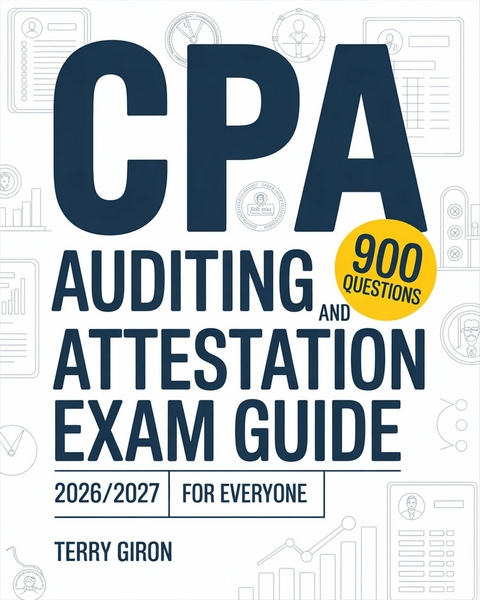
CPA Auditing and Attestation Exam Guide 2026/2027 for Everyone (eBook)
227 Seiten
Publishdrive (Verlag)
978-0-00-112824-8 (ISBN)
The CPA Auditing and Attestation Exam Guide 2026/2027 for Everyone is a structured learning resource designed to support candidates preparing for the Auditing and Attestation (AUD) section of the CPA Examination. This guide presents auditing principles, professional standards, and exam-relevant concepts in a clear, organized format suitable for learners at all stages of CPA exam preparation.
The content focuses on helping readers understand and apply auditing concepts commonly tested on the AUD exam. Key topic areas include audit planning and risk assessment, internal controls, evidence and sampling, audit procedures, audit reports, ethics and professional responsibilities, attestation engagements, and compliance audits. Explanations emphasize practical application, professional judgment, and exam-focused understanding rather than rote memorization.
Designed for Everyone-including accounting students, recent graduates, and working professionals-this guide serves as a comprehensive review and structured reference to help learners organize their study, reinforce auditing fundamentals, and approach the AUD exam with confidence.
Disclaimer: This exam guide is an independent educational resource created for general exam preparation purposes. It is not affiliated with, endorsed by, or sponsored by the AICPA, NASBA, or any official CPA examination authority. All terminology and references are used solely for educational purposes.
Chapter 2 — Ethics, Professional Responsibilities & Engagement Acceptance (Exam Topic Area)
Ethics, independence, professional responsibilities, and quality control
- Explain how the AICPA Conceptual Framework for independence operates when a partner holds a material indirect financial interest in a client through a blind trust — identify the steps the firm must take and why the conceptual framework is necessary.
- A firm provides tax planning advice that results in management making decisions that are substantially managerial in nature for an audit client. Analyze whether independence is impaired and describe the specific safeguards, if any, that could be applied.
- Describe in detail how an audit firm’s leadership responsibilities for quality within a system of quality management (ISQM 1 / AICPA QC) should be operationalized at both firm and engagement levels for a multi-office regional firm.
- A close relative of the engagement partner holds a material equity interest in the client. Construct an argument analyzing whether the engagement partner must be removed from the engagement or whether other safeguards suffice, citing the covered-member concept.
- Discuss the ethical and independence considerations and consequences when an audit firm’s nonattest practice (consulting) hires the CFO of an attest client into a senior advisory role shortly after the audit is issued.
- Evaluate how contingent fees for nonattest work performed for a client can create threats to independence for an audit engagement that follows; propose how the conceptual framework assesses and mitigates those threats.
- Explain the interaction between the AICPA Code’s principles (responsibilities, the public interest, integrity, objectivity and independence, due care, scope and nature of services) and the application of professional skepticism in planning and performing an audit.
- A firm discovers an instance of intentional misstatement by engagement staff during fieldwork. Detail the firm’s professional responsibility obligations (to client, regulators, and others) and the quality control steps required before issuing the report.
- Compare and contrast independence in fact and independence in appearance, giving two real-world examples for each and explaining the practical consequences for auditor reporting and firm reputation.
- A public company audit client requests the auditor provide valuation models for a complex acquisition that will be included in management’s disclosures. Analyze whether the auditor can provide such models and, if so, what safeguards are required under quality control and independence rules.
- Explain how engagement acceptance and continuance policies under a firm’s QC system should address clients in severe financial distress and the ethical implications of continuing such engagements.
- A senior manager rotated off an engagement accepts a position as CFO of a former audit client two months after rotation. Discuss the professional independence rules governing cooling-off periods, immediate threats, and any necessary firm actions.
- Analyze how an auditor’s receipt of a large, unsolicited gift from a client’s CEO during the audit period should be handled under the AICPA ethics rules and QC system, including documentation and reporting.
- Describe the responsibilities of the engagement quality reviewer (EQR) in a complex fraud-risk audit and explain how the EQR’s independence and competence should be evaluated under firm quality control policies.
- For an attest engagement, delineate the circumstances under which an auditor may provide internal audit outsourcing (co-sourcing) services without impairing independence, and explain the required quality control safeguards.
- Explain the ethical obligations and reporting options for a CPA who, during an audit, uncovers illegal acts by management that could materially affect the financial statements.
- A firm’s quality control monitoring finds repeated documentation deficiencies across engagements. Design an action plan to remediate root causes, including governance, training, and monitoring changes.
- Discuss the ethical and independence implications of an audit firm lending staff to an attest client for a temporary operational task (e.g., helping with an ERP conversion).
- Analyze the application of the “covered member” concept to a scenario where the audit engagement partner’s spouse is a director of a small audit client; consider whether independence is compromised.
- Explain how “independence safeguards” differ from “independence proscriptions,” and give three examples of each, explaining why one is preferred over the other in professional practice.
- Describe in detail the responsibilities of firm management under AS 1220 / ISQM 1 regarding human resources — recruitment, assignment, professional development — and how those responsibilities affect audit quality.
- A firm is approached to audit an entity where a significant former partner now serves as CEO and has stock options. Evaluate independence, including potential threats and remedial steps.
- Explain how the requirement for rotation of the engagement partner for public company audits mitigates independence threats, and discuss potential unintended consequences of rotation on audit quality.
- A firm treats a serious independence breach as a “one-off” and declines to disclose it to regulators. Analyze the ethical, legal, and QC ramifications of non-disclosure.
- Discuss the professional and ethical issues that arise when an auditor is asked to reduce the scope of procedures after initially planned fieldwork has already begun.
- Analyze the role and ethical responsibilities of an audit firm when a client’s board insists on aggressive accounting that is within GAAP gray areas but would mislead users about performance trends.
- Describe how a firm should evaluate and document independence when accepting a related party client that has complex intercompany relationships and cross guarantees across jurisdictions.
- A firm’s audit committee requires direct communication with staff below the engagement manager level. Assess the ethical and QC considerations, including confidentiality and reporting lines.
- Explain how the AICPA Code addresses conflicts of interest when a partner has a significant outside business interest that could affect a client’s audit, and describe required disclosures and actions.
- Discuss how a system of quality management should adapt for engagements with high levels of estimation uncertainty (e.g., fair value measurements), and what ethical judgment factors are most critical.
- A firm considers waiving independence concerns after obtaining a fully informed consent from the client. Critically evaluate when (if ever) such consent is permissible under AICPA rules and firm QC.
- Explain the auditor’s professional responsibilities when management refuses to provide access to certain records on the grounds of client confidentiality; discuss escalation routes and possible report modifications.
- Describe how rotation and partner tenure policies interact with EQCR (engagement quality control review) effectiveness and the firm’s monitoring activities.
- Analyze the ethical implications and independence risks when a member of the audit engagement team holds a small, nonmaterial financial interest in the client that is immaterial individually but material in aggregate across the team.
- Explain how an audit firm should handle allegations of sexual harassment by a partner at a client site, focusing on conflict of interest, independence, and quality control.
- Discuss the professional responsibility to communicate with predecessor auditors during an engagement acceptance and the ethical constraints that might limit such communications.
- A firm’s IT consulting arm develops automated controls for a client’s production system. Evaluate how that activity affects independence and what policies would permit or prohibit continued audit services.
- Explain how the “reasonable investor” perspective is applied when assessing independence in appearance in the context of familial relationships and gifts.
- A CPA discovers that the engagement partner intentionally instructed staff to omit certain corroborative procedures to shorten fieldwork. Identify the professional responsibility breaches and the firm’s QC remedies.
- Describe how an auditor should evaluate independence when the audit client is a not-for-profit organization that relies heavily on in-kind contributions from board members who are also significant vendors.
- Explain how professional skepticism should be embedded into firm training and performance evaluations as part of a quality control system, and how to measure its effectiveness.
- Analyze the differences between the PCAOB/non-PCAOB independence rules for non-audit services and provide an example where the two yield different outcomes.
- A firm is asked to perform litigation support involving quantification of damages for a current audit client; discuss the ethical considerations and whether such engagement impairs independence.
- Explain the quality control considerations and documentation expectations when an engagement team uses a Big Data analytics tool developed by a third party to test a client population.
- Discuss the interplay between confidentiality obligations and legal duty to report (e.g., to regulators, law enforcement) in cases of discovered illegal acts by audited entities.
- A firm’s monitoring function...
| Erscheint lt. Verlag | 22.12.2025 |
|---|---|
| Sprache | englisch |
| Themenwelt | Wirtschaft ► Betriebswirtschaft / Management |
| ISBN-10 | 0-00-112824-8 / 0001128248 |
| ISBN-13 | 978-0-00-112824-8 / 9780001128248 |
| Informationen gemäß Produktsicherheitsverordnung (GPSR) | |
| Haben Sie eine Frage zum Produkt? |
 EPUB (Adobe DRM)
Größe: 964 KB
Kopierschutz: Adobe-DRM
Adobe-DRM ist ein Kopierschutz, der das eBook vor Mißbrauch schützen soll. Dabei wird das eBook bereits beim Download auf Ihre persönliche Adobe-ID autorisiert. Lesen können Sie das eBook dann nur auf den Geräten, welche ebenfalls auf Ihre Adobe-ID registriert sind.
Details zum Adobe-DRM
Dateiformat: EPUB (Electronic Publication)
EPUB ist ein offener Standard für eBooks und eignet sich besonders zur Darstellung von Belletristik und Sachbüchern. Der Fließtext wird dynamisch an die Display- und Schriftgröße angepasst. Auch für mobile Lesegeräte ist EPUB daher gut geeignet.
Systemvoraussetzungen:
PC/Mac: Mit einem PC oder Mac können Sie dieses eBook lesen. Sie benötigen eine
eReader: Dieses eBook kann mit (fast) allen eBook-Readern gelesen werden. Mit dem amazon-Kindle ist es aber nicht kompatibel.
Smartphone/Tablet: Egal ob Apple oder Android, dieses eBook können Sie lesen. Sie benötigen eine
Geräteliste und zusätzliche Hinweise
Buying eBooks from abroad
For tax law reasons we can sell eBooks just within Germany and Switzerland. Regrettably we cannot fulfill eBook-orders from other countries.
aus dem Bereich