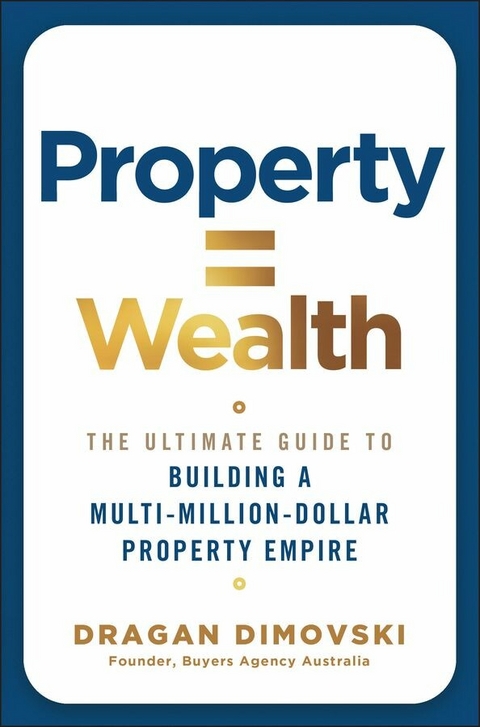
Property = Wealth (eBook)
162 Seiten
Wiley (Verlag)
978-1-394-38944-5 (ISBN)
The essential property investment guide that turns everyday Australians into confident wealth builders
It's time to realise your dream of financial freedom through property, but how do you know where to start? It's easy to feel like you're drowning in conflicting advice from agents, spruikers and well-meaning friends. Every expert seems to have a different agenda, leaving you stuck with analysis paralysis and unsure who to trust with your biggest financial decisions.
Property = Wealth cuts through the noise with straight-talking advice from property investment advisor Dragan Dimovski. Drawing on more than 20 years' experience in the property world, Dragan reveals the strategies, mindset and team you need to build lasting wealth. No sales pitches, no hidden agendas - just the honest guidance you need to make smart property decisions.
You'll discover:
- How to build a trustworthy team and spot the professionals who truly work for your best interests
- Proven investment strategies for buy-and-hold, adding value and advanced development
- Smart portfolio design techniques that balance cash flow with capital growth
- Negotiation tactics that get you better deals from real estate agents
- Risk management strategies that protect your investments from common pitfalls
Whether you're buying your first investment property or expanding an existing portfolio, this book gives you the confidence to navigate Australia's property market like a pro. Property = Wealth is your one-stop guide to building genuine wealth through property investment the right way, without the overwhelm.
DRAGAN DIMOVSKI is a Qualified Property Investment Advisor and the founder of Buyers Agency Australia. He assists his clients in achieving their dreams of financial freedom.
CHAPTER 1
ASSEMBLING YOUR A-TEAM
Read this chapter to learn:
- which professionals you’ll need to engage when purchasing property
- their roles, motivations and loyalties
- what you’ll pay for their services.
Before we dive into this chapter, it’s incredibly important to keep in mind that everyone in the property world is trying to sell you something, and I mean everyone. It’s imperative you understand that nobody works for free. Professionals such as real estate agents, mortgage brokers and conveyancers need to make a living, and that means they’re selling something, whether it’s a house, their expertise or their time.
They often rely on the purchaser’s lack of knowledge to turn a profit. If you walk into a situation unprepared, there’s a good chance you’ll hand over more money than necessary to someone who doesn’t have your best interests at heart. They may be earning a commission based on the decisions you make, and they may have vested interests that conflict with yours. You need to know what each professional does, who pays them and where you fit into their lives, rather than focusing only on how they can help you.
The more you learn and the more experienced you become, the less likely it is you’ll fall for high-pressure sales tactics or less-than-helpful advice.
CHOOSING THE RIGHT PROFESSIONALS
Choosing the right professionals is paramount to your success. As in any aspect of your life, the wrong influences can cost you dearly. You don’t want to look back after years of hard work, only to realise you didn’t hire the right people or put your money towards the best options. Opportunity cost can compound over time, so line up your ducks as early and efficiently as possible. The sooner you start, the more time your investments will have to grow, while knowledge and planning will minimise the cost of missed opportunities.
Think of it like this. I don’t know much about fixing cars. Sure, I could watch a YouTube tutorial, buy the spare parts and try to fix the car myself. But with no experience, what are the chances I’d do a good job? And I’d probably end up spending money on tools I might never use again. So I rely on a mechanic who has the skills, and the tools, to get it done right the first time. The same applies to property transactions. I wouldn’t suggest you go through this complex process alone. Instead, I recommend that you build a team of reliable, qualified experts with proven track records who do this every single day. And just as you’d research unbiased reviews and ask for verified recommendations before choosing a mechanic, research your property investment support team thoroughly.
UNDERSTANDING SALES INCENTIVES
Keep in mind that people will sell you what they have to offer, rather than encouraging you to explore what’s best for you. Why would they send you to a competitor when they can convince you to spend your money with them? Their incentives won’t always align with your best interests, so be discerning about the options presented to you. Scrutinise everything you’re told, and never be afraid to ask questions or request further information.
Here’s the good news: you’ve already bought this book! My sale is done, so any bias I may have no longer benefits me financially. My main focus is to give you real value by sharing the lessons I’ve learned. I’m hoping the opportunity costs I’ve paid over the years will help reduce yours!
STORY TIME: My first property
In my early twenties, I was gifted a ticket to a two-day seminar in Melbourne that focused on using renovation strategies to flip entry-level properties such as units. The seminar pitched an ‘easy’ approach, promising a $30 000 renovation could yield a $70 000 profit. But no guidance was offered on what to look for and how to select. Young and intrigued, I decided to give it a try.
I bought a unit in Pymble, Sydney, spent $30 000 on renovations, held on to it for 18 months and then sold it. I broke even. I hadn’t made a cent! Not only did I spend on the renovation, but I also missed out on rental income while the work was being done. I lacked the know-how either to choose a property with strong renovation potential or to negotiate a favourable purchase price. In the end, I walked away with the same amount of money I started with … and more than a few grey hairs!
My first foray into property investment! At the ripe old age of 22, I took the plunge — and fell flat. Still, I hadn’t lost money, and I had gained valuable experience. The most important lessons I took away?
- Anyone who tries to convince you property investment is easy is lying.
- Don’t believe everything a spruiker says just because they drive a Bentley.
- Do your own homework, always! Don’t take anything you’re told at face value.
I had experienced the sting of opportunity cost. I had spent nearly two years treading water while those who made smarter choices made profits.
GETTING TO KNOW THE KEY PLAYERS
Recognising which professionals to work with and which self-proclaimed experts to avoid involves knowing exactly what each brings to the table. With that in mind, we’ll go over the key players you’ll encounter on your property journey. I’m not talking about property spruikers; I’m talking about the real professionals. The ones you truly need by your side, no matter how seasoned you become.
I’ll explain their roles, what they’re really selling (sometimes it’s YOU) and how to make sure each one is looking out for your best interests. With this foundational knowledge, you’ll be empowered to make the informed decisions that will lead you to a more successful and rewarding property investment experience.
FINANCIAL ADVISER
Let’s begin with your first port of call: a financial adviser.
You’ve probably heard people say, ‘If I ever win the lottery, the first thing I’ll do is hire a financial adviser!’ Sounds responsible, right? But what exactly does this role entail?
A financial adviser helps clients make the decisions that enable them to reach their financial goals. They have the skills, qualifications and experience to offer personalised advice tailored to your situation. The key word here is personalised, because financial services law recognises different types of advice — specifically, factual information, general advice and personal advice.
Factual information, as the name implies, is objective. It’s just the facts about a product or strategy and represents the most basic standard of advice. For example, the interest rate on a savings account is 4.5 per cent per annum for the first three months.
General advice is a step up but remains broad and non-specific. It’s an opinion or recommendation that is not personally tailored for you. An example might be an Instagram post that suggests everyone should have some stocks in their portfolio. It may be well-intended, but it doesn’t take into account your particular circumstances.
A financial adviser who offers personal advice takes into account your specific situation, goals and objectives before making recommendations. They are authorised to advise you on whether to buy, sell or hold financial products such as superannuation, insurance and shares.
So what separates today’s financial advisers from those of the past? For some years they have been regulated by the Australian Securities and Investments Commission (ASIC). They are required to adhere to a professional code of ethics. As a client, you’re protected by these regulations, ensuring the advice you receive meets strict standards. For the past 15 years, the financial advice industry has been on a constantly changing regulatory path that is likely to continue evolving into the future. However, it’s still wise to do your own due diligence and to verify that your chosen adviser is genuinely qualified. After all, fraud and false claims do exist — just think of the infamous Melissa Caddick case!
It is also important to remember that not all financial advisers offer the same services. They have different service models, fee structures, specialisations and qualifications, which can be confusing. So when comparing advisers, it’s important to compare like for like.
The good news is that all financial advisers are legally required to act in your best interests and comply with the code of ethics. The Best Interests Duty (BID) is a legal obligation for all financial advisers when providing personal financial advice. The Financial Planners and Advisers Code of Ethics, originally introduced by the Financial Adviser Standards and Ethics Authority (FASEA) and now overseen by Treasury and ASIC, sets legally binding principles to ensure ethical conduct.
Education standards have also risen significantly. Today’s financial advisers must meet stringent education requirements, though some longstanding advisers are exempt. My advice? Find one who has taken the time and effort to obtain a relevant degree or higher qualification.
It’s also important to understand how financial advisers are compensated, particularly...
| Erscheint lt. Verlag | 19.12.2025 |
|---|---|
| Sprache | englisch |
| Themenwelt | Wirtschaft ► Betriebswirtschaft / Management |
| Schlagworte | are houses affordable in Australia? • Auction • Australian property investing • buyer's agent • can I buy a house Australia? • Conveyancer • easy property investing Australia • Equity • financial freedom • first home buyer • home investing Australia • Housing crisis • Investment Property • is property investing easy in Australia? • mortgage • Mortgage Broker • personal finance • property portfolio • real estate agent • simple property investing Australia • Stamp duty |
| ISBN-10 | 1-394-38944-2 / 1394389442 |
| ISBN-13 | 978-1-394-38944-5 / 9781394389445 |
| Informationen gemäß Produktsicherheitsverordnung (GPSR) | |
| Haben Sie eine Frage zum Produkt? |
 EPUB (Adobe DRM)
Kopierschutz: Adobe-DRM
Adobe-DRM ist ein Kopierschutz, der das eBook vor Mißbrauch schützen soll. Dabei wird das eBook bereits beim Download auf Ihre persönliche Adobe-ID autorisiert. Lesen können Sie das eBook dann nur auf den Geräten, welche ebenfalls auf Ihre Adobe-ID registriert sind.
Details zum Adobe-DRM
Dateiformat: EPUB (Electronic Publication)
EPUB ist ein offener Standard für eBooks und eignet sich besonders zur Darstellung von Belletristik und Sachbüchern. Der Fließtext wird dynamisch an die Display- und Schriftgröße angepasst. Auch für mobile Lesegeräte ist EPUB daher gut geeignet.
Systemvoraussetzungen:
PC/Mac: Mit einem PC oder Mac können Sie dieses eBook lesen. Sie benötigen eine
eReader: Dieses eBook kann mit (fast) allen eBook-Readern gelesen werden. Mit dem amazon-Kindle ist es aber nicht kompatibel.
Smartphone/Tablet: Egal ob Apple oder Android, dieses eBook können Sie lesen. Sie benötigen eine
Geräteliste und zusätzliche Hinweise
Buying eBooks from abroad
For tax law reasons we can sell eBooks just within Germany and Switzerland. Regrettably we cannot fulfill eBook-orders from other countries.
aus dem Bereich