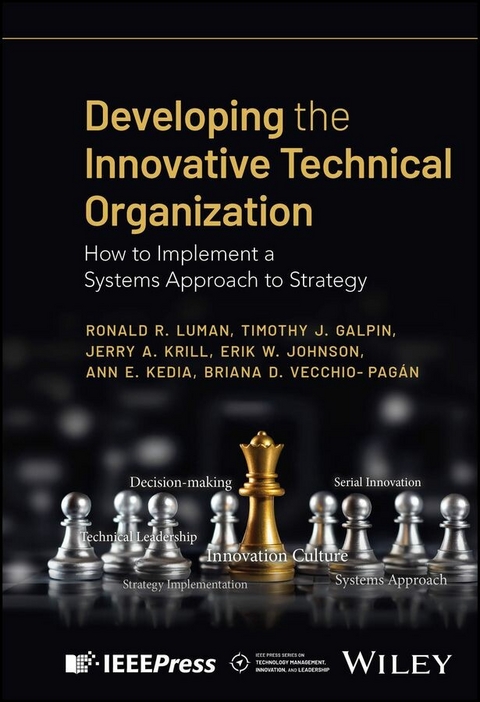
Developing the Innovative Technical Organization (eBook)
288 Seiten
Wiley-IEEE Press (Verlag)
978-1-394-37612-4 (ISBN)
A proven systems approach to driving innovation and strategy in complex technical organizations
The call for corporate innovation is often celebrated in theory, but innovation is rarely achieved at scale within established technical organizations. Developing the Innovative Technical Organization: How to Implement a Systems Approach to Strategy addresses this challenge by exploring how the Johns Hopkins University Applied Physics Laboratory (APL) successfully elevated its impact through a rigorously designed and executed strategy system.
The authors, all current or former senior leaders at APL, detail APL's decade-long journey of strategy development and implementation, from articulating a long-range vision to building a sustainable annual cycle that ensures accountability, alignment, and full enterprise engagement. Rich with practical lessons, cultural insights, and stories of both setbacks and successes, this work goes beyond case anecdotes to present a comprehensive methodology. Written as a strategy guidebook, it will enable readers to adapt this systems approach to their own organizations, ensuring that innovation is not the exception but the expectation.
Applicable to technical organizations across the for-profit, nonprofit, and government sectors, this essential guide to embedding innovation into strategy and sustaining impact in the face of evolving challenges introduces:
- A full-cycle system linking vision, strategy articulation, decision-making, innovation, and accountability processes.
- Methods to align resources with strategic priorities to maximize organizational agility.
- Cultural and communications lessons learned in engaging middle management and staff in innovation initiatives.
- Detailed examples of innovation experiments and their influence on organizational transformation.
- Strategy-driven, innovative results attributed to implementing this systems approach at APL.
Developing the Innovative Technical Organization is a must-read for executives, senior managers, and decision-makers in technical organizations, particularly those seeking to scale innovation and implement strategy in complex environments. It is recommended for graduate-level courses in engineering management, business strategy, and organizational leadership, and is also a valuable reference for consultants and policymakers.
RONALD R. LUMAN, DSc, is a Senior Adviser, former Chief of Staff, and former Assistant Director for Strategy at APL.
TIMOTHY J. GALPIN, PhD, is the former Chief Strategy Officer and Assistant Director for Programs at APL.
JERRY A. KRILL, PhD, is APL's Assistant Director for Science and Technology and Chief Technology Officer.
ERIK W. JOHNSON, MBA, is APL's Chief of Staff and former Managing Executive of its Force Projection Sector.
ANN E. KEDIA, MS, is the Chief Communications Officer at APL and former Vice President at T. Rowe Price.
BRIANA D. VECCHIO-PAGÁN, PhD, is Program Manager for Innovation and Collaboration at APL.
With a foreword by Admiral James Stavridis, USN (RET)
1
Introduction
This is a leadership and management book focused on how a technical organization can elevate itself through strategy development and implementation centered on innovation. If you are a technologist, engineer, or scientist who has moved into management functions in a technology, engineering, or research organization and you recognize the need to take your own organization to a new level of capability and impact, then this book is for you.
Written by principals in the conception and implementation of a vision and strategy system at the nation's largest university-affiliated research center (UARC),1 the book rests on two premises that have been borne out through experimentation and experience. The first is that taking a systems approach to integrating strategy development and execution results in a strategy-driven organization. The second is that a relentless focus on infusing innovation into the entire organization produces a beneficial culture change that raises the organization to a new level of results and success.
Many excellent business strategies have died on the vine in the implementation phase. To avoid that outcome, the systems approach to strategy we describe begins its development with execution in plain view, and execution likewise keeps the strategy always in sight. They go hand in hand. The key to successful implementation is to make the strategy foundational to the organization's planning and execution cycle, acknowledging that many strategic and operational planning activities interrelate and that elements of the strategy require occasional adjustments. That is, we advocate and demonstrate institutionalizing the vision and strategy such that they are always visible and meaningful to decision-making at all levels of the organization. Specifically, the strategy should carry consequences for resource allocation, executive accountability, programmatic priorities, and innovation. This is what we mean when we say that an organization is strategy driven.
The beneficial cultural change of the second premise is achieved through a dynamic and sustained set of innovation-promoting initiatives aligned with the organization's vision and strategy. Simply imploring staff members to be more innovative or enhancing the physical environment is unlikely to produce lasting change. This book describes some prerequisites for widespread innovation and suggests elements of an innovation incentive program that focus on empowering all staff members to innovate.
The heart of the book holds true to its title by suggesting an integrated strategy development and implementation system for creating an innovative technical organization. We describe six strategic planning methods, woven together to form an integrated system, that you can consider adopting and adapting for your own organization:
- a classic vision framework [1];
- a one-page strategy articulation adapted from industry [2];
- a continuous decision-making process [3];
- alignment of resources to strategic priorities;
- regular accountability reviews; and
- genuine engagement of the entire staff in fostering innovation aligned with the vision and strategy.
In short, the book offers a system that has been engineered for implementing business strategies where innovation is a principal objective. We describe the purpose and practice for each system element and the lessons learned during implementation over nearly 15 years to enable you to adapt the system to your organization's unique strategic needs. Along the way, we present examples and stories of cultural issues and their resolution and detail a series of initiatives that encourage all staff members to innovate in all that they do. Regardless of your corporate business sector, the case study evidence can reassure you that your organization's vision and strategy can be successfully implemented to drive the organization forward, even through volatile times. To help you determine your company's readiness to implement a new strategy that won't end up sitting on the shelf, we offer probing questions at the end of each chapter.
The basics of this integrated systems approach were first published in an IEEE Engineering Management Review article [4], which was necessarily concise and rather narrowly focused on the particular implementation as it evolved at the Johns Hopkins Applied Physics Laboratory (APL).2 This book includes much of the material from that article but expands on it and supplements it with new material. Writing the book enabled us to reflect on our experience, conduct additional research, and expand our lessons learned to be applicable across a broad range of technical organizations. We also address more deeply several critical topics that we only touched on in our initial work, such as considering innovation prerequisites and performance, communicating strategy, and fully engaging middle management. Moreover, we provide additional detail on the specifics of developing and implementing strategy. It is our hope that this expanded discussion will be used as a guidebook by a wide range of technical organizations seeking to realize a bold and compelling vision.
Consequently, the rest of the book is organized as follows:
- Chapter 2, The Strategic Innovation Imperative, discusses why technical organizations should innovate strategically. It includes examples of threats and opportunities that could trigger an organization to realize the need for a new vision and strategy founded on infusing innovation throughout the enterprise.
- Chapter 3, The Integrated Strategy System, introduces the approach and its underpinnings. The strategy system consists of a four-element annual cycle as its core activity, guided by a long-range vision framework and complemented by an innovation program designed to empower the entire organization to innovate. By identifying differences in implementation between nonprofit and for-profit organizations, we aim to provide a blueprint for application to your own organization.
- Chapter 4, Implementing the System's Annual Cycle: Phase 1, discusses how a strategy-driven organization would implement the strategy system's annual cycle described in Chapter 3. We provide practical tips and point to valuable lessons that we learned when implementing the cycle at APL. This chapter also includes a robust discussion of the steps APL leaders took to inspire innovative approaches among the entire staff and to incentivize the behaviors (e.g., collaboration and boldness) and outcomes they sought to foster.
- Chapter 5, Annual Strategy Cycle Planning Guide, elaborates on the previous chapter with detailed guidance and methods for strategy development, refinement, and execution, including sequencing and scheduling the annual strategy cycle. We provide insights on the strategic planning horizon, strategy updates, resource allocation, and scheduling of critical activities. It concludes with a supporting sample letter, focused on aligning resources to strategic execution priorities, that kicks off the annual cycle.
- Chapter 6, Building the Long-Range Vision to Anchor the System: Phase 2, describes how the strategy-driven organization would implement the full strategy system by developing the long-range vision framework to which the annual strategy system is anchored. We offer practical tips and lessons learned from our experience with this phase of the system.
- Chapter 7, Innovating Innovation – “Keep What Works,” introduces four environmental prerequisites for an innovative culture, each of which requires some experimentation to establish in any organization. We suggest a set of innovation initiatives, designed to be managed as a formal yet dynamic program that keeps what works (as indicated by metrics) while being refreshed with new ideas annually. The chapter closes with enterprise-wide innovation performance measures and indicators useful for tracking progress.
- Chapter 8, Engaging Middle Management, explores some mid-level leaders' natural skepticism about a vision and strategy system developed by executive leadership. It provides methods for proactively engaging middle managers and eliminating existing bureaucracy to make room for a streamlined strategic planning process that you can adapt to your own organization.
- Chapter 9, Communicating the Strategy, discusses the importance of effective communications to the success of implementing an organization's strategy. It explores nuances associated with various cultures and business sectors so that you can formulate a supportive communications strategy tailored to your own organization.
- Chapter 10, Strategy-Driven Results, answers the question, “Will this really work?” by detailing outcomes that are traceable to the strategy implementation, such as serial innovations and external recognitions as evidence of closing the “strategy-to-performance gap” [5], particularly with regard to innovation.
- Chapter 11, Lessons Learned and Retrospective, recounts the significant lessons we learned from implementing the strategy system. These lessons broadly apply to any organization embarking on the journey that is strategy and innovation. In particular, we offer insights on specific roles and behaviors of the organization's leadership team that are critical for the successful and sustained implementation of strategy.
- Appendix A describes the origins and current state of the United States' often-overlooked...
| Erscheint lt. Verlag | 19.12.2025 |
|---|---|
| Sprache | englisch |
| Themenwelt | Wirtschaft |
| ISBN-10 | 1-394-37612-X / 139437612X |
| ISBN-13 | 978-1-394-37612-4 / 9781394376124 |
| Informationen gemäß Produktsicherheitsverordnung (GPSR) | |
| Haben Sie eine Frage zum Produkt? |
 EPUB (Adobe DRM)
Größe: 16,4 MB
Kopierschutz: Adobe-DRM
Adobe-DRM ist ein Kopierschutz, der das eBook vor Mißbrauch schützen soll. Dabei wird das eBook bereits beim Download auf Ihre persönliche Adobe-ID autorisiert. Lesen können Sie das eBook dann nur auf den Geräten, welche ebenfalls auf Ihre Adobe-ID registriert sind.
Details zum Adobe-DRM
Dateiformat: EPUB (Electronic Publication)
EPUB ist ein offener Standard für eBooks und eignet sich besonders zur Darstellung von Belletristik und Sachbüchern. Der Fließtext wird dynamisch an die Display- und Schriftgröße angepasst. Auch für mobile Lesegeräte ist EPUB daher gut geeignet.
Systemvoraussetzungen:
PC/Mac: Mit einem PC oder Mac können Sie dieses eBook lesen. Sie benötigen eine
eReader: Dieses eBook kann mit (fast) allen eBook-Readern gelesen werden. Mit dem amazon-Kindle ist es aber nicht kompatibel.
Smartphone/Tablet: Egal ob Apple oder Android, dieses eBook können Sie lesen. Sie benötigen eine
Geräteliste und zusätzliche Hinweise
Buying eBooks from abroad
For tax law reasons we can sell eBooks just within Germany and Switzerland. Regrettably we cannot fulfill eBook-orders from other countries.
aus dem Bereich