The Laundromat Business Bible (eBook)
147 Seiten
Robert F. Cannon (Verlag)
978-0-00-068031-0 (ISBN)
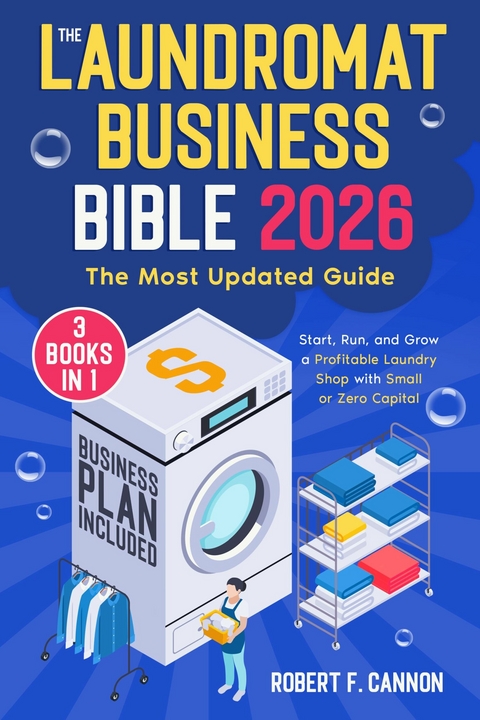
How to Make Money on Autopilot in 2025... With Little or NO MONEY Down!
Here's the deal... Starting and growing a business is not that easy nowadays.
87% Of the business fails in the first 3 years, for a simple reason... WRONG BUSINESS MODEL!
The Laundromat business is for anyone who want a steadily growing stream of income, and don't want to worry about certain government regulations, covid or anything that can get in the way of their business success.
And inside this book you will get the exact blueprint I used to scale my Laudromat Business to 7 figures in less than 3 years!
Check out what's inside:
✅ How to start with zero or no money down
✅ 7 Secrets to start a successful laundromat business right away
✅ How to save a lot of money when starting out
✅ Laundromat Equipment, what do you need to get started?
✅ The best strategies to run the business on autopilot
✅ How to Maximize Your Profits and make sure you are cash-positive from the start?
✅ Everything you need to know about Future Planning and Maintenance
✅ How to build a brand everybody knows about
✅ So much more!
This manual will literally walk you step by step on building a business that can generate solid income for years and decades without the usual stress and headaches entrepreneurs have to go through!
Scroll back up, get your copy, and Become the Next Laundromat Success Story!
Chapter 2: Key Considerations Before Launching
Initiating a laundromat business requires careful planning and evaluation. The initial investment, encompassing equipment and leasehold improvements, demands thorough financial projections. Understanding the scope of these costs prevents unexpected financial burdens and ensures a realistic budget.
Location analysis is critical. Demographic research identifies areas with high rental populations and limited in-unit laundry facilities. Assessing competitor presence and local demand reveals market saturation or potential service gaps. Accessibility and parking availability further influence customer traffic. Diversifying revenue streams through ancillary services enhances profitability. Evaluating these key considerations before launching mitigates risks and lays a solid foundation for long-term success.
Startup Costs and Investment Levels
The initial financial outlay for a laundromat varies significantly based on location, equipment, and business size. A comprehensive budget is essential to avoid undercapitalization. Equipment acquisition, including washing machines and dryers, constitutes a substantial portion of the startup costs. New, high-efficiency machines can range from $5,000 to $10,000 each, while used equipment may offer lower upfront costs but potentially higher maintenance expenses.
Leasehold Improvements and Initial Inventory
Leasehold improvements, such as flooring, lighting, and plumbing, also contribute to startup costs. These expenses vary based on the condition of the leased space and the extent of required renovations. An initial inventory of laundry supplies, vending machine products, and change funds is necessary. These costs, while smaller than equipment and leasehold improvements, must be accounted for in the overall budget.
Contingency Planning and Financial Projections
Developing a contingency fund, accounting for unexpected expenses, is crucial. A buffer of 10-20% of the total estimated startup costs is recommended. Financial projections, including revenue forecasts and expense estimates, provide a roadmap for the business’s financial health. These projections should incorporate realistic assumptions about customer traffic, service pricing, and operational efficiency. The total investment level should align with the owner's financial capacity and risk tolerance. A detailed financial plan mitigates risks and ensures a solid foundation for the business.
Here is a table illustrating potential startup costs:
| Expense Category | Estimated Cost Range | Notes |
| Washing Machines (New) | $100,000 - $200,000 (20 machines) | $5,000 - $10,000 per machine |
| Dryers (New) | $50,000 - $100,000 (10 dryers) | $5,000 - $10,000 per dryer |
| Leasehold Improvements | $20,000 - $50,000 | Varies by location |
| Initial Inventory | $5,000 - $10,000 | Supplies, vending, change fund |
| Contingency Fund (15%) | $26,250 - $54,000 | 15% of total estimated cost |
| Total Estimated Startup Costs | $201,250 - $414,000 |
|
Evaluating Location and Demographics
Selecting an optimal location is crucial for a laundromat's success. High-traffic areas with a dense population of renters and families provide a strong customer base. Demographic research identifies areas with a high percentage of apartment dwellers or households without in-unit laundry. For example, census data from 2022 indicates that neighborhoods with over 60% renter occupancy show higher demand for laundromat services.
Accessibility and Visibility
Accessibility and visibility are key factors in location selection. A location with ample parking and easy access from major roads attracts more customers. Proximity to complementary businesses, such as grocery stores or convenience stores, further enhances customer convenience. A corner location, for instance, offers better visibility compared to a mid-block space. Traffic flow patterns and public transportation access influence customer traffic. A location near a bus stop or subway station can increase foot traffic, especially during peak hours.
Demographic Data and Market Analysis
Demographic data, including median income, household size, and age distribution, provides insights into customer spending habits and service preferences. Areas with a median household income of $40,000 to $70,000 often exhibit consistent demand for affordable laundry services. Market analysis, including competitor analysis and demand assessment, helps determine market saturation and potential service gaps. Identifying underserved areas or niche markets, such as student housing or senior living facilities, can create a competitive advantage. The location should align with the target demographic’s needs and preferences to ensure a steady customer flow.
Here is a table illustrating key demographic and location factors:
| Factor | Importance | Example Metric | Impact on Business |
| Renter Occupancy | High | 60% or higher | Increased customer base |
| Median Household Income | Moderate | $40,000 - $70,000 | Consistent demand for services |
| Accessibility | High | Ample parking, proximity to transit | Increased customer traffic |
| Visibility | High | Corner location, main street frontage | Increased customer awareness |
| Proximity to Complementary Businesses | Moderate | Near grocery stores, apartments | Increased customer convenience |
| Competitor Density | Low | Few existing laundromats | Reduced competition |
Assessing Competition and Local Demand
Evaluating the existing laundromat landscape is crucial for strategic positioning. Identifying competitors, their pricing structures, and their service offerings provides insights into market saturation and potential service gaps. A detailed competitive analysis involves visiting each competitor's location, noting their equipment condition, customer traffic, and service quality. For instance, a competitor charging $3.00 per wash and $0.50 per 10 minutes of drying sets a benchmark for local pricing.
Demand Assessment and Market Saturation
Assessing local demand involves analyzing demographic data and conducting surveys. Areas with a high density of apartment dwellers or households without in-unit laundry exhibit consistent demand. For example, a survey conducted in a neighborhood with 70% renter occupancy revealed that 80% of residents utilize laundromat services at least twice a month. Understanding market saturation prevents over-investment in areas with excessive competition. If multiple laundromats operate within a one-mile radius, market saturation may limit potential revenue.
Identifying Service Gaps and Niche Markets
Identifying service gaps and niche markets creates a competitive advantage. Offering specialized services, such as eco-friendly laundry options or 24-hour operation, caters to specific customer needs. For instance, a laundromat located near a college campus might offer student discounts or extended hours during exam periods. Targeting niche markets, such as senior living facilities or tourist accommodations, further diversifies the customer base and increases revenue. A thorough assessment of competition and local demand ensures that the business aligns with market needs and avoids oversaturation.
Here is a table illustrating key competitive and demand factors:
| Factor | Importance | Example Metric | Impact on Business |
| Competitor Pricing | High | $3.00 per wash, $0.50 per 10 min dry | Sets local pricing benchmark |
| Equipment Condition | Moderate | Age and efficiency of machines | Influences operational costs and customer satisfaction |
| Customer Traffic | High | Peak hours and average visits | Indicates demand and revenue potential |
| Renter Occupancy | High | 70% renter occupancy | High demand for laundry services |
| Survey Results | Moderate | 80% use laundromat twice monthly | Confirms demand and usage... |
| Erscheint lt. Verlag | 9.12.2024 |
|---|---|
| Sprache | englisch |
| Themenwelt | Wirtschaft ► Betriebswirtschaft / Management |
| ISBN-10 | 0-00-068031-1 / 0000680311 |
| ISBN-13 | 978-0-00-068031-0 / 9780000680310 |
| Informationen gemäß Produktsicherheitsverordnung (GPSR) | |
| Haben Sie eine Frage zum Produkt? |
 EPUB (Adobe DRM)
Größe: 874 KB
Kopierschutz: Adobe-DRM
Adobe-DRM ist ein Kopierschutz, der das eBook vor Mißbrauch schützen soll. Dabei wird das eBook bereits beim Download auf Ihre persönliche Adobe-ID autorisiert. Lesen können Sie das eBook dann nur auf den Geräten, welche ebenfalls auf Ihre Adobe-ID registriert sind.
Details zum Adobe-DRM
Dateiformat: EPUB (Electronic Publication)
EPUB ist ein offener Standard für eBooks und eignet sich besonders zur Darstellung von Belletristik und Sachbüchern. Der Fließtext wird dynamisch an die Display- und Schriftgröße angepasst. Auch für mobile Lesegeräte ist EPUB daher gut geeignet.
Systemvoraussetzungen:
PC/Mac: Mit einem PC oder Mac können Sie dieses eBook lesen. Sie benötigen eine
eReader: Dieses eBook kann mit (fast) allen eBook-Readern gelesen werden. Mit dem amazon-Kindle ist es aber nicht kompatibel.
Smartphone/Tablet: Egal ob Apple oder Android, dieses eBook können Sie lesen. Sie benötigen eine
Geräteliste und zusätzliche Hinweise
Buying eBooks from abroad
For tax law reasons we can sell eBooks just within Germany and Switzerland. Regrettably we cannot fulfill eBook-orders from other countries.
aus dem Bereich