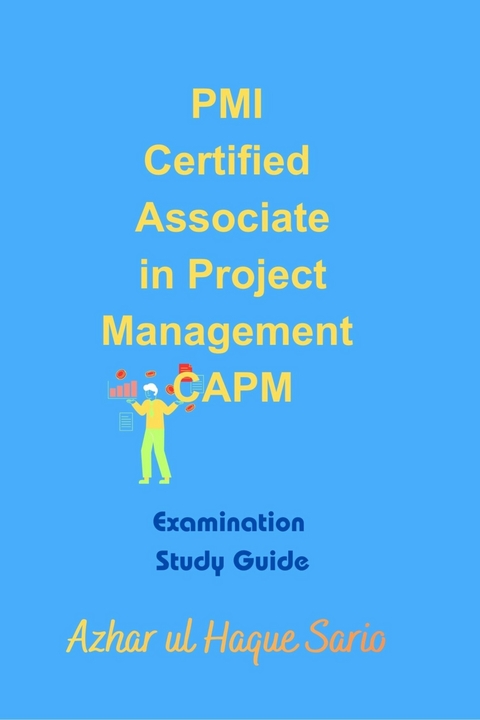
PMI Certified Associate in Project Management CAPM (eBook)
158 Seiten
Azhar Sario Hungary (Verlag)
978-3-384-78074-4 (ISBN)
Unlock the secrets of the 2026 CAPM exam with a guide that speaks your language-no jargon, just clarity.
This book is a comprehensive roadmap designed specifically for the 2026 Certified Associate in Project Management (CAPM) syllabus, breaking down complex methodologies into digestible, real-world concepts. It covers the full spectrum of modern project management, from the rigid structure of predictive 'Waterfall' life cycles to the fluid adaptability of Agile frameworks like Scrum and Kanban. You will find detailed explanations of core fundamentals, including the strategic hierarchy of projects, programs, and portfolios, and the critical distinction between temporary projects and ongoing operations. The content dives deep into the 'Iron Triangle' of scope, schedule, and cost, while also integrating modern 'Power Skills' like emotional intelligence and conflict resolution. It provides a robust toolkit for planning, executing, and monitoring projects, featuring practical guides on using Risk Registers, Stakeholder Registers, and Work Breakdown Structures (WBS). The book also explores the evolving role of the Business Analyst, teaching you how to bridge the gap between technical features and business value through effective elicitation and communication strategies.
What sets this guide apart is its refusal to treat project management as a dry, academic exercise; instead, it presents the material as a living, breathing discipline essential for the modern professional. While other books might drown you in rote memorization of inputs and outputs, this guide focuses on the 'why' and 'how' behind the processes, using relatable analogies-like comparing project constraints to a 'Iron Triangle' or explaining the difference between a project manager and a sponsor through the lens of a ship's captain and its owner. It addresses the hybrid reality of 2026, where you aren't just choosing between Agile or Waterfall but blending them to fit the specific needs of your organization. By emphasizing value delivery over mere compliance and integrating forward-looking trends like AI-driven sentiment analysis and digital dashboards, this book equips you not just to pass an exam, but to step into a project leadership role with confidence and strategic insight.
Key Topics Covered:
Strategic Frameworks: Understanding the hierarchy of Portfolios, Programs, and Projects.
Methodology Mastery: Deep dives into Predictive (Waterfall), Adaptive (Agile), and Hybrid approaches.
Core Planning Tools: detailed guides on Critical Path Method (CPM), Earned Value Management (EVM), and WBS creation.
Agile Ecosystems: Exploring Scrum, Kanban, XP, and SAFe components like Backlogs and Burndown Charts.
Business Analysis: Techniques for elicitation, stakeholder identification, and requirements traceability.
Power Skills: The vital role of Emotional Intelligence (EQ), leadership vs. management, and ethical decision-making.
Copyright Disclaimer: This publication is independently produced by Azhar ul Haque Sario and is not affiliated with, sponsored by, or endorsed by the Project Management Institute (PMI). All references to PMI, CAPM, and PMBOK are used under nominative fair use for educational purposes only.
Agile Frameworks/Methodologies
This guide provides a deep dive into Task 1: Explain when it is appropriate to use an adaptive approach, analyzing the friction between predictive certainty and adaptive flexibility, and exploring the ecosystem required to sustain agility.
Part 1: The Great Divide – Adaptive vs. Predictive Approaches
To understand when to use an adaptive approach, we must first critically compare it against its predecessor: the predictive, plan-based model. By 2026, the industry acknowledges that neither is "better" in a vacuum; their value is entirely contextual.
The Predictive (Plan-Based) Paradigm
Often referred to as "Waterfall," this approach treats a project like a carefully orchestrated symphony. The score is written before the first note is played. It assumes that the future is knowable and that risk lies in deviation from the plan.
The Philosophy: "Measure twice, cut once."
The 2026 Context: Even in an AI-driven world, predictive projects remain dominant in physical engineering, heavy construction, and regulatory compliance sectors where the cost of change is astronomical.
Pros of Predictive Projects
Predictability of Cost and Schedule: For organizations governed by strict fiscal years or fixed-bid contracts, predictive models offer a "comfort of certainty." Stakeholders know exactly when the deliverables will arrive and how much they will cost, assuming the scope remains stable.
Clear Accountability: With a hierarchical Work Breakdown Structure (WBS), every package of work is assigned. There is little ambiguity about who is responsible for what, which is crucial in low-trust or highly regulated environments.
Ease of Coordination: When managing large-scale infrastructure—like building a hyper-loop terminal—interdependencies are physical. You cannot pour concrete before rebar is laid. Predictive scheduling (Critical Path Method) manages these physical sequences better than any agile board.
Cons of Predictive Projects
** The "Late Failure" Syndrome:** The most dangerous flaw is that value is often realized only at the very end. If the market shifts or the user need changes during the 12-month build, the project can be technically "on time and on budget" but a complete business failure.
Resistance to Change: Change Control Boards (CCBs) are designed to limit scope creep. However, in a volatile market, resisting change is often synonymous with resisting innovation. The rigorous process to approve a change request can suffocate creativity.
Analysis Paralysis: Teams often spend months documenting requirements for a future that will likely change before the documentation is even signed off.
The Adaptive (Agile) Paradigm
Adaptive approaches accept uncertainty as a fundamental truth. Instead of trying to plan away the uncertainty, they build processes to metabolize it.
The Philosophy: "Inspect and adapt."
The 2026 Context: Adaptive is now the default for knowledge work, R&D, and any domain where the "solution" is not fully known at the start.
Pros of Adaptive Projects
Early and Continuous Value Delivery: By breaking work into iterations (sprints), the organization gets usable product increments within weeks, not months. This allows for early ROI and validates assumptions before the budget is exhausted.
Risk Reduction via Feedback: Risk is not managed by a register alone; it is managed by putting a prototype in the customer's hands. If the customer hates it, you fail fast and cheap. This "empirical process control" is the heartbeat of adaptive success.
Flexibility and Competitiveness: If a competitor launches a new AI feature on Tuesday, an adaptive team can reprioritize their backlog on Wednesday to respond. This agility is a massive strategic advantage in the fast-paced markets of 2026.
Cons of Adaptive Projects
Scope Creep and "Gold Plating": Without a fixed scope baseline, there is a risk of endless iteration. Stakeholders may keep adding "just one more feature," leading to a project that never technically finishes.
High Demand on Stakeholders: Adaptive projects require active, daily engagement from business representatives (e.g., Product Owners). In many organizations, these stakeholders are too busy to collaborate daily, leading to bottlenecks.
Uncertainty of Final Cost: "We don't know exactly what we will end up with, but we know it will be valuable" is a hard sell to a CFO who needs to sign a fixed-budget check.
Part 2: Structural Suitability – Fitting Agility into the Organization
One of the most nuanced skills for a CAPM candidate is recognizing that you cannot force an adaptive project into a rigid structure without friction. The organizational structure dictates the flow of communication and authority, which directly impacts the viability of adaptive approaches.
1. Hierarchical (Functional) Structures
Suitability: LOW
The Reality: In a functional silo, staff report to a functional manager (e.g., Head of Engineering) rather than a project manager.
The Friction: Adaptive approaches require cross-functional collaboration. If a developer has to ask their functional boss for permission to talk to a tester in another department, the "speed of agility" dies. The bureaucracy of a hierarchy strangles the rapid decision-making required for iterations.
2. Projectized Structures
Suitability: HIGH
The Reality: The project manager has full authority, and teams are often co-located (physically or virtually) and dedicated solely to the project.
The Fit: This is the native habitat of Agile. The team acts as a cohesive unit (a "pod" or "squad") with no competing loyalties. They can swarm on problems, pivot direction instantly, and operate with the autonomy that adaptive frameworks like Scrum demand.
3. Matrix Structures (Weak, Balanced, Strong)
Suitability: MEDIUM (Requires Tailoring)
The Reality: This is the most common structure in 2026 enterprises. Staff report to both a functional manager and a project lead.
The Nuance:
Weak Matrix: Very difficult for adaptive. The Project Manager is a coordinator with no power to protect the team's time during a sprint.
Strong Matrix: Can work well if the Project Manager (or Scrum Master) has the authority to "ring-fence" the team's capacity. The challenge here is "resource thrashing," where a specialist is pulled into too many different agile teams, destroying the focus required for adaptive work.
4. Virtual and Hybrid Organizations
Suitability: HIGH (With Modern Tooling)
The 2026 Perspective: In 2026, "virtual" is the norm. While the Agile Manifesto originally preferred face-to-face conversation, modern "Digital Headquarters" (using advanced collaboration platforms) have made virtual adaptive teams highly effective.
The Key: Adaptive approaches work here if the organization invests in asynchronous communication mastery. Virtual structures require even more discipline in agile ceremonies (like the Daily Standup) to maintain alignment without physical proximity.
Part 3: The Ecosystem of Agility – OPAs and EEFs
To assess if an adaptive approach is appropriate, you must look at the soil in which the project will grow. In PMI terminology, we look at Organizational Process Assets (OPAs) and Enterprise Environmental Factors (EEFs).
Enterprise Environmental Factors (EEFs)
These are the conditions outside the project team’s control that influence the project. For adaptive approaches to thrive, specific EEFs must be present.
1. Organizational Culture and Risk Tolerance
This is the single biggest factor. Does the organization punish failure?
The Adaptive Need: Adaptive approaches require a culture of psychological safety. Teams must feel safe to admit a sprint failed or an experiment didn't work. If the EEF is a "blame culture," the team will revert to predictive behavior—hiding risks and padding estimates—to protect themselves.
2026 Trend: Look for organizations that value "Learning Velocity" over "Utilization."
2. Geographic Distribution of Resources
The Adaptive Need: While tools bridge gaps, extreme time zone differences (e.g., New York vs. Singapore) act as a negative EEF for adaptive teams that rely on real-time collaboration. Effective adaptive approaches in this environment require "handoff protocols" rather than simultaneous swarming.
3. Marketplace Conditions
The...
| Erscheint lt. Verlag | 18.12.2025 |
|---|---|
| Reihe/Serie | Project Management Institute PMI Courses |
| Sprache | englisch |
| Themenwelt | Wirtschaft ► Betriebswirtschaft / Management ► Projektmanagement |
| Schlagworte | Agile and Hybrid Methodologies • Business Analysis Frameworks • CAPM Exam Prep 2026 • PMI Certification Guide • Predictive Waterfall Planning • Project Management Fundamentals • Risk and Schedule Management |
| ISBN-10 | 3-384-78074-4 / 3384780744 |
| ISBN-13 | 978-3-384-78074-4 / 9783384780744 |
| Informationen gemäß Produktsicherheitsverordnung (GPSR) | |
| Haben Sie eine Frage zum Produkt? |
 EPUB (Ohne DRM)
Digital Rights Management: ohne DRM
Dieses eBook enthält kein DRM oder Kopierschutz. Eine Weitergabe an Dritte ist jedoch rechtlich nicht zulässig, weil Sie beim Kauf nur die Rechte an der persönlichen Nutzung erwerben.
Dateiformat: EPUB (Electronic Publication)
EPUB ist ein offener Standard für eBooks und eignet sich besonders zur Darstellung von Belletristik und Sachbüchern. Der Fließtext wird dynamisch an die Display- und Schriftgröße angepasst. Auch für mobile Lesegeräte ist EPUB daher gut geeignet.
Systemvoraussetzungen:
PC/Mac: Mit einem PC oder Mac können Sie dieses eBook lesen. Sie benötigen dafür die kostenlose Software Adobe Digital Editions.
eReader: Dieses eBook kann mit (fast) allen eBook-Readern gelesen werden. Mit dem amazon-Kindle ist es aber nicht kompatibel.
Smartphone/Tablet: Egal ob Apple oder Android, dieses eBook können Sie lesen. Sie benötigen dafür eine kostenlose App.
Geräteliste und zusätzliche Hinweise
Buying eBooks from abroad
For tax law reasons we can sell eBooks just within Germany and Switzerland. Regrettably we cannot fulfill eBook-orders from other countries.
aus dem Bereich