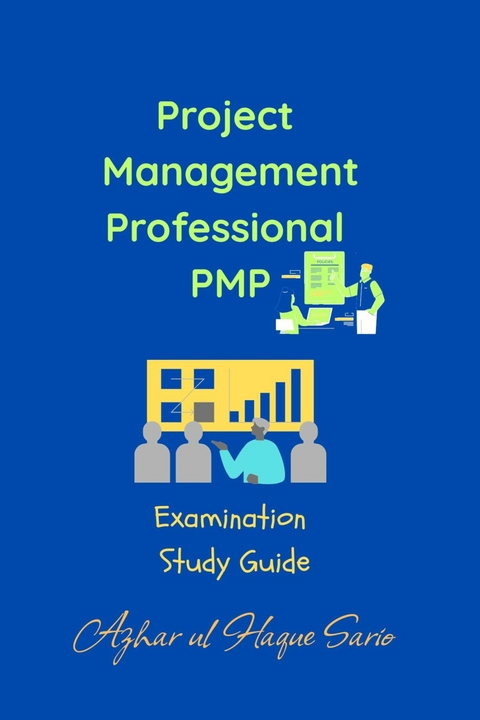
Project Management Professional PMP (eBook)
192 Seiten
Azhar Sario Hungary (Verlag)
978-3-384-78069-0 (ISBN)
Are you ready to stop managing tasks and start leading people in the AI-driven world of 2026?
This book is your comprehensive roadmap to the future of project management. It covers the three critical domains of the PMP exam: People, Process, and Business Environment. You will learn how to manage conflict in hybrid teams. It explains how to lead with emotional intelligence. The book details how to build shared understanding in virtual groups. It breaks down the 'T-shaped' talent model. You will discover how to use AI for risk assessment. It covers the shift from KPIs to OKRs. The guide explains servant leadership in a digital age. It teaches you to negotiate agreements using data. You will learn to manage project artifacts with modern tools. It discusses the importance of ESG and sustainability. The content explores predictive, adaptive, and hybrid methodologies. It shows you how to handle organizational change. You will find steps to close projects successfully. It focuses on value delivery over just output. This guide is built for the modern professional.
While traditional study guides focus on outdated 'waterfall' charts and manual calculations, this book provides the competitive advantage of future-proofing your career for 2026 and beyond. Its unique value lies in its integration of Artificial Intelligence and 'Power Skills' directly into the PMP framework, showing you not just what to do, but how to do it alongside AI agents and remote teams. Where other books ignore the messy reality of human dynamics, this book prioritizes psychological safety and cultural intelligence as key performance drivers. It does not just help you pass an exam; it helps you survive in an economy where robots manage tasks and humans lead people. It replaces abstract theory with '2026 Reality' examples, like handling 'Shadow AI' risks and navigating 'Green Financing,' ensuring you are ready for the challenges that standard textbooks haven't even predicted yet.
In this guide, you will find that 'conflict' isn't a failure; it is an opportunity to innovate, provided you interpret the source and stage correctly. You will see why the 2026 standard moves away from 'one size fits all' resolutions and towards tailored strategies like collaboration and compromise supported by digital tools. The book redefines leadership, moving from the 'boss' mentality to the 'gardener' approach, where your job is to create an ecosystem for the team to thrive. You will learn to navigate the 'Digital Noise' framework to prevent misunderstandings in global, asynchronous teams.
We dive deep into the technical side, too, but with a twist. You won't just learn to estimate budgets; you will learn to anticipate 'compute costs' for generative AI and budget for carbon footprints. You will see how 'Smart Contracts' and blockchain are changing procurement, allowing for automated payments based on verified milestones. The book explains how to use 'Digital Twins' for quality control and 'Predictive Analytics' to spot risks before they become issues. From defining 'Minimum Business Increments' to managing 'Stakeholder Sentiment' via NLP, this is the ultimate playbook for the next generation of project leaders.
Disclaimer: This book is an independent publication by Azhar ul Haque Sario. It is not affiliated with, endorsed by, or sponsored by the Project Management Institute (PMI) or any official board. All references to 'PMP', 'PMBOK', and other trademarks are used under nominative fair use for educational and descriptive purposes only.
Section 2: Process
Domain I: Execute Project with Urgency to Deliver Business Value
In the traditional "waterfall" days, value was often delivered only at the very end of a project—a "big bang" release. In 2026, this is unacceptable. The market moves too fast. If you wait 12 months to deliver, the problem you solved may no longer exist. "Urgency" here does not mean panic or haste; it means a relentless focus on the flow of value.
1. Assess Opportunities to Deliver Value Incrementally
The Shift from MVP to MBI: For years, the industry obsessed over the Minimum Viable Product (MVP). However, by 2026, the Project Management Institute (PMI) and Disciplined Agile frameworks emphasize a critical distinction:
MVP (Minimum Viable Product): An investment in learning. It is an experiment to validate a hypothesis. It might not generate revenue.
MBI (Minimum Business Increment): An investment in value. This is the smallest piece of functionality that provides value to the customer and the organization.
Strategic Execution: To execute with urgency, you must identify MBIs. You cannot simply "build the thing." You must ask: "What is the smallest slice of this project that we can release to generate revenue, save costs, or improve compliance right now?"
Real-World Application (The "AI Rollout" Example): Imagine you are leading a project to implement a Generative AI customer service bot for a bank.
Traditional Approach: You spend 18 months building a bot that handles checking, savings, mortgages, and loans. You launch it all at once.
2026 Incremental Approach:
Increment 1 (Month 2): The bot only handles "Password Resets." Value: Immediate 15% reduction in call center volume.
Increment 2 (Month 4): The bot handles "Balance Inquiries." Value: Another 10% reduction.
Increment 3 (Month 6): The bot handles "Mortgage Prequalification." Value: New revenue generation.
By assessing these opportunities, you deliver business value while the project is still running, funding the remainder of the project with the savings from the first phase.
Key Techniques for 2026:
Value Stream Mapping: visualizes the flow of value and identifies bottlenecks (delays between "code written" and "value realized").
Weighted Shortest Job First (WSJF): A prioritization model used in Scaled Agile (SAFe) to calculate the "Cost of Delay." If delaying a feature costs the company $10k/week, that feature takes priority over a low-value feature, regardless of how easy the low-value one is to build.
2. Examine the Business Value Throughout the Project
Value is not static. A feature deemed "critical" in January might be irrelevant by July due to a competitor's release or a regulatory change.
The "Value Guardian" Mindset: In 2026, the Project Manager must constantly audit the backlog against the business strategy. This requires a shift from "Plan Conformance" (did we stick to the schedule?) to "Value Conformance" (is this still worth doing?).
Methods of Examination:
Benefit-Cost Analysis (BCA) Real-Time Tracking: utilizing AI dashboards that integrate with financial systems to show real-time ROI. If labor costs spike, the AI recalculates the projected ROI. If it dips below a threshold, the project triggers a "Stop/Pivot" review.
OKRs (Objectives and Key Results): Align project outputs to organizational outcomes. If the Organization's Key Result is "Increase Gen Z engagement by 20%," and your project is building a desktop-only application, you are examining the value and finding a misalignment. You must pivot to mobile-first immediately.
Scenario: You are building a logistics warehouse. Midway through, fuel prices triple. The original plan relied on diesel trucks.
Old Way: Build the warehouse as planned.
New Way: Re-examine value. The operational costs will destroy the ROI. You halt construction on the diesel refueling station and pivot to installing EV charging infrastructure, even if it delays the schedule by two weeks. You have protected the long-term business value over the short-term schedule.
3. Support the Team to Subdivide Project Tasks to Find the MVP/MBI
This is where the Project Manager acts as a "Servant Leader." Teams, especially technical ones, often want to build the "Ferrari" when a "Skateboard" will suffice. Your role is to help them slice the work horizontally (end-to-end value) rather than vertically (technical layers).
Cognitive Sub-division: Large tasks cause "cognitive overload." By breaking tasks down into investable units (Invest: Independent, Negotiable, Valuable, Estimable, Small, Testable), you reduce risk.
The "Slicing the Cake" Metaphor:
Vertical Slicing (Bad): Baking the sponge, then the icing, then the cherry. You can't eat it until the end.
Horizontal Slicing (Good): Creating a cupcake. It has sponge, icing, and a cherry. It is small, but it is a complete dessert.
2026 Toolset:
Generative AI Decomposition: You can now feed a high-level Epic (e.g., "Implement Single Sign-On") into an LLM and ask it to "Break this down into user stories that take no longer than 3 days each." The AI acts as a junior analyst, providing a draft that the team refines.
DoR (Definition of Ready): ensuring a task is small enough to be completed in a single iteration. If it’s not, the team cannot pull it in.
Domain II: Manage Communications
In 2026, communication is the primary differentiator between human Project Managers and AI agents. While AI can generate a status report, it cannot read the room, detect hesitation in a stakeholder's voice, or navigate political minefields.
1. Analyze Communication Needs of All Stakeholders
Communication is not "one size fits all." It is "one size fits one."
Information Asymmetry: The goal is to eliminate information asymmetry—where one group knows critical info that another lacks. However, you must also avoid "Information Overload."
Stakeholder Persona Mapping (2026 Edition):
The Data-Driven CFO: Wants a live PowerBI dashboard link. Does not want narrative emails.
The Visionary CMO: Wants a 3-minute video summary of the product demo.
The Risk-Averse Compliance Officer: Wants a detailed log of all security changes, pushed automatically to their audit tool.
AI-Enhanced Analysis: In 2026, we use Sentiment Analysis. AI tools scan project Slack/Teams channels (anonymized) to detect terms indicating stress, confusion, or burnout. If the word "blocked" or "unclear" appears 40% more often this week, the PM knows—before anyone complains—that communication is failing.
2. Determine Communication Methods, Channels, Frequency, and Level of Detail
The era of "The Weekly Status Meeting" is dying. It is being replaced by Asynchronous Transparency.
Push vs. Pull vs. Interactive:
Pull (The Standard): Project data lives in a "Single Source of Truth" (e.g., Jira, Monday.com, Asana). Stakeholders "pull" the info when they need it.
Push (The Exception): Used only for urgent alerts or "Call to Action" items. If you push too often, you become noise.
Interactive (The Premium): Reserved for problem-solving, negotiation, and team bonding. We do not meet to report status; we meet to unblock status.
The "Hybrid Communication Charter": With teams distributed globally, you must define "Golden Hours" (overlap times) for synchronous comms.
Rule: "No decisions are made in hallway conversations. If it isn't written in the project channel, it didn't happen."
3. Communicate Project Information and Updates Effectively
Effectiveness in 2026 is defined by Brevity and Visuals.
The "Executive Summary" Art Form: Executives in 2026 read efficiently. Your updates must follow the BLUF (Bottom Line Up Front) method:
The Ask: Do you need money, a decision, or help? (First sentence).
The Impact: What happens if we don't do it?
The Context: Details for those who care.
Visual Data Storytelling: Don't send a spreadsheet. Send a trend line.
Bad: "We closed 40 bugs this week."
Good: [Chart showing bug closure rate vs. incoming bug rate]. "We are closing bugs faster than they are found. We are on track for the quality gate."
4. Confirm Communication is Understood and Feedback is Received
Sending is only half the loop. Receipt and comprehension are the other half.
The "Teach-Back" Method: In high-stakes meetings, ask stakeholders to summarize the decision back...
| Erscheint lt. Verlag | 18.12.2025 |
|---|---|
| Reihe/Serie | Project Management Institute PMI Courses |
| Sprache | englisch |
| Themenwelt | Wirtschaft ► Betriebswirtschaft / Management ► Projektmanagement |
| Schlagworte | Agile and Hybrid Methodologies • Artificial Intelligence AI • PMP Exam Prep 2026 • pmp study guide • project management professional • Servant Leadership • Virtual Team Management |
| ISBN-10 | 3-384-78069-8 / 3384780698 |
| ISBN-13 | 978-3-384-78069-0 / 9783384780690 |
| Informationen gemäß Produktsicherheitsverordnung (GPSR) | |
| Haben Sie eine Frage zum Produkt? |
 EPUB (Ohne DRM)
Digital Rights Management: ohne DRM
Dieses eBook enthält kein DRM oder Kopierschutz. Eine Weitergabe an Dritte ist jedoch rechtlich nicht zulässig, weil Sie beim Kauf nur die Rechte an der persönlichen Nutzung erwerben.
Dateiformat: EPUB (Electronic Publication)
EPUB ist ein offener Standard für eBooks und eignet sich besonders zur Darstellung von Belletristik und Sachbüchern. Der Fließtext wird dynamisch an die Display- und Schriftgröße angepasst. Auch für mobile Lesegeräte ist EPUB daher gut geeignet.
Systemvoraussetzungen:
PC/Mac: Mit einem PC oder Mac können Sie dieses eBook lesen. Sie benötigen dafür die kostenlose Software Adobe Digital Editions.
eReader: Dieses eBook kann mit (fast) allen eBook-Readern gelesen werden. Mit dem amazon-Kindle ist es aber nicht kompatibel.
Smartphone/Tablet: Egal ob Apple oder Android, dieses eBook können Sie lesen. Sie benötigen dafür eine kostenlose App.
Geräteliste und zusätzliche Hinweise
Buying eBooks from abroad
For tax law reasons we can sell eBooks just within Germany and Switzerland. Regrettably we cannot fulfill eBook-orders from other countries.
aus dem Bereich