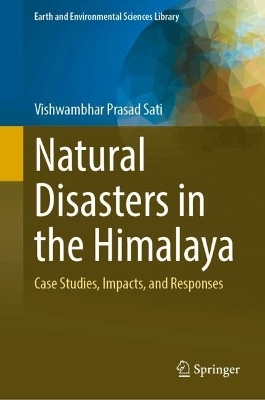
Natural Disasters in the Himalaya
Springer International Publishing (Verlag)
978-3-032-17374-4 (ISBN)
- Noch nicht erschienen - erscheint am 29.03.2026
- Versandkostenfrei
- Auch auf Rechnung
- Artikel merken
This book provides a comprehensive analysis of natural disasters both terrestrial and hydrological specifically within the Himalayan region. Spanning 13 chapters, it delves into key aspects of disaster management, from foundational concepts to rehabilitation policies. The book begins with an introduction to disaster classification, followed by an in-depth exploration of various terrestrial disasters, including earthquakes, and geohydrological disasters, illustrated through case studies of four significant events that occurred in different parts of the Central Himalaya. Further chapters focus on landslide disasters, the variability of rainfall patterns, and the increasing prevalence of forest fires. The book also examines the impact of cloudburst and glacial lake outburst flood (GLOF)-triggered disasters, which have become more frequent and severe due to climate change and anthropogenic global warming. Through a scientific approach, the text highlights the interplay between environmental changes and disaster occurrences, presenting data, case studies, and analytical insights. This book is an essential resource for students, researchers, academicians, policymakers, and disaster management professionals. It offers critical perspectives on disaster preparedness, response strategies, and long-term resilience planning for one of the most fragile and ecologically significant mountain systems in the world the Himalaya.
Vishwambhar Prasad Sati, born in 1966, holds a Doctor of Letters (D.Litt.) and Ph.D. degrees, currently serving as a Senior Professor of Geography and Resource Management and Dean of Faculty, School of Earth Sciences and Natural Resources Management at Mizoram University, a Central University in Aizawl, India. With nearly three decades of teaching experience, he has contributed to various higher education institutions within and outside India, including the Eritrea Institute of Technology in Asmara, Eritrea (NE Africa), the Institute of Mountain Hazards and Environment in Chengdu, China, and HNB Garhwal University in Srinagar Garhwal. Throughout his illustrious career, he has actively engaged in research, holding prestigious positions as a Presidential (PIFI) Fellow/Visiting Professor (2016) Chinese Academy of Sciences (CAS), Visiting Scientist (2014) Chinese Academy of Sciences , Visiting Scholar (2010) The World Academy of Sciences (TWAS), Visiting Scientist (2012) Indian National Science Academy (INSA), General Fellow (2008-2009) Indian Council of Social Science Research (ICSSR), and Associate (2008) Indian Institute of Advanced Study (IIAS). He is recognized as 0.5% researchers of the world and 50 top influential academicians of India. Furthermore, he has received recognition for his contributions, including a Visiting Professor Award from the Ministry of Education and Science at Lviv Polytechnic National University in Lviv, Ukraine, IMPRI India, a Best Paper Award from Natural Hazards Research (an Elsevier Journal), Best Presentation Award in the International Conference, held at Jurich, Switzerland, and the title of Senior Global Fellow from the Grassroots Institute in Canada. His extensive academic travels, spanning 50 countries and all over India, have contributed to his comprehensive understanding of diverse geographical landscapes. Additionally, he has successfully supervised more than a dozen Ph.D. scholars. His expertise lies in Natural Resource Management, Environment-Development Interface, Climate Change, Rural Livelihoods, Disaster-Related issues, and the Culture of the Himalayan region. Vishwambhar Prasad Sati has developed numerous models and action plans for environmental conservation and economic development in the fragile Himalayan ecosystems. His impactful contributions extend to more than 200 research papers and articles and over three dozen published books, establishing his academic legacy at both national and international levels.
Introduction.- The Himalayan Region.- The Central Himalayan Region.- Natural and Human Aspects.- Major Objectives and Research Methodology.- Classification of Natural Disasters in the Himalaya.- Earthquake Disasters.
| Erscheint lt. Verlag | 29.3.2026 |
|---|---|
| Reihe/Serie | Earth and Environmental Sciences Library |
| Zusatzinfo | XVII, 177 p. 67 illus. in color. |
| Verlagsort | Cham |
| Sprache | englisch |
| Maße | 155 x 235 mm |
| Themenwelt | Naturwissenschaften ► Geowissenschaften ► Geografie / Kartografie |
| Wirtschaft ► Betriebswirtschaft / Management ► Allgemeines / Lexika | |
| Wirtschaft ► Betriebswirtschaft / Management ► Unternehmensführung / Management | |
| Schlagworte | disaster management • earthquakes • Himalaya • Landslides • natural disasters |
| ISBN-10 | 3-032-17374-4 / 3032173744 |
| ISBN-13 | 978-3-032-17374-4 / 9783032173744 |
| Zustand | Neuware |
| Informationen gemäß Produktsicherheitsverordnung (GPSR) | |
| Haben Sie eine Frage zum Produkt? |
aus dem Bereich