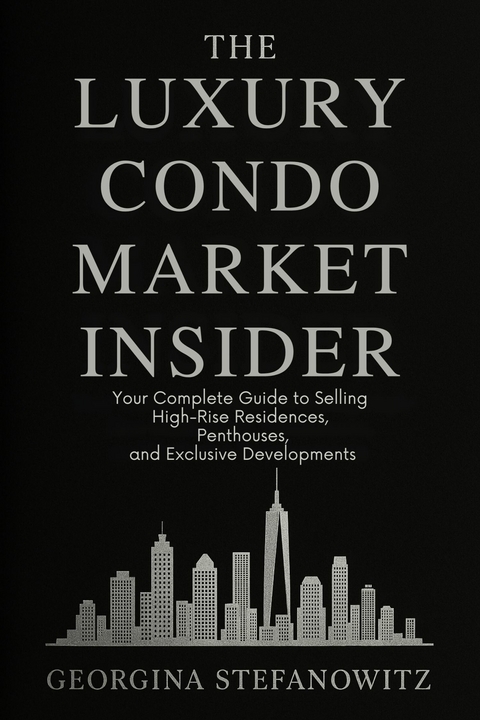
The Luxury Condo Market Insider (eBook)
102 Seiten
JNR Publishing (Verlag)
978-0-00-112162-1 (ISBN)
Master the Art of Selling Million-Dollar High-Rise Properties to High-Net-Worth Clients
Discover the insider secrets that separate top-producing luxury real estate agents from the rest. The Luxury Condo Market Insider reveals the sophisticated strategies, psychological insights, and proven techniques needed to dominate the luxury condo market and build a seven-figure real estate career.
What You'll Master:
Advanced valuation techniques for luxury properties that justify premium pricing
International buyer psychology and cultural considerations for global clients
Sophisticated negotiation strategies for high-stakes transactions
Technology integration and virtual selling for remote luxury buyers
Crisis management and market adaptation during economic uncertainty
Personal branding strategies that attract wealthy clients
Comprehensive templates, checklists, and implementation tools
From Beginner to Luxury Market Expert
Whether you're transitioning from traditional residential sales or aiming to dominate your local luxury market, this comprehensive guide gives you everything you need to succeed in high-end condo sales. Learn how to identify and serve international buyers, master complex valuations, and build lasting relationships with wealthy clients who become sources of ongoing referrals.
TAGS: luxury real estate, luxury condos, high-end properties, luxury home sales, real estate agent training, luxury property marketing, international buyers, luxury negotiation, high-net-worth clients, luxury property valuation, penthouse sales, luxury real estate investing, real estate success, wealthy clients, luxury property staging, real estate branding, luxury sales techniques
Chapter 1: Decoding the Luxury Condo Universe
Understanding What Makes a Condo "Luxury"
Here's what most agents get wrong about luxury condos: they think it's all about the price. Sure, a $500,000 condo isn't luxury, but neither is every $2 million unit. I've seen $8 million condos that felt like glorified hotel rooms and $1.5 million units that exuded genuine luxury. The difference lies in understanding what luxury actually means to your buyer.
True luxury in the condo market is defined by five core elements that work together to create an exceptional living experience. First is location exclusivity—not just a good neighborhood, but the best address in that neighborhood. Think Central Park West facing the park, not the side street. It's the difference between telling people you live "near Lincoln Center" versus "at Lincoln Center."
The second element is architectural distinction. Luxury condos are often housed in buildings designed by renowned architects or converted historic structures with significant cultural value. The building itself becomes part of the luxury story. When someone mentions they live in a Zaha Hadid-designed tower or a converted Art Deco landmark, they're making a statement about their taste and sophistication.
Third is the curation of amenities that go beyond basic gym and pool offerings. I'm talking about amenities that save time and enhance lifestyle: 24/7 concierge service that can arrange anything from dinner reservations to private jet bookings, wine storage with climate control, private dining rooms for entertaining, and even services like on-site car detailing or pet grooming. These aren't just conveniences—they're lifestyle enablers.
Fourth is the quality of finishes and customization options. Luxury buyers expect materials and craftsmanship that will impress their peers. This means imported marble, custom millwork, top-tier appliances, and often the ability to customize layouts or finishes to personal taste. The difference between luxury and regular condos often comes down to these details that most people never see but discerning buyers definitely notice.
Finally, there's the exclusivity factor—the number of units, the privacy level, and the caliber of neighbors. A luxury building might have only two units per floor with private elevator access, or it might be designed so that owners rarely encounter each other unless they choose to. This appeals to buyers who value privacy and exclusivity as much as material luxury.
Let me give you a real example from my practice. I recently sold a $4.2 million condo in Miami's Fisher Island. The unit itself was beautiful but not dramatically different from units you might find in other high-end buildings. What made it luxury was the combination: Fisher Island's complete exclusivity (accessible only by ferry), the building's limited number of units, amenities including a championship golf course and private beach club, and the fact that residents included celebrities and Fortune 500 CEOs. The buyer wasn't just purchasing a condo—they were buying into an exclusive community.
Why Condos Versus Single-Family Luxury Homes
Understanding why affluent buyers choose condos over single-family homes is crucial for effective selling. This isn't about settling for less—it's about choosing a different lifestyle that better fits their needs and preferences.
The primary draw is the lock-and-leave lifestyle. Many luxury condo buyers are successful professionals with demanding careers, frequent travelers, or people who maintain multiple residences. They want a beautiful, secure home without the headaches of property maintenance. When a tech executive tells me they're traveling 200 days a year, a luxury condo makes perfect sense. They can leave for a month-long business trip to Asia knowing their building's management will handle everything from plant watering to mail collection.
Security is another major factor that's often underestimated. High-net-worth individuals face security concerns that most people never consider. Luxury condo buildings offer multiple layers of security: controlled access, 24-hour security staff, surveillance systems, and the safety of knowing exactly who has access to the building. This level of security would be extremely expensive to replicate in a single-family home.
The amenities factor cannot be overstated. Consider what it would cost to replicate the amenities of a luxury condo building in a private home: a full-service spa, professional-grade fitness center, wine storage facility, private dining rooms, and concierge service. Even if you could afford to build these amenities, you'd need staff to maintain them. In a luxury condo, these costs are shared among residents and professionally managed.
Many luxury condo buyers also value the social aspects. These buildings often foster communities of like-minded individuals—successful professionals, entrepreneurs, and cultural leaders. The networking opportunities and social connections can be valuable both personally and professionally. I've seen business deals worth millions emerge from casual conversations in luxury condo lobbies.
Finally, there's the urban lifestyle factor. Many luxury condos are located in prime urban locations where single-family luxury homes either don't exist or would cost exponentially more. A $5 million condo in Manhattan's Upper East Side offers a lifestyle and location that might require $15-20 million for a comparable single-family townhouse.
Identifying Your Target Buyers
The luxury condo market attracts several distinct buyer profiles, each with unique motivations and preferences. Understanding these profiles allows you to tailor your approach and marketing strategy effectively.
The Global Executive represents a significant portion of luxury condo buyers. These are high-level corporate executives, often with international responsibilities, who value convenience and low maintenance above all else. They typically earn seven-figure incomes and view their primary residence as a base of operations rather than a weekend project. They're attracted to buildings with strong concierge services, proximity to business districts, and amenities that support their professional lifestyle.
I recently worked with a pharmaceutical company CEO who was relocating from Switzerland. His primary requirements were a building with 24-hour security (for confidentiality reasons), proximity to major airports, and amenities that would allow him to entertain business associates. Price was secondary to functionality and prestige. These buyers often make quick decisions when they find the right property because time is their most valuable commodity.
Successful Entrepreneurs form another key segment. Unlike corporate executives, entrepreneurs often have more flexible schedules but irregular income patterns. They're typically attracted to condos that make statements about their success and provide networking opportunities with other successful individuals. These buyers often want customization options and are willing to pay premiums for unique features or exclusive access.
The Empty Nester Affluent represents buyers whose children have grown and who are downsizing from large family homes but not from luxury. These buyers have typically built substantial wealth over their careers and want to maintain a luxurious lifestyle while eliminating the burdens of large property maintenance. They often prioritize cultural amenities, proximity to arts and dining, and buildings with sophisticated, mature resident communities.
International Buyers bring unique considerations but represent enormous opportunity. They're often seeking investment properties, second homes, or safe havens for wealth preservation. These buyers may be less familiar with local market conditions but often have substantial purchasing power and are willing to pay premiums for properties in prestigious locations. Understanding their cultural preferences and financial structures is crucial for success.
Tech Wealth represents a growing segment, particularly in markets like San Francisco, Seattle, and Austin. These buyers often have significant stock options or cryptocurrency wealth and may have unconventional financial profiles. They're typically drawn to smart building technology, modern design, and amenities that support their lifestyle preferences.
Finally, there's the Investor Luxury segment—buyers purchasing high-end condos as investment vehicles rather than primary residences. These buyers focus on rental potential, appreciation prospects, and tax advantages. They're often more analytical in their approach and may purchase multiple units over time.
Current Market Dynamics and Opportunities
The luxury condo market operates under different dynamics than traditional residential real estate, and understanding these dynamics is essential for success. Market timing, inventory levels, and buyer behavior patterns all differ significantly from the broader market.
One of the most important dynamics is the seasonal nature of luxury sales. Unlike traditional real estate markets that peak in spring and summer, luxury condo sales often follow different patterns based on buyer demographics. International buyers may be more active during certain seasons based on their home country patterns or vacation schedules. Empty nesters might be more active in fall and winter when they're focused on making life changes rather than summer travel.
The...
| Erscheint lt. Verlag | 12.12.2025 |
|---|---|
| Sprache | englisch |
| Themenwelt | Betriebswirtschaft / Management ► Spezielle Betriebswirtschaftslehre ► Immobilienwirtschaft |
| ISBN-10 | 0-00-112162-6 / 0001121626 |
| ISBN-13 | 978-0-00-112162-1 / 9780001121621 |
| Informationen gemäß Produktsicherheitsverordnung (GPSR) | |
| Haben Sie eine Frage zum Produkt? |
 EPUB (Adobe DRM)
Größe: 2,4 MB
Kopierschutz: Adobe-DRM
Adobe-DRM ist ein Kopierschutz, der das eBook vor Mißbrauch schützen soll. Dabei wird das eBook bereits beim Download auf Ihre persönliche Adobe-ID autorisiert. Lesen können Sie das eBook dann nur auf den Geräten, welche ebenfalls auf Ihre Adobe-ID registriert sind.
Details zum Adobe-DRM
Dateiformat: EPUB (Electronic Publication)
EPUB ist ein offener Standard für eBooks und eignet sich besonders zur Darstellung von Belletristik und Sachbüchern. Der Fließtext wird dynamisch an die Display- und Schriftgröße angepasst. Auch für mobile Lesegeräte ist EPUB daher gut geeignet.
Systemvoraussetzungen:
PC/Mac: Mit einem PC oder Mac können Sie dieses eBook lesen. Sie benötigen eine
eReader: Dieses eBook kann mit (fast) allen eBook-Readern gelesen werden. Mit dem amazon-Kindle ist es aber nicht kompatibel.
Smartphone/Tablet: Egal ob Apple oder Android, dieses eBook können Sie lesen. Sie benötigen eine
Geräteliste und zusätzliche Hinweise
Buying eBooks from abroad
For tax law reasons we can sell eBooks just within Germany and Switzerland. Regrettably we cannot fulfill eBook-orders from other countries.
aus dem Bereich