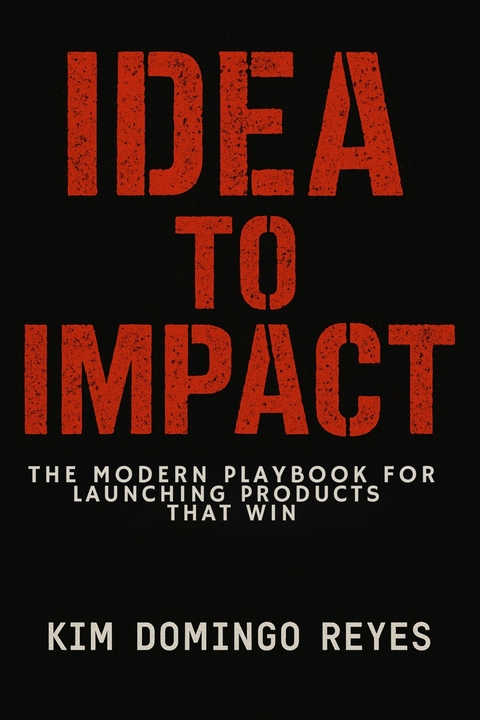
Idea to Impact (eBook)
156 Seiten
JNR Publishing (Verlag)
978-0-00-112155-3 (ISBN)
Your brilliant idea deserves more than just a shot in the dark. It deserves a playbook.
In today's fast-moving market, the gap between a promising idea and a successful product is wider than ever. It's a journey filled with uncertainty, risk, and countless pitfalls that can derail even the most passionate innovators. How do the best product teams navigate this journey? They don't guess. They use a playbook.
Idea to Impact: The Modern Playbook for Launching Products That Win is your definitive guide to the entire product creation process. Author Kim Domingo Reyes cuts through the noise and theory to deliver a clear, actionable, and repeatable framework for building products that customers love. This book is meticulously designed to be a hands-on workshop, taking you from the earliest stages of ideation to the complexities of scaling a successful product.
Stop wasting time on features nobody wants and start building with confidence. This playbook contains the strategies and tactics used by today's most successful startups and tech companies to dominate their markets.
This playbook will teach you to:
Discover and validate high-potential business ideas grounded in real customer pain.
Craft a Minimum Viable Product (MVP) that maximizes learning while minimizing waste.
Navigate the search for Product-Market Fit (PMF) with a clear, data-driven process.
Develop a powerful brand, positioning, and Unique Selling Proposition (USP).
Execute a Go-to-Market strategy that builds unstoppable momentum.
Lead agile teams and foster a culture of high-performance innovation.
The game has changed. It's time to get your copy of the playbook. Scroll up and click 'Buy Now' to start your journey from Idea to Impact!
Idea to Impact is more than just a book; it's your coach, your strategist, and your step-by-step guide through the four critical quarters of the product development game.
First Quarter: The Setup - Learn how to find your winning idea by identifying market gaps and deep customer needs. We'll give you the tools to create a rock-solid business blueprint and validate your core assumptions before you even take the field.
Second Quarter: The Drive - This is where you execute. Get a masterclass in building an effective MVP, designing an intuitive user experience, and creating a strategic product roadmap that guides your team. You'll learn the rhythm of agile development to move faster and smarter than the competition.
Third Quarter: The Score - A great product needs a great launch. This section is your offensive strategy, covering everything from brand positioning and pricing to executing a Go-to-Market plan that puts points on the board and builds a loyal user base.
Fourth Quarter: Winning the Game - It's not enough to score; you have to win. Learn the secrets to scaling your technology and team, building feedback loops that keep you ahead, and navigating the competitive landscape to ensure long-term, durable success.
With real-world case studies, practical exercises, and a complete toolkit of templates, Idea to Impact is the only playbook you need to turn your vision into a winning product.
TAGS: product management, product launch, startup playbook, go-to-market strategy, lean startup, MVP, minimum viable product, SaaS, entrepreneurship, startup guide, product-market fit, business strategy, agile development, software development, product design
2
Chapter 1: Finding Your Breakthrough Idea (Or, "Is This Thing On?")
Every great product, every game-changing service, every “why didn’t I think of that?” innovation starts with a single, solitary idea. But let’s be brutally honest: ideas are cheap. Grandmothers have ideas. Your cat probably has a few (mostly involving tuna). What separates a fleeting thought from a foundational concept for a successful product is its potential to create *value* – for customers, and consequently, for your business.
This chapter is about sharpening your radar to spot those truly promising ideas. It’s about looking at the world not just as it is, but as it *could* be, and identifying the gaps, frustrations, and unmet needs that are practically begging for a solution. It’s less about waiting for a mythical muse to bop you on the head and more about developing a curious, observant, and slightly rebellious mindset.
Spotting Market Gaps & Emerging Opportunities: Your Innovation Playground
The world is already jam-packed with products and services, right? Every conceivable niche seems to be filled. Or is it? The truth is, new gaps and opportunities emerge constantly, often hiding in plain sight. These gaps aren’t just voids; they’re invitations to innovate. They appear because of seismic shifts or subtle tremors in:
- Technology: Think about how advancements in AI, mobile computing, or biotech have opened up entirely new product categories. What’s becoming possible tomorrow that wasn’t possible yesterday? Sometimes opportunities bloom at the intersection of different fields, like AI meeting remote work culture.
- Consumer Habits & Preferences: People change. Their tastes evolve. They adopt new lifestyles (hello, digital nomadism), prioritize new values (sustainability, anyone?), or develop new frustrations with old ways of doing things. Why do people still struggle with certain daily tasks despite an abundance of apps?
- Regulations & Policy: New laws or deregulation can create instant demand for new solutions (think GDPR and data privacy tools, or a new environmental regulation sparking demand for green tech).
- Cultural Trends: Shifts in fashion, media consumption, social interaction, or wellness trends can create fertile ground for products that align with the new zeitgeist.
- Economic Conditions: Recessions might spur demand for budget-friendly alternatives, while boom times might see a rise in luxury or convenience-focused products.
- Neglected Industries: Some sectors get complacent, chugging along for decades without meaningful innovation. A fresh perspective or a new technology applied to such an industry can be revolutionary.
Identifying these gaps requires more than just casual observation. It demands an active curiosity. Don’t just accept the world as it is; constantly ask “why?” and “why not?” Dive deep. Read industry reports, yes, but also lurk in online forums, social media groups, and product review sections. Listen for the collective sighs, the “I wish someone would just…” comments. These are goldmines.
The Power of Customer Pain Points: Solving Real Problems for Real People
Here’s a secret that’s not really a secret: people don’t buy products; they buy solutions to their problems. They buy “better versions of themselves.” At the heart of every truly successful product is a well-understood, keenly felt customer pain point. Your brilliant idea doesn’t need to solve world hunger (though if it does, call us!), but it *must* address a real, compelling need for a specific group of people. Something that’s significant enough for them to actively seek a solution and, crucially, be willing to pay for it or invest their time.
Forget about the grandeur of your vision for a moment and focus intensely on the human beings who might use your product. Who are they? What are their daily struggles, their aspirations, their frustrations? Talk to them. Listen – really listen – not just to what they say, but how they say it. What makes them sigh, roll their eyes, or get animated with annoyance? Look for patterns in their complaints, friction points in their workflows, or persistent inefficiencies they’ve just learned to live with.
A genuine pain point isn’t a mild inconvenience; it’s something that causes tangible discomfort, whether that’s lost time, wasted money, stress, anxiety, or missed opportunities. When your product directly alleviates that pain, it’s not just a nice-to-have; it’s a need-to-have. This human-centric approach ensures your solution is a tangible improvement in someone’s life, not just a collection of cool features.
Problem-Driven Mindset: Marry the Problem, Not Your Solution
Many entrepreneurs and product creators make a classic mistake: they fall head-over-heels in love with their solution. Their idea for an app, a gadget, a platform becomes their precious baby, and they’ll defend it to the death, even if the market is politely (or not so politely) saying, “Thanks, but no thanks.”
A far more robust approach is to adopt a problem-driven mindset. Fall in love with the *problem* your customers face. Obsess over it. Understand its nuances, its root causes, its emotional impact. Ask yourself, “What is the underlying human dilemma, the fundamental challenge, that my product aims to resolve?”
Let’s say you’re building an expense management app. The surface-level problem might be “tracking expenses.” But dig deeper. Is the *real* problem that people feel anxious and out of control about their finances? Or that they waste precious weekend hours manually inputting receipts instead of spending time with family? By reframing and deeply understanding the core problem, you open up a much wider and more meaningful space for innovative solutions. This focus on the problem guards against building features nobody needs (aka “feature bloat”), helps you prioritize ruthlessly, and ensures your product remains deeply relevant to actual human desires.
A problem worth solving generally has a few key characteristics:
- Significant: Is it a trivial annoyance or a substantial burden? How much time, money, or emotional energy does it consume?
- Urgent: Do people need a fix *now*, or can they happily procrastinate on it indefinitely?
- Common/Pervasive: Does it affect a large enough group of people to build a sustainable business around? A super-niche problem might be fascinating, but can it support your ambitions?
When you’ve truly nailed the problem, your solution will feel like a natural, obvious answer, not something you have to aggressively sell. Users should hear your value proposition and think, “That’s *exactly* what I’ve been looking for!”
Differentiation from Day One: Don’t Be a “Me-Too” Product
The marketplace is a noisy, crowded party. If you walk in wearing the same outfit as ten other people and saying the exact same things, you’ll blend into the wallpaper. In a world saturated with copycat solutions and slight variations on existing themes, daring to be different isn’t just advisable; it’s critical for survival. Too many products are launched as “slightly cheaper” or “marginally different” versions of something that already exists. Customers can sniff this out instantly. If you’re not offering a unique, compelling advantage, why should they go through the hassle of switching?
Your differentiation can take many forms:
- Superior User Experience (UX): Maybe existing solutions are clunky and confusing. Yours is intuitive, elegant, and a joy to use.
- Cutting-Edge Technology: You might be leveraging a new technological breakthrough to solve the problem in a fundamentally better way.
- Unique Features/Functionality: You offer a critical capability that no one else does.
- Underserved Niche: You’re tailoring your solution to a specific subgroup whose needs are ignored by broader market players.
- Remarkable Customer Service: Perhaps in an industry known for chatbots and long hold times, you offer 24/7 human support that genuinely helps.
- Striking Aesthetics or Brand Story: Your product’s design is iconic, or your brand connects with customers on an emotional level.
- Different Business Model: You might offer a novel pricing structure or a community-driven approach.
- Ethical/Sustainable Angle: In a market full of disposable or ethically dubious products, yours is eco-friendly or champions fair trade.
The key is to identify something your competitors aren’t doing, or aren’t doing well, and make that your cornerstone. Articulate this differentiation early and clearly, and let it guide your product decisions. This unique angle is what will make your product memorable and give customers a clear reason to choose you.
Takeaways & Real-World Application
Let’s distill this down to actionable insights:
- Become an Opportunity Detective: Market gaps aren’t just “out there”; they’re created by shifts in tech, culture, and customer needs. Constantly question norms and study trends to spot them.
- Real-World...
| Erscheint lt. Verlag | 12.12.2025 |
|---|---|
| Sprache | englisch |
| Themenwelt | Wirtschaft ► Betriebswirtschaft / Management |
| ISBN-10 | 0-00-112155-3 / 0001121553 |
| ISBN-13 | 978-0-00-112155-3 / 9780001121553 |
| Informationen gemäß Produktsicherheitsverordnung (GPSR) | |
| Haben Sie eine Frage zum Produkt? |
 EPUB (Adobe DRM)
Größe: 2,1 MB
Kopierschutz: Adobe-DRM
Adobe-DRM ist ein Kopierschutz, der das eBook vor Mißbrauch schützen soll. Dabei wird das eBook bereits beim Download auf Ihre persönliche Adobe-ID autorisiert. Lesen können Sie das eBook dann nur auf den Geräten, welche ebenfalls auf Ihre Adobe-ID registriert sind.
Details zum Adobe-DRM
Dateiformat: EPUB (Electronic Publication)
EPUB ist ein offener Standard für eBooks und eignet sich besonders zur Darstellung von Belletristik und Sachbüchern. Der Fließtext wird dynamisch an die Display- und Schriftgröße angepasst. Auch für mobile Lesegeräte ist EPUB daher gut geeignet.
Systemvoraussetzungen:
PC/Mac: Mit einem PC oder Mac können Sie dieses eBook lesen. Sie benötigen eine
eReader: Dieses eBook kann mit (fast) allen eBook-Readern gelesen werden. Mit dem amazon-Kindle ist es aber nicht kompatibel.
Smartphone/Tablet: Egal ob Apple oder Android, dieses eBook können Sie lesen. Sie benötigen eine
Geräteliste und zusätzliche Hinweise
Buying eBooks from abroad
For tax law reasons we can sell eBooks just within Germany and Switzerland. Regrettably we cannot fulfill eBook-orders from other countries.
aus dem Bereich