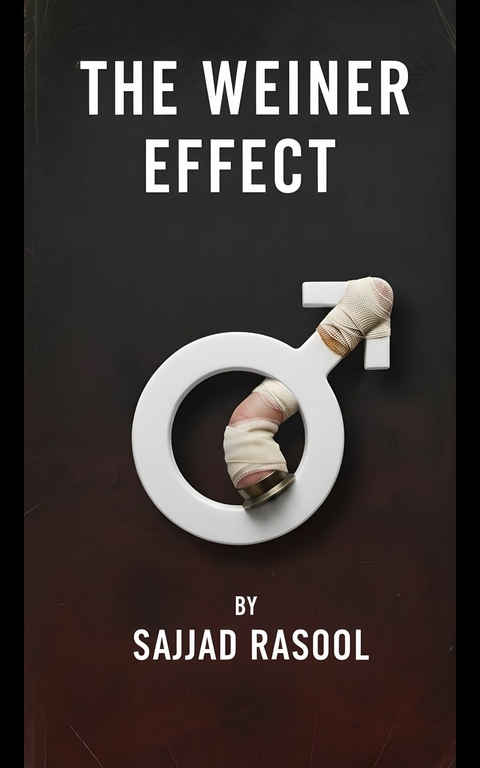
The Weiner Effect (eBook)
206 Seiten
Publishdrive (Verlag)
978-0-00-111926-0 (ISBN)
Stop chasing The Winner Effect. Discover The Weiner Effect-the raw, brutal truth about what it takes to truly succeed in a society that demands you stay silent.
In the ruthless, unmapped territories of the modern male experience, we are taught to hide our vulnerabilities. We are polished into tools, forced to conform, and told to never show a crack. But what if the flawless bell is the one that rings hollow?
Sajjad Rasool's sharp, uncompromising novel cuts through the noise to explore the hidden cost of masculinity, ambition, and pressure. THE WEINER EFFECT is not about how to win; it's about what remains after you've been broken.
The Bell That Sings Loudest is Always Cracked.
Henry, a street-hardened observer, has spent his life navigating the cruel expectations of community, fatherhood, and business. When a strange, damaged brass bell enters his life, he begins to uncover a powerful truth:
The true measure of a man is not his seamless exterior, but the sound that escapes his deepest flaw.
The 'Ding' of easy success is fleeting. The BONG of hard-won resilience is eternal.
This book is a journey into the psychology of success and failure, showing how societal pressure (The Winner Effect) can actually crush the spirit, while acknowledged vulnerability (The Weiner Effect) can unlock true power.
For fans of dark, literary fiction, character studies, and works that explore the human condition, THE WEINER EFFECT is a necessary, unforgettable read. It's a message to the 'brotherhood of the spine and the seed'-to every male across the entire living spectrum-that refusing to ring hollow is the ultimate act of defiance.
Chapter 1: Dawn Bell
The bell in the factory had been broken ten years; Ray wound it with his thumb and listened for the ding no one else would hear. It was a brass nub, worn smooth by the sweat of a dozen foremen before him, set into the concrete pillar by the loading dock like a dead eye. It used to signal lunch, shift change, fire. Now it signaled nothing but Ray’s own private start to the day, a ritual as secret and shameful as the scratching of an itch in a crowded room.
He pressed his thumb into the cold metal. He held his breath. In the silence of 4:00 AM, before the boilers kicked on, before the men shuffled in with their thermoses and their resentment, Ray needed to feel that little phantom vibration. Ding.
You’re the boss. You’re the big dog. You’re the man.
It was a lie, of course. He knew it in the way his knees popped when he crouched to check the hydraulic lines. He knew it in the way the silence of his house rang louder than the factory floor. But here, in the dark, touching the dead bell, he could pretend.
He exhaled, the steam of his breath ghosting against the pillar. He adjusted his belt. It was cutting into his gut again. He’d moved the notch three months ago, drilling a new hole in the cheap leather with an awl on his workbench, and already the leather was straining against the buckle. He hated that buckle. It was a cheap thing, tin pressed to look like silver, with a generic eagle stamped on it. He’d bought it at a truck stop when he got the promotion, paying twelve dollars for a piece of costume jewelry that was supposed to say Authority. Now, buried under the soft, doughy roll of his stomach, it just felt like a cold reminder of what he was losing.
He walked the line. The machines were sleeping beasts, hulking presses and stamping units painted a chipped, sickly industrial green. They smelled of oil and ozone, a heavy, metallic perfume that clung to Ray’s skin even after a twenty-minute shower. Ray loved this smell. It was the smell of work. Real work. Not the typing and clicking the suits did upstairs in the glass offices, dealing with "logistics" and "optimization." This was work where you could lose a finger if you were stupid, where you went home smelling like iron and effort. It was a place where size mattered—the size of the press, the size of the output, the size of the man running it.
He patted the side of Press #4. "Wakey wakey, sweetheart," he muttered.
He checked the clipboard hanging by the station. Quotas were up. Always up. Management wanted 15% more units by Friday. They didn't send 15% more men. They didn't send 15% better steel. They just sent the email, signed by a man named Sterling who had hands soft as bread dough. Get it done, Ray.
He felt the ding again, sharper this time. It wasn't a sound; it was a tightness in his groin, a sudden, cold contraction. It happened whenever he thought about the numbers. It happened whenever he thought about home, about Sarah turning her back to him in bed, the way the sheets barely moved, the way her breathing evening out told him she wasn't waiting for him to touch her. She was relieved he wouldn't.
Use it, he told himself. Use the ding.
He turned the tightness into a strut. He rolled his shoulders. He practiced the face he would wear when the team arrived—the hard jaw, the eyes that missed nothing. The Foreman face. He checked his reflection in the dark safety glass of the supervisor’s booth. He sucked in his gut. For a second, he looked formidable. Then he exhaled, and the illusion pooled around his waist.
At 4:45 AM, the side door banged open. The morning crew drifted in like ash, bringing the gray dawn air with them.
There was Stucky, old and bent, carrying his lunch pail like a sentence he was serving. Stucky had been here since the days when they let you smoke on the line. He looked at Ray with the tired eyes of a man who had seen ten foremen come and go.
There was Miller, eyes red-rimmed, smelling of last night’s cheap beer and regret. Miller was always skating on the edge of fired, saved only by hands that moved faster than his brain.
And then there was the new kid.
Ray stopped. He felt his hands curl into fists.
The kid—what was his name? Jace? Jake? Just "Kid"—was sickeningly young. Maybe twenty. He wore a tight white thermal shirt that looked painted on, showing the ridges of abdominals that looked carved from wood. His arms were thick, ropy with muscle that hadn't come from lifting steel plates for a wage but from a gym, from vanity, from hours spent looking in a mirror. He had headphones around his neck and he was laughing at something on his phone.
He looked... wet. That was the word Ray’s brain supplied. Not sweaty yet, but fresh, new, unsealed. He looked like he had too much blood. He looked like he was about to burst out of his own skin.
"Morning, boss!" the Kid chirped, slamming his locker shut. The sound echoed like a gunshot.
Ray stared at him. The Kid didn't look down. He grinned. He did a little hop, shaking out his legs like a boxer entering the ring, then reached down and adjusted himself. A casual, blatant shifting of his package in his tight jeans. Left, right, settle.
Ray felt the heat climb up his neck. It was such a small thing. Men scratched. Men adjusted. It was part of the language of the floor. But the way the Kid did it—like he was weighing gold, like he was presenting it to the room, like he was checking to make sure his weapon was still there—it felt like a slap. It was a display. It was a challenge.
"You're late," Ray said. His voice sounded thin in the big room. He tried to deepen it, to add the gravel of command.
The Kid checked an imaginary watch on his bare wrist. "Clock says 4:52, boss. Shift starts at 5."
"Shift starts when I say you're ready to work," Ray snapped. "Tuck that shirt in. You look like you're going to a disco. Or a street corner."
The Kid blinked, his grin not fading, just changing shape. It became pitying. "Sure thing, boss." He tucked the shirt in, emphasizing the flat washboard of his stomach, the narrow waist, the way the denim hugged his hips. He did it slowly, maintaining eye contact.
Ray turned away, his heart hammering against his ribs. Ding.
By 9:00 AM, the factory was a deafening roar. The floor vibrated. The air was thick with metal dust that tasted like copper pennies. Ray walked the catwalk, watching the heads bobbing below.
He watched the Kid on Line 3. The specific job was the stamps—feeding sheets of aluminum into the press, hitting the dual safety buttons, waiting for the thunk-hiss, pulling the piece out. It was rhythm work. Boring. Hypnotic. Dangerous if you got lazy.
The Kid wasn't lazy. He was fast. Annoyingly fast. He fell into a rhythm that made the other men look like they were wading through molasses. Slide, press, thunk, toss. Slide, press, thunk, toss.
Ray watched the muscles in the Kid's back ripple through the thermal shirt. He saw Stucky and Miller watching too. They weren't looking at the Kid with desire—they were looking with the dull, heavy envy of men who knew their own bodies were rotting piles of aches and pains. The Kid was a reminder of everything they had spent. He was a shiny new Cadillac parked in a scrapyard.
Ray went down the stairs. The ding was persistent now, a low-level nausea that churned in his gut. He needed to assert himself. He needed to show he was the alpha dog in this kennel. He needed to mark his territory.
He walked up to Line 3. The Kid didn't stop.
"You're rushing the cycle," Ray shouted over the noise.
The Kid didn't look up. "Hitting the numbers, boss. Actually, beating 'em. Ask me about my score."
"I said you're rushing. The stamp needs a half-second cool down or you get burrs on the edge. Check your work."
The Kid pulled a piece, inspected the edge with a theatrical flourish, and held it up to Ray. It was perfect. Clean, shiny, sharp.
"Looks good to me," the Kid yelled. He winked. A slow, arrogant wink.
Ray stared at the piece of metal. It was perfect. That made it worse. Perfection was insubordination.
"You got a smart mouth, Kid," Ray said, leaning in close. He smelled the Kid's sweat—acrid, sharp, testosterone-heavy. It wasn't the stale sweat of the old men. It smelled like raw energy. It made Ray feel old and dry, like husks of corn. "You think cause you got big arms you know this machine? This machine will eat you. It will take that hand and turn it into hamburger."
"I respect the machine," the Kid said, his voice flat now. "Do you?"
Ray stiffened. "What did you say?"
"I said, do you? Cause you haven't run a line in five years, Ray. Stucky told me. Said you used to be good. Used to be."
The silence in Ray's head was absolute. The factory noise dropped away. All he heard was the ding. Hard. Loud. Like a hammer on a bell.
He thinks you're soft. He thinks you're a clipboard holder. He thinks you're a gelding. He thinks your wife knows it too.
Ray grabbed the safety key from his belt. His hands were shaking, just a little....
| Erscheint lt. Verlag | 9.12.2025 |
|---|---|
| Sprache | englisch |
| Themenwelt | Wirtschaft ► Betriebswirtschaft / Management ► Unternehmensführung / Management |
| ISBN-10 | 0-00-111926-5 / 0001119265 |
| ISBN-13 | 978-0-00-111926-0 / 9780001119260 |
| Informationen gemäß Produktsicherheitsverordnung (GPSR) | |
| Haben Sie eine Frage zum Produkt? |
 EPUB (Adobe DRM)
Größe: 667 KB
Kopierschutz: Adobe-DRM
Adobe-DRM ist ein Kopierschutz, der das eBook vor Mißbrauch schützen soll. Dabei wird das eBook bereits beim Download auf Ihre persönliche Adobe-ID autorisiert. Lesen können Sie das eBook dann nur auf den Geräten, welche ebenfalls auf Ihre Adobe-ID registriert sind.
Details zum Adobe-DRM
Dateiformat: EPUB (Electronic Publication)
EPUB ist ein offener Standard für eBooks und eignet sich besonders zur Darstellung von Belletristik und Sachbüchern. Der Fließtext wird dynamisch an die Display- und Schriftgröße angepasst. Auch für mobile Lesegeräte ist EPUB daher gut geeignet.
Systemvoraussetzungen:
PC/Mac: Mit einem PC oder Mac können Sie dieses eBook lesen. Sie benötigen eine
eReader: Dieses eBook kann mit (fast) allen eBook-Readern gelesen werden. Mit dem amazon-Kindle ist es aber nicht kompatibel.
Smartphone/Tablet: Egal ob Apple oder Android, dieses eBook können Sie lesen. Sie benötigen eine
Geräteliste und zusätzliche Hinweise
Buying eBooks from abroad
For tax law reasons we can sell eBooks just within Germany and Switzerland. Regrettably we cannot fulfill eBook-orders from other countries.
aus dem Bereich