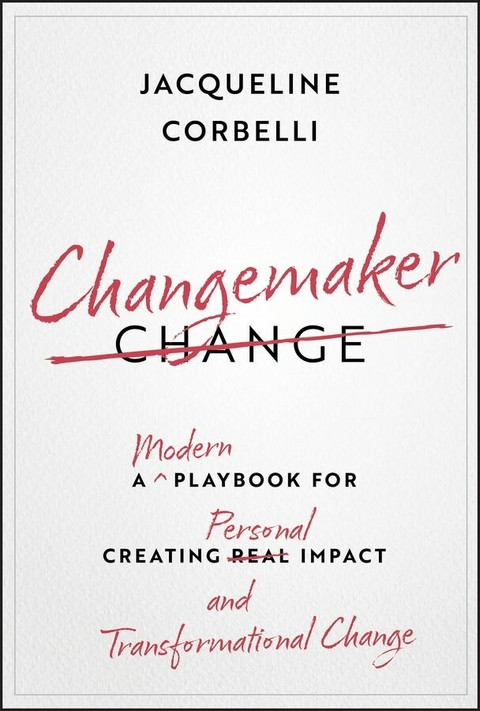
Changemaker (eBook)
282 Seiten
Wiley (Verlag)
978-1-394-30536-0 (ISBN)
A practical and effective guide for solving big, tough problems in any industry
In Changemaker: A Modern Playbook for Creating Personal Impact and Transformational Change, Emmy winner, tech innovator, and change leader, Jacqueline Corbelli, delivers a practical guide to attacking big problems head-on. The author shows you how to seamlessly go from identifying a problem to effectively resolving it, offering a step-by-step approach to tackling tough issues. Inside, you'll find a practical and versatile framework to using the resources you have available to you and your organization in a wide variety of situations and contexts.
The book explains how to identify and deconstruct core problems into manageable components and provides an organized and coherent way for you to solve each part of the problem, one piece at a time. You'll also discover:
- Strategies for leveraging advanced technology, government agencies, NGOs, and businesses in your problem-solving journey
- Techniques for establishing robust but realistic timelines and adhering to them
- Ways to prioritize problems and proposed changes based on their potential impact and resource demands
Perfect for both professionals working in large organizations and individuals driving actionable change, Changemaker is the missing piece of the puzzle you've been searching for as you work to solve the biggest and toughest challenges in your work.
JACQUELINE 'JACQUIE' CORBELLI is an inspirational leader, entrepreneur, and author whose transformational approach to problem solving has made a positive impact on business and the world across her decades-long career. Her work across finance, advertising, technology, sustainability, and global development have proven time and again that her consistent framework combined with passion, innovation and persistence yields tremendous results and world-scale change.
As the first female founder of an advertising technology company and creator of an AI-powered sustainability platform, Jacquie has fueled the success of her companies and been recognized for her groundbreaking leadership by New York Business Journal and Fast Company. Jacquie has partnered with institutions such as the United Nations and the Vatican, bringing her expertise to some of the world's most pressing challenges. Jacquie has been featured in The Wall Street Journal, Bloomberg Business, and Fox Business. She lives in New York with her husband, daughters, and dog, and can be seen around the world doing important work in service to others.
1
The Path to Creating New Futures
The journey begins with this powerful idea: Solutions to even the most difficult challenges often hide in plain sight. This may seem hard to believe. However, I will give you many reasons to see the truth of this statement in the following pages. Through the examples and illustrations I share you will not only understand why this is so, but you’ll also have a solid foundation for understanding how it applies to solving real-world problems, on a personal level and a global one as well. You may even find yourself with a new desire to play a part. For now, I’ll begin to build that foundation very simply. Think about the last time you lost your keys or your phone. You searched everywhere, only to find it right on the countertop—or, if you’re like me, sometimes right in your own hand. These everyday moments aren’t just a function of forgetfulness; they also highlight an important truth: What we see—or don’t see—often depends on where we focus our attention.
hiding in plain sight, idiom: Refers to objects or solutions that are easily overlooked due to the simple and uncomplicated nature of their location.
As simplistic as it may seem, this same idea also applies to contributing to major change as well. As you are about to see from the following examples, sometimes solutions to problems are around us, but we miss them because we’re not looking for them in the right way. Throughout history, major shifts often began with someone suddenly recognizing something that was there all along. The key both then, and which applies to this day, is in learning how to see it—notice the opportunities that others overlook, question the assumptions that keep problems locked in place, and most importantly act when the moment presents itself.
The pages ahead will help you explore how you can develop this kind of awareness and think differently about the true extent of your own capabilities. There are a wide variety illustrations within to show you how I did so, and a DIY way to achieve it yourself. You’ll also find a workbook at the end to hone your skills. So let’s get started by first considering some real-world examples of how seeing differently leads to lasting and even historic change.
Learning to See
One of the greatest and most groundbreaking examples of seeing the same thing differently in human history is Sir Isaac Newton’s discovery of gravity. For centuries, people experienced gravity firsthand—when you trip over a tree root, for instance, you fall straight to the ground. But it took Newton’s relentless curiosity and determination to transform part of our everyday experience into a scientific law that captured the very essence of gravity. Newton’s work proved that the missing piece to understanding this natural force observed for thousands of years had been hiding in plain sight all along. In his ability to carefully observe, question, and connect the dots between seemingly separate phenomena he uncovered one of the most fundamental principles of our universe.
Newton’s discovery was much more than just an explanation of why things fall—it also revealed gravity as a universal force that not only governs the drop of an apple from a tree but the motion of planets around the sun (National Geographic, 2022). This particular revelation laid the groundwork for countless other scientific breakthroughs that we rely on today, making possible everything from precise flight path calculations that enable us to travel across the globe in mere hours, to the development of space travel, where understanding gravitational pull is crucial to launching rockets and exploring beyond our atmosphere.
The implications didn’t stop there. Newton’s work also allowed us to solve practical challenges, like reliable access to electricity through innovations such as hydroelectric power, which harnesses gravity-driven water flow. Finally his principles also paved the way for futuristic advancements, like calculating rocket propulsion trajectories for space exploration (Enel Group, 2025). Each of these forms of innovation occurred because Isaac Newton saw what others had missed: Gravity wasn’t a new invention; it required his unique ability to step back from individual observations and view them through a uniquely different lens.
Your ability to master a version of what Newton did, as you’ll note throughout these pages, is at the core of becoming a changemaker: Even profound discoveries can be within reach if you learn to see differently, connect the dots, and act on the new insights this generates. Newton displayed the power of combining his simple yet disciplined thought process with deep personal curiosity proving out the universal truth—sometimes the solutions to the world’s biggest challenges are not far off; they’re just waiting for someone, anyone, to look closely enough to find them.
Another illustration of the groundbreaking solutions that can be discovered in this way happened in the early 1900s, long before the invention of refrigerators and modern preservation techniques emerged. Food contamination and spoilage were still life-threatening challenges at the time. Without a reliable way to keep food fresh, communities around the world faced severe health risks, from bacterial illnesses to widespread starvation. For generations, the inability to safely store and preserve food was simply accepted as an unavoidable reality. Yet, just like gravity, the solution to this global challenge existed right in front of everyone’s eyes: heat.
In this example, it was the relentless curiosity and experimentation of Louis Pasteur that uncovered a profound connection between preservation and heat. In 1862, he demonstrated that heating wine to temperatures between 60 and 100 °C could kill off harmful microorganisms and prevent spoilage (Nelson, 2009). This simple yet revolutionary discovery revealed that food could be preserved—not just for days, but for months—by targeting the same bacteria responsible for its decay. Of course, Pasteur didn’t invent heat, nor did he stumble upon a new technology. Rather, he applied the power of a familiar process in a way no one had thought to do previously.
Over the years, like Newton, Pasteur expanded on his insight, refined his method, and proved that the heating process could be used for a wide range of food products. That breakthrough laid the foundation for what we now know as pasteurization—a practice that went on to permanently transform food safety and revolutionize global food storage and transportation. Today, pasteurization is so ingrained in our everyday life that it’s easy to forget how groundbreaking it once was. Pasteur was able to see a method for heating food that solved a problem plaguing humanity for centuries.
This example, like the one with Newton, illustrates how transformational change can occur by seeing the extraordinary in the ordinary. These breakthroughs weren’t hidden in a lab or locked behind complex technology. They were outcomes of a simple, observable process waiting for someone with the curiosity and persistence to recognize their potential. In this way they also serve as real and powerful evidence of the core assumption made at the start of this chapter, that the answers to the biggest challenges may not be as distant or complicated as they seem, just waiting to be seen differently. These next examples aren’t groundbreaking in the same ways Newton’s and Pasteur’s are, but of equal significance to this assumption:
A simple invention, used every day without a second thought, yet transformative in its own right, is the zipper. It’s illuminating because the invention existed long before it was ever perfected. The first hints of the concept behind it can be traced back to the inventor of the sewing machine, Elias Howe, who first imagined it as a mechanism for fastening fabric. It was an enterprising Swede named Gideon Sundback who brought the design to life and made it practical (Bellis, 2016).
Like the others, the idea behind the zipper drew from principles that had existed for centuries before: The fundamental mechanism—interlocking teeth—was a staple of technology as far back as the second century BCE (Freeth, 2022). Gears with interlocking teeth were used, for example, to turn clock hands, power grain mills, and drive machinery. Howe saw the applications in everyday life and tapped their potential for fastening clothing. The idea was simple, visible, and already well understood—yet it wasn’t fully realized until he took the step to reimagine its purpose.
It’s now hard to imagine life without zippers. They’re in our jackets, suitcases, shoes, and even high-tech gear like diving suits and spacesuits. What’s more, despite its simplicity, the zipper has remained largely unchanged for over a century, demonstrating how effective a straightforward idea can be when applied in the right way. Once again, this seemingly small innovation solved a persistent problem with elegance and efficiency by leveraging a concept that had existed for hundreds of years.
The zipper is an innovation that grew from reimagining the familiar. Like the others, it illustrates that visionary ideas don’t necessarily require groundbreaking technology or complex theories; sometimes they emerge from looking with fresh eyes. They give you a reason to reflect on your own ability to recognize untapped...
| Erscheint lt. Verlag | 2.12.2025 |
|---|---|
| Sprache | englisch |
| Themenwelt | Wirtschaft ► Betriebswirtschaft / Management ► Unternehmensführung / Management |
| Schlagworte | Business problem solving • business problem solving guide • organized problem solving • Problem Solving • problem solving approach • problem solving framework • problem solving guide • problem solving technologies • problem solving timelines |
| ISBN-10 | 1-394-30536-2 / 1394305362 |
| ISBN-13 | 978-1-394-30536-0 / 9781394305360 |
| Informationen gemäß Produktsicherheitsverordnung (GPSR) | |
| Haben Sie eine Frage zum Produkt? |
 EPUB (Adobe DRM)
Kopierschutz: Adobe-DRM
Adobe-DRM ist ein Kopierschutz, der das eBook vor Mißbrauch schützen soll. Dabei wird das eBook bereits beim Download auf Ihre persönliche Adobe-ID autorisiert. Lesen können Sie das eBook dann nur auf den Geräten, welche ebenfalls auf Ihre Adobe-ID registriert sind.
Details zum Adobe-DRM
Dateiformat: EPUB (Electronic Publication)
EPUB ist ein offener Standard für eBooks und eignet sich besonders zur Darstellung von Belletristik und Sachbüchern. Der Fließtext wird dynamisch an die Display- und Schriftgröße angepasst. Auch für mobile Lesegeräte ist EPUB daher gut geeignet.
Systemvoraussetzungen:
PC/Mac: Mit einem PC oder Mac können Sie dieses eBook lesen. Sie benötigen eine
eReader: Dieses eBook kann mit (fast) allen eBook-Readern gelesen werden. Mit dem amazon-Kindle ist es aber nicht kompatibel.
Smartphone/Tablet: Egal ob Apple oder Android, dieses eBook können Sie lesen. Sie benötigen eine
Geräteliste und zusätzliche Hinweise
Buying eBooks from abroad
For tax law reasons we can sell eBooks just within Germany and Switzerland. Regrettably we cannot fulfill eBook-orders from other countries.
aus dem Bereich