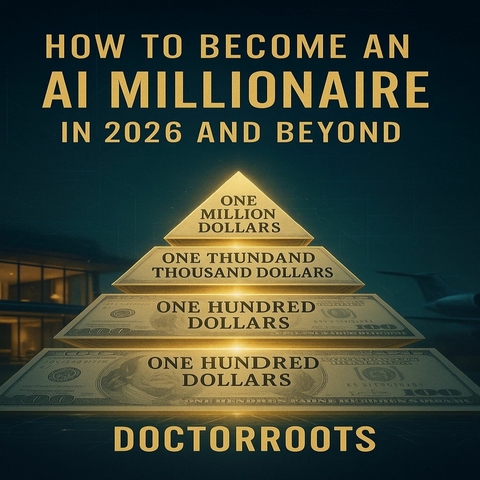
How to Become an AI Millionaire in 2026 and Beyond (eBook)
263 Seiten
Publishdrive (Verlag)
978-0-00-111459-3 (ISBN)
A new kind of gold rush is here-not one of pickaxes and dirt, but of ideas, innovation, and determination. How to Become an AI Millionaire in 2026 and Beyond is more than a book; it's a movement, a wake-up call, and a roadmap for anyone ready to claim their place in the future that's already unfolding before us.
The author invites you to see this extraordinary age of artificial intelligence not as a threat, but as the most incredible opportunity of our lifetime. The future no longer belongs only to the rich, the connected, or the educated elite-it belongs to those who dare to dream, to act, and to learn. You do not need a college degree or even a high school diploma to succeed in this new era. What you need is a vision for your life, the determination to pursue it, and the willingness to learn and act decisively.
Across the world, ordinary people are already transforming their lives through this new digital revolution: a single mother building her online business from home, a retired teacher creating income streams with AI-powered tools, and a young student using a simple laptop to reach a global audience. They all started with nothing more than courage, curiosity, and commitment-and now, they are thriving. So can you.
This book gives you a step-by-step blueprint for building wealth intelligently, ethically, and sustainably in the AI-driven economy. Inside, the author will show you how to:
Turn your ideas into real income streams using simple digital tools.
Build profitable ventures that grow even while you sleep.
Discover powerful AI platforms that multiply your creativity and productivity.
Develop the mindset that transforms obstacles into opportunities.
Create lasting financial freedom before 2026-and continue building beyond it.
But this journey is about far more than money. It's about transformation-stepping out of fear, breaking the limits others placed on you, and reclaiming your power to create the life you deserve. Each page of this book is designed to reignite your belief in yourself and remind you that greatness doesn't require permission-it requires purpose, persistence, and bold action.
The author writes with warmth, clarity, and passion, turning complex technology into a message of hope, empowerment, and possibility. His voice speaks directly to those who have been overlooked, underestimated, or told that success is reserved for someone else. This book is proof that the door to prosperity is open to everyone willing to walk through it.
The truth is simple: the future will not wait. Every moment of hesitation is a moment of opportunity lost. The next generation of millionaires is already being created-not in boardrooms or universities, but in bedrooms, coffee shops, and living rooms around the world. The only question left is whether you will watch it happen or make it happen.
Your future is calling. Your time is now.
Take your place in this new era of wealth, purpose, and limitless possibility with How to Become an AI Millionaire in 2026 and Beyond.
Neural Networks: Learning Like the Human Brain
Among the most fascinating developments in artificial intelligence is the neural network, a computational structure inspired by the intricate workings of the human brain. These networks consist of layers upon layers of interconnected nodes—artificial "neurons"—that process information in parallel, passing signals between one another in patterns that mirror biological neural activity. Each connection has a weight that determines its influence, and these weights adjust during training to improve performance.
To understand how neural networks process information, imagine analyzing a photograph to determine whether it contains a cat. The first layer of neurons might detect elementary features: edges, corners, contrasts between light and dark. These basic observations pass to the next layer, which combines them into slightly more complex patterns: curves that might be whiskers, circles that could be eyes, triangles that suggest ears. Deeper layers synthesize these intermediate features into higher-level concepts: a furry texture, a face-like arrangement, four legs in proportion. The final layers integrate all this hierarchical processing to reach a conclusion: this image contains a cat with ninety-seven percent certainty.
This layered, hierarchical approach mirrors how human vision works, progressing from simple feature detection in early visual processing to complex object recognition in higher brain regions. By mimicking this biological strategy, neural networks achieve remarkable capabilities that seemed impossible just decades ago. They can identify faces in crowds, transcribe spoken words with near-perfect accuracy, and even generate photorealistic images from text descriptions.
Neural networks power many technologies we now take for granted. When your smartphone unlocks by recognizing your face, a neural network is comparing your features against its trained model. When you speak to a virtual assistant and it understands your request despite background noise, neural networks are processing the audio signals. When your email automatically filters spam with uncanny accuracy, neural networks are analyzing patterns in message content, sender behavior, and user interactions.
The versatility of neural networks extends across every industry imaginable. In medicine, they analyze radiological images to detect tumors, predict patient outcomes, and recommend treatment protocols. In finance, they assess credit risk, optimize trading strategies, and detect anomalous transactions that might indicate fraud. In manufacturing, they perform quality control, predict equipment failures, and optimize production schedules. In creative fields, they compose music, generate artwork, and even write poetry that captures human emotion.
Natural Language Processing: Teaching Machines to Understand Us
Natural Language Processing represents one of AI's most profound achievements: bridging the communication gap between human expression and machine comprehension. This branch of artificial intelligence enables computers to understand, interpret, generate, and respond to human language in all its complexity, ambiguity, and nuance. Through NLP, machines can read documents, translate between languages, answer questions, summarize texts, and even detect emotional undertones hidden in written or spoken words.
The challenge of natural language processing extends far beyond simple word recognition. Human language is riddled with ambiguity, context-dependency, and cultural variation. The same word can have dozens of meanings depending on context. Sarcasm inverts literal meaning. Idioms make no logical sense when interpreted word by word. Grammar rules have countless exceptions. Yet humans navigate this complexity effortlessly, understanding meaning through context, tone, and shared cultural knowledge.
Modern NLP systems tackle these challenges by training on billions of text examples, learning not just vocabulary and grammar but the subtle patterns that convey meaning. They understand that "bank" means something different in "river bank" versus "savings bank." They recognize that "That's just great" might express genuine enthusiasm or bitter sarcasm depending on context. They learn that "It's raining cats and dogs" has nothing to do with falling animals but everything to do with heavy precipitation.
When you ask a customer service chatbot for help with your account, NLP algorithms parse your request, understand your intent, and formulate an appropriate response. When you use translation software to read a foreign website, NLP systems navigate not just word-for-word conversion but cultural and contextual adaptation. When you dictate a message to your phone, NLP converts acoustic signals into text while handling your accent, speaking pace, and background noise.
Advanced language models developed by organizations like OpenAI, Anthropic, and Google have pushed NLP to extraordinary heights. These systems can write coherent essays on complex topics, generate marketing copy that captures brand voice, create fiction that maintains narrative consistency, and engage in conversations that feel genuinely human. They understand context across long documents, maintain consistency across multiple interactions, and even exhibit what appears to be reasoning about abstract concepts.
For entrepreneurs, NLP opens doors to countless opportunities. Every business generates and processes text: emails, reports, customer feedback, social media posts, technical documentation, legal contracts. NLP can automate the analysis of this textual data, extracting insights that would take humans months to discover. It can personalize communication at scale, ensuring every customer feels heard and understood. It can monitor brand reputation across millions of online conversations, alerting businesses to problems before they escalate.
Computer Vision: Teaching Machines to See
Computer vision represents another cornerstone of artificial intelligence—the ability of machines to extract meaningful information from visual inputs, interpreting and acting upon what they "see" in images and videos. By analyzing patterns in pixels, computer vision systems can identify objects, read text, track movement, measure distances, and even interpret human emotions through facial expressions and body language.
This technology has already begun transforming industries in ways both visible and invisible. In retail environments, AI-powered cameras monitor inventory levels automatically, detecting when shelves need restocking and identifying misplaced items that could confuse customers. Loss prevention systems can identify suspicious behavior patterns, alerting security to potential theft before it occurs. Customer analytics track shopping patterns, optimizing store layouts to improve the shopping experience and increase sales.
Manufacturing has embraced computer vision for quality control with enthusiasm that traditional methods never inspired. AI systems inspect products on assembly lines at speeds impossible for human workers, detecting defects measured in fractions of millimeters. They identify contamination in food processing, spot microscopic cracks in metal components, and ensure consistent quality in everything from semiconductor chips to pharmaceutical tablets. These systems work twenty-four hours without fatigue, maintaining consistent accuracy that improves over time.
Healthcare applications of computer vision save lives daily. Radiologists use AI assistance to detect tumors in medical imaging, often identifying cancers at stages too early for human eyes to reliably spot. Dermatologists employ computer vision to analyze skin lesions, distinguishing between benign moles and potential melanomas with accuracy that matches or exceeds human specialists. During surgery, computer vision guides robotic instruments with precision measured in micrometers, enabling procedures that human hands alone could never perform.
The autonomous vehicle industry depends entirely on computer vision to navigate our complex world. These systems must identify and track dozens of objects simultaneously: other vehicles, pedestrians, cyclists, traffic signals, road signs, lane markings, construction zones, and unexpected obstacles. They must work in all weather conditions, from bright sunshine to heavy rain, adapting to changing light conditions and maintaining safety even when road markings are obscured.
Agriculture has discovered that computer vision can revolutionize food production. Drones equipped with specialized cameras monitor crop health across vast fields, identifying disease, pest infestations, or nutrient deficiencies before they spread. Harvesting robots use computer vision to determine fruit ripeness, picking only what is ready while leaving the rest to mature. Livestock monitoring systems track animal behavior and health, alerting farmers to illness or injury that requires attention.
Predictive Analytics: Seeing the Future through Data
One of artificial intelligence's most commercially valuable applications is predictive analytics—the science of using historical patterns to forecast future outcomes with remarkable accuracy. By analyzing past behaviors, trends, seasonal variations, and subtle correlations, AI systems can anticipate what will likely happen next, providing businesses and individuals with the closest thing to a crystal ball that science can offer.
Financial institutions have embraced predictive analytics as a cornerstone of risk management and fraud prevention. By analyzing millions of transactions, AI systems learn the normal spending patterns of individual customers and can instantly flag anomalies that might indicate stolen credit cards or compromised...
| Erscheint lt. Verlag | 29.11.2025 |
|---|---|
| Sprache | englisch |
| Themenwelt | Wirtschaft ► Betriebswirtschaft / Management |
| ISBN-10 | 0-00-111459-X / 000111459X |
| ISBN-13 | 978-0-00-111459-3 / 9780001114593 |
| Informationen gemäß Produktsicherheitsverordnung (GPSR) | |
| Haben Sie eine Frage zum Produkt? |
 EPUB (Adobe DRM)
Kopierschutz: Adobe-DRM
Adobe-DRM ist ein Kopierschutz, der das eBook vor Mißbrauch schützen soll. Dabei wird das eBook bereits beim Download auf Ihre persönliche Adobe-ID autorisiert. Lesen können Sie das eBook dann nur auf den Geräten, welche ebenfalls auf Ihre Adobe-ID registriert sind.
Details zum Adobe-DRM
Dateiformat: EPUB (Electronic Publication)
EPUB ist ein offener Standard für eBooks und eignet sich besonders zur Darstellung von Belletristik und Sachbüchern. Der Fließtext wird dynamisch an die Display- und Schriftgröße angepasst. Auch für mobile Lesegeräte ist EPUB daher gut geeignet.
Systemvoraussetzungen:
PC/Mac: Mit einem PC oder Mac können Sie dieses eBook lesen. Sie benötigen eine
eReader: Dieses eBook kann mit (fast) allen eBook-Readern gelesen werden. Mit dem amazon-Kindle ist es aber nicht kompatibel.
Smartphone/Tablet: Egal ob Apple oder Android, dieses eBook können Sie lesen. Sie benötigen eine
Geräteliste und zusätzliche Hinweise
Buying eBooks from abroad
For tax law reasons we can sell eBooks just within Germany and Switzerland. Regrettably we cannot fulfill eBook-orders from other countries.
aus dem Bereich