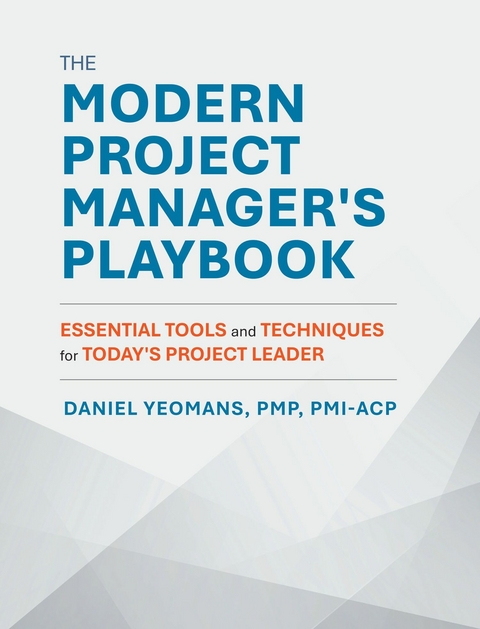
Modern Project Manager's Playbook (eBook)
288 Seiten
Bookbaby (Verlag)
979-8-3178-2169-2 (ISBN)
Author Biography - Daniel Yeomans Daniel Yeomans is an educator, consultant, and author specializing in Project, Program, and Portfolio Management, with more than two decades of experience leading organizational improvement initiatives across corporate, academic, and government environments. His expertise spans the disciplines of project delivery, business analysis, and strategic alignment, enabling organizations to translate their vision into measurable results. Daniel has served as a trusted advisor and instructor for diverse audiences, including graduate students, continuing education professionals, and corporate leaders. He teaches at Northwest University, Green River College, and Seattle Colleges, where his courses in Project Management, Business Analysis, Risk Management, and Agile Frameworks are known for blending academic rigor with real-world application. Beyond academia, he has delivered corporate programs for clients such as Microsoft, Charlie's Produce, Red Dot Corporation, Trident Seafoods, and Seattle Public Schools, focusing on leadership development, process management, and negotiation excellence. Daniel also develops professional courses for the Coursera learning platform, where his online programs have reached a global community of more than 160,000 learners across industries and continents. This number grows my thousands monthly. His courses emphasize accessibility, interactivity, and immediate workplace application-empowering professionals worldwide to master modern project and program management practices. Daniel's work is anchored in the belief that project management is not limited to those with formal titles-every professional can benefit from structured thinking, effective communication, and stakeholder engagement. His teaching style emphasizes practical frameworks such as PMI's Standard for Program Management, the PMBOK® Guide, BABOK®, and Scrum.org methodologies, while integrating modern advancements in Artificial Intelligence, Systems Thinking, and Enterprise Risk Management. An early advocate of AI integration in management practice, Daniel develops learning modules that help students and professionals leverage Generative AI tools to enhance decision-making, benefits realization, and stakeholder analysis. His recent work, Generative AI for Program Managers, explores how emerging technologies are redefining leadership and strategy in project environments. Daniel holds multiple professional credentials, including PMP®, PMI-RMP®, PMI-PBA®, Scrum.org and Scrum Alliance certifications, and the ASQ Certified Manager of Quality/Organizational Excellence (CQM/OE) designation. His educational and consulting philosophy reflects a commitment to continuous learning, ethical leadership, and sustainable success. Whether guiding organizations through complex transformations or mentoring students entering the profession, his mission is simple: to develop thoughtful, adaptable leaders equipped to navigate the challenges of modern business. When not teaching or consulting, Daniel enjoys writing, traveling, and reflecting on the intersection between professional growth and personal meaning-a theme that often surfaces in his Food for Thought essays found throughout his courses and publications.
The Modern Project Manager's Playbook bridges the gap between theory and application-offering a clear, practical roadmap for professionals who manage work, lead teams, or drive organizational change. Written by educator, consultant, and author Daniel Yeomans, this comprehensive guide combines decades of experience in corporate, academic, and public-sector environments with globally recognized frameworks from PMI(R), IIBA(R), Scrum Alliance(R), Scrum.org, and ASQ(R). The book moves beyond process and terminology to address what truly drives success in modern organizations adaptability, communication, collaboration, and strategic alignment. Through engaging explanations, real-world examples, and over a dozen practical templates, Yeomans translates complex management principles into actionable steps that improve decision-making, stakeholder engagement, and value delivery. Each chapter is organized for quick learning and immediate application. Readers will explore the full spectrum of management practices, from foundational techniques such as the Work Breakdown Structure, RACI Matrix, and Risk Register to advanced tools like the Balanced Scorecard, Benefits Management Framework, and Generative AI methods for smarter planning and continuous improvement. The result is a toolkit that helps any professional whether new to project management or leading enterprise-level programs build confidence, clarity, and measurable results. While rooted in the standards of PMI's PMBOK Guide and the Standard for Program Management, The Modern Project Manager's Playbook goes further by embracing Agile and hybrid approaches that reflect today's rapidly evolving business environment. Yeomans illustrates how predictive, adaptive, and hybrid methods can coexist, helping managers choose the right approach for the right context. Readers will find frameworks for stakeholder management, risk planning, communication strategy, and benefits realization all supported by tools that can be adapted to organizations of any size. This book is designed for project managers, business analysts, program leads, and any manager wanting to strengthen project management skills. It is equally valuable for professionals pursuing certifications such as PMP , PMI-RMP , PMI-PBA , PMI-ACP , or Scrum Master, and for educators or corporate trainers seeking an accessible yet comprehensive resource. Accessible, practical, and forward-looking, The Modern Project Manager's Playbook provides both the structure and flexibility needed to thrive in a fast-paced, technology-driven world. It delivers more than tools it fosters the mindset of a modern leader: thoughtful, adaptive, ethical, and results-focused. Yeomans challenges readers to see project management not just as a discipline, but as a universal skill set that empowers leaders at every level to transform vision into value. With its blend of professional rigor and approachable style, this book equips readers with the knowledge, templates, and confidence to guide any initiative from concept to completion while inspiring teams, managing change, and delivering sustainable results.
Chapter 1:
The Project Management
Profession
Introduction: Turning Great Ideas into Reality
Every breakthrough idea—whether it’s launching a new app, building infrastructure, or delivering a service—requires more than vision. It demands precise planning and execution to deliver expected
benefits and value. Project management (PM) is the discipline that turns great ideas into reality.
As organizations navigate increasingly complex and fast-changing environments, effective project management has emerged as a critical driver of success. This chapter introduces the profession of project management, its value to organizations, the roles and skills required, and the trends shaping its future.
Project Management (PM) transforms visionary concepts into real-world results. As organizations navigate complex, fast-paced environments, effective PM has become a crucial driver of success. Welcome to Chapter 1 where we introduce key concepts in project management.
Project management can make or break an organization. Here are a few references that justify this statement
- The U.S. Bureau of Labor Statistics reports that 50.5% of small businesses fail by year five. Poor project management is a leading cause.
- A Team Stage study conducted in 2024 stated, “70% of all projects fail to deliver what was promised. However, implementing solid project management practices can reduce this rate to 20% or below.”
- According to PMI’s Pulse of the Profession reports, roughly 37% of projects fail due to unclear objectives and milestones. More broadly, PMI has found that only about 60% of projects meet their original goals and business intent, meaning up to 40% fall short in some way.
The Value of Project Management
Project management is more than meeting deadlines and budgets; it’s about delivering meaningful value. A successful project manager defines value from each stakeholder’s perspective and delivers it effectively.
This goal brings with it a challenge. Value means different things to different stakeholders. The Project Manager must work closely with all stakeholders, define value in their terms, and work diligently to deliver value throughout the project. Note how value definitions are different among various stakeholders.
- Customers: A solution that meets needs
- Executives: ROI and strategic alignment
- Teams: Opportunities for growth
Driving Organizational Success
The Project Manager ensures strategy execution and goal alignment. All projects must support the overall strategic initiatives of the firm and add value. Project Managers must analyze all projects and recommend moving forward, deferring, or even cancelling the initiative.
Reducing Failure Risks
You can manage risks, or they will manage you. The Project Manager must plan for, identify, evaluate, respond to, and control risk from Day 1 of the project. Proactive risk management increases success rates.
Optimizing Resources
Resources are essential to project success. Resources include personnel, equipment, materials, supplies, and other miscellaneous needs such as work permits. The Project Manager must identify and manage all resources. Balanced use of time, cost, and talent is key to success.
Rewards and Realities of the Profession
Project management can be a rewarding career in terms of compensation and internal satisfaction. However, becoming an outstanding Project Manager is a journey.
- Attractive Compensation: 2025 data shows PMs earning median salaries of $120K+ (PMI Survey).
- High Stress and Visibility: The PM job is not an easy one. PMs navigate tight deadlines, high accountability, and cross-functional dynamics. They must be accessible to their teams at all times. However, the reward of delivering on-time, within budget, and providing value is unparalleled.
- Servant Leadership: A modern PM acts as a servant leader, empowering teams and fostering success. Servant leadership can be defined as leading by serving others, removing obstacles, and enabling team excellence.
The Project Manager’s Triangle: Balancing Constraints
At the heart of every project lies the challenge of balancing time, cost, and scope—the triple constraints. Quality is the fourth dimension that must be maintained throughout. A change to any one constraint inevitably affects the others. This dynamic interplay requires project managers to be adept at trade-off decisions while maintaining stakeholder satisfaction.
Illustration 1.1: The Project Manager’s Triangle
The Project Manager’s Triangle shows three primary considerations a project must meet. They include:
- Time (schedule)
- Cost (budget)
- Scope (deliverables)
At the center of the triangle lies Quality (Q):
- Conformance to requirements: Deliver what was approved and no extras. Extras are referred to as Scope Creep. Scope Creep is also referred to as “gold-plating.”
- Fitness for use: Ensure the final product and/or service developed by the project adds value to all impacted stakeholders.
Delivering value means meeting these constraints while satisfying stakeholder expectations. Overall project management success is determined by your ability to meet all project expectations as illustrated in the Project Manager’s Triangle.
Project Management Approaches: One Size Does Not Fit All
There are many approaches to managing a project. Predictive project management is typified by building to the plan. Adaptive project management features User Stories and a Product backlog to build a product using iterations or Sprints. Hybrid projects combine both Predictive and Adaptive methods. The table below highlights various approaches.
The table 1.1 below provides a brief overview of various project management frameworks that a Project Manager must consider.
Table 1.1 Project Management Approaches
| Approach | Characteristics | Example |
| Predictive | Low change, single delivery, extensive planning | Building a bridge |
| Predictive Incremental | Low-moderate change, phased deliveries | HR system rollout |
| Predictive Iterative | Moderate to high change, phased deliveries | Updating a website |
| Adaptive (Agile) | High change, iterative delivery, customer collaboration | Mobile app development |
| Hybrid | Combines predictive and adaptive elements | Hardware-software integration |
Program Management vs. Project Management
Project and program management are often mistaken. Projects are often subsets of programs. We will differentiate between program and project management throughout the book. Here is a short table 1.2 that helps understand the differences.
Table 1.2 Program Management vs. Project Management
| Feature | Project Management | Program Management |
| Focus | Specific deliverables | Coordinated strategic outcomes |
| Scope | Defined, narrow | Broader, multi-project alignment |
| Timeframe | Temporary, defined end date | Longer-term, may continue ongoing |
| Success Measure | On time, on budget, within scope | Strategic benefit... |
| Erscheint lt. Verlag | 2.12.2025 |
|---|---|
| Sprache | englisch |
| Themenwelt | Wirtschaft ► Betriebswirtschaft / Management ► Projektmanagement |
| ISBN-13 | 979-8-3178-2169-2 / 9798317821692 |
| Informationen gemäß Produktsicherheitsverordnung (GPSR) | |
| Haben Sie eine Frage zum Produkt? |
 EPUB (Adobe DRM)
Kopierschutz: Adobe-DRM
Adobe-DRM ist ein Kopierschutz, der das eBook vor Mißbrauch schützen soll. Dabei wird das eBook bereits beim Download auf Ihre persönliche Adobe-ID autorisiert. Lesen können Sie das eBook dann nur auf den Geräten, welche ebenfalls auf Ihre Adobe-ID registriert sind.
Details zum Adobe-DRM
Dateiformat: EPUB (Electronic Publication)
EPUB ist ein offener Standard für eBooks und eignet sich besonders zur Darstellung von Belletristik und Sachbüchern. Der Fließtext wird dynamisch an die Display- und Schriftgröße angepasst. Auch für mobile Lesegeräte ist EPUB daher gut geeignet.
Systemvoraussetzungen:
PC/Mac: Mit einem PC oder Mac können Sie dieses eBook lesen. Sie benötigen eine
eReader: Dieses eBook kann mit (fast) allen eBook-Readern gelesen werden. Mit dem amazon-Kindle ist es aber nicht kompatibel.
Smartphone/Tablet: Egal ob Apple oder Android, dieses eBook können Sie lesen. Sie benötigen eine
Geräteliste und zusätzliche Hinweise
Buying eBooks from abroad
For tax law reasons we can sell eBooks just within Germany and Switzerland. Regrettably we cannot fulfill eBook-orders from other countries.
aus dem Bereich