


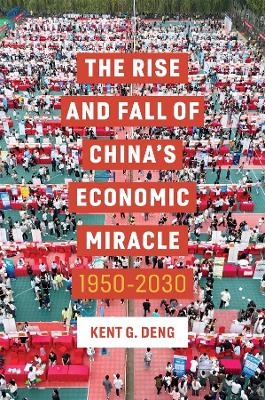
The Rise and Fall of China's Economic Miracle
1950 - 2030
Seiten
2026
Polity Press (Verlag)
978-1-5095-7036-2 (ISBN)
Polity Press (Verlag)
978-1-5095-7036-2 (ISBN)
- Noch nicht erschienen (ca. Juni 2026)
- Portofrei ab CHF 40
- Auch auf Rechnung
- Artikel merken
After several decades of unprecedented growth that turned China into the world’s second largest economy, today China is facing major economic challenges, exacerbated by rising tariffs imposed by its most important export market, the United States. How can we explain the extraordinary rise and sudden faltering of China’s economic miracle?
Kent Deng takes a long-term view, charting the development of China’s economy from the nineteenth century to the present day. He shows that the policies implemented during Mao’s rule from the 1950s to the 1970s led to a growth cul-de-sac with major economic disincentives and mass poverty. This forced Mao’s successor, Deng Xiaoping, to reform and open up China’s economy with a view to unleashing the economic power of the market. The new model developed by Deng Xiaoping combined state-led import dependency with exports in order to catch up with the West, and success in achieving exports depended on a unique combination of cheap labour, cheap land and low environmental protection which, taken together, gave China an absolute advantage in the global market, enabling it to produce goods very cheaply and export them to Western countries where the costs were much higher. But Deng’s economic model is now facing increasing resistance from those countries on which China has relied for its export growth. Since 2010, two doors have been closing on China: the door for goods heading for China (vital for China’s modernization) and the door for goods coming from China (vital for paying for China’s imports). This is likely to end China’s hitherto uninterrupted ‘import-export combo’ loop. The 2025 tariff war between United States and China is only the most recent manifestation of this new state of affairs in the global economy.
Given the headwinds China now faces, and given that many low-income countries have now modelled themselves on China and begun to supply the world market with low-priced goods, China would need an economic miracle to bounce back to its pre-2010 growth trajectory.
Kent Deng takes a long-term view, charting the development of China’s economy from the nineteenth century to the present day. He shows that the policies implemented during Mao’s rule from the 1950s to the 1970s led to a growth cul-de-sac with major economic disincentives and mass poverty. This forced Mao’s successor, Deng Xiaoping, to reform and open up China’s economy with a view to unleashing the economic power of the market. The new model developed by Deng Xiaoping combined state-led import dependency with exports in order to catch up with the West, and success in achieving exports depended on a unique combination of cheap labour, cheap land and low environmental protection which, taken together, gave China an absolute advantage in the global market, enabling it to produce goods very cheaply and export them to Western countries where the costs were much higher. But Deng’s economic model is now facing increasing resistance from those countries on which China has relied for its export growth. Since 2010, two doors have been closing on China: the door for goods heading for China (vital for China’s modernization) and the door for goods coming from China (vital for paying for China’s imports). This is likely to end China’s hitherto uninterrupted ‘import-export combo’ loop. The 2025 tariff war between United States and China is only the most recent manifestation of this new state of affairs in the global economy.
Given the headwinds China now faces, and given that many low-income countries have now modelled themselves on China and begun to supply the world market with low-priced goods, China would need an economic miracle to bounce back to its pre-2010 growth trajectory.
Kent G. Deng is Professor of Economic History at the London School of Economics and Political Science.
| Erscheint lt. Verlag | 11.6.2026 |
|---|---|
| Verlagsort | Oxford |
| Sprache | englisch |
| Themenwelt | Wirtschaft ► Volkswirtschaftslehre |
| ISBN-10 | 1-5095-7036-5 / 1509570365 |
| ISBN-13 | 978-1-5095-7036-2 / 9781509570362 |
| Zustand | Neuware |
| Informationen gemäß Produktsicherheitsverordnung (GPSR) | |
| Haben Sie eine Frage zum Produkt? |
Mehr entdecken
aus dem Bereich


aus dem Bereich
Buch | Softcover (2024)
Kohlhammer (Verlag)
CHF 75,60


