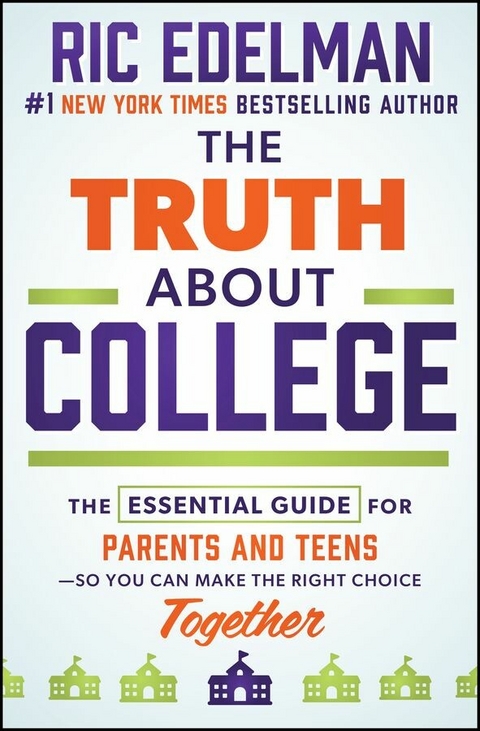
Truth About College (eBook)
246 Seiten
Wiley (Verlag)
978-1-394-40686-9 (ISBN)
An unbiased, accurate, and up-to-date guide to making college-related decisions
Should I go to college? Which college should I go to? When should I go? What should I study? How should I pay for college? Should I work while I'm attending?
In The Truth About College: The essential guide to help your teenagers succeed - so college doesn't ruin their lives, #1 New York Times bestselling author, Ric Edelman, delivers an unbiased and eye-opening guide for parents who want to help their children answer their college questions and for the teenagers doing their best to make the 'right' choice.
This is not an anti-college screed or a full-throated endorsement of college for everyone. It's a deeply researched decision-making guide that carefully considers the unique characteristics, considerations, and circumstances that will influence college-related decisions. The book recognizes that college is not a subject that should be considered through an ideological lens. It shouldn't be one characterized by snap decisions or decisions made based on what peers or parents did or didn't do. Instead, you'll learn all about the real-world benefits and costs of attending college today. You'll discover the doors it unlocks, the doors it closes, the most common mistakes made by college students, and how to minimize the downsides and cost if you or your child decide to attend.
Inside the book:
- A comprehensive and accurate exploration of the specific information that you and your child need to make the most beneficial decisions possible
- Concise summaries at the end of each chapter for easy review, as well as a standalone, step-by-step guide to talking with your teenagers about college
- Clear-eyed, unbiased advice from an experienced finance professional based on contemporary evidence and data about college and the college experience
Perfect for all teenagers preparing to go (or not go) to college and their parents, The Truth About College is packed with the information you need to make smart decisions that will be beneficial over the long-term.
RIC EDELMAN founded the nation's largest financial planning firm, is recipient of two Lifetime Achievement Awards, appeared on Oprah five times and was once the answer to a New York Times crossword puzzle. He's the #1 New York Times bestselling author of 14 books and, for four decades, one of America's most trusted voices on personal finance.
An unbiased, accurate, and up-to-date guide to making college-related decisions Should I go to college? Which college should I go to? When should I go? What should I study? How should I pay for college? Should I work while I m attending? In The Truth About College: The essential guide to help your teenagers succeed so college doesn t ruin their lives, #1 New York Times bestselling author, Ric Edelman, delivers an unbiased and eye-opening guide for parents who want to help their children answer their college questions and for the teenagers doing their best to make the right choice. This is not an anti-college screed or a full-throated endorsement of college for everyone. It s a deeply researched decision-making guide that carefully considers the unique characteristics, considerations, and circumstances that will influence college-related decisions. The book recognizes that college is not a subject that should be considered through an ideological lens. It shouldn t be one characterized by snap decisions or decisions made based on what peers or parents did or didn t do. Instead, you ll learn all about the real-world benefits and costs of attending college today. You ll discover the doors it unlocks, the doors it closes, the most common mistakes made by college students, and how to minimize the downsides and cost if you or your child decide to attend. Inside the book: A comprehensive and accurate exploration of the specific information that you and your child need to make the most beneficial decisions possible Concise summaries at the end of each chapter for easy review, as well as a standalone, step-by-step guide to talking with your teenagers about college Clear-eyed, unbiased advice from an experienced finance professional based on contemporary evidence and data about college and the college experience Perfect for all teenagers preparing to go (or not go) to college and their parents, The Truth About College is packed with the information you need to make smart decisions that will be beneficial over the long-term.
Chapter One
The Benefits of Getting a College Degree
Ask any adult about the importance of going to college, and you’re likely to get an answer that emphasizes career. Your parents, grandparents, step-parents or guardian, as well as high school guidance counselors and college admissions officers and recruiters, along with every well-meaning adult helping to set you on the path to prosperity and happiness, will tell you that a college degree lets you enter a career that offers more money than you’d otherwise be able to get.
They’re not wrong.
And so, as we explore the many benefits of getting a college degree, that’s where we’ll start.
Better Salary
College graduates earn far more money than those who only have a high school diploma. And when I say “far more,” I mean it: The Bureau of Labor Statistics says the average high school graduate earned $51,781 in 2024, while the average college graduate earned $120,302 – or 2.3 times more. Over an entire career, college grads earn a median $900,000 more than non-graduates, according to the Social Security Administration.
As you’ll see in Chapter 6, college graduates are more likely to own their homes than those who only went to high school, and their homes are worth more, too. And the more a house is worth, the more it rises in value over time – helping college graduates retire with even greater wealth compared to those who never went beyond high school.
It’s worth highlighting two factors that help explain why college graduates earn more money over their careers. First, they’re more likely to be promoted than non-degreed workers (because they’re more likely to be in careers that offer advancement), and promotions usually result in higher pay.
Second, college graduates are less likely to be out of work at any point; the unemployment rate, which rises and falls with economic conditions, is almost always nearly twice as high for those with only a high school diploma as it is for college graduates, according to the Pew Research Center.
Avoiding unemployment isn’t just important for your future finances; it helps your mental health, too. Losing a job is extremely stressful, not least because you’ll worry about paying your bills while you’re unemployed. Half of workers who are laid off (known as separated from service because the employer eliminated many jobs, not just yours) take more than five months to find a new job, according to the Bureau of Labor Statistics.
And finding a job after losing one often forces people to relocate, which would disrupt your family and force you to incur moving-related expenses – resulting in even more stress. A 2019 Harris Poll found that more than half (53%) of those who only went to high school had been laid off at some point, compared to just 36% of college graduates. And when laid off, high school graduates were only about half as likely to be financially prepared as those with a college degree (43% versus 64%).
Thus, if you don’t go to college, you’re more likely to be stuck in the same low-paying job and more likely to lose it – and when you do, you’ll be less likely to be financially prepared. Pretty strong arguments for getting a college degree.
Consider all this if you aren’t yet persuaded that a college degree is a great path to financial success. And while you’re at it, also consider this: The higher income you’ll get thanks to your degree will give you a better opportunity to save and invest (thus providing the ability to build wealth) compared to people with lower incomes.
How Salary Leads to Wealth
That last point is important, because there are only three ways people get money in America: earn it, inherit or marry into it, or win it (through gambling and lotteries). The odds of success via gambling and lotteries are astronomically small, so we’ll set that aside. And if you’re like most Americans, any inheritance you get will be so small or so far into the future that it isn’t worth discussing here. Equally unlikely is the notion that you will “marry up” – meaning securing a spouse who’s wealthy. So, we’ll also put aside inheritances and marrying someone rich.
That leaves you with only one avenue: you’ll have to earn whatever money you hope to have in the future. That’s actually the official name: The Internal Revenue Service calls it earned income. Yet, it’s barely enough for most people to pay their basic costs of living: housing, utilities, food, clothes, transportation, health care and insurance.
After paying those bills, most Americans have no money left for entertainment, dining out or vacations. I’m not saying no one ever goes out for dinner (they sure do!). But since they’ve spent all their income on necessities, they must use credit cards for everything else – and that’s a disastrous behavior. You see, if you use a credit card to pay a $25 restaurant tab, you’ll not only have to repay that “principal” (the amount you borrowed), you’ll also have to pay interest to the credit card company to compensate them for paying that tab when you weren’t able to. Every dollar you pay to credit cards for luxuries (and frivolities) is a dollar you can’t use to pay your basic expenses. And the less money you have to buy necessities, the more you’ll use credit cards. This downward spiral lands millions of people in dire financial circumstances. Indeed, Americans in 2025 owed $1.2 trillion in credit card debt, an average of $6,000 per U.S. household, according to the Federal Reserve Bank of New York.
Here’s why using credit cards is the path to poverty: If you make purchases totaling $10,000 in cash, you spend $10,000. But if you use credit cards for those purchases and then pay the minimum monthly payment ($225), you won’t pay off the cards for five years, according to Experian, and you’ll end up repaying $16,036. That’s because the average credit card user pays 21% in annual interest charges.
But some people – mostly college graduates – earn lots of money. Not only can they pay their monthly bills in full, they can also pay for luxuries like eating out and taking vacations without going into credit card debt. Even after they splurge, they still have money left over, which they can put into savings and investments. Thus, instead of paying interest, they get to earn interest – and this is the magic formula that allows people in America to amass wealth.
This is the big secret that no one in the American education system tells you about. You’re led to believe that you need a good education so you can get a good job and earn a good salary. That’s true, but it’s not the full story. You see, it’s not enough that you earn a good salary. Your salary must be so good that you are able to put some of it into savings and investments.
You see, a high earned income lets you enjoy a nicer lifestyle than is possible with a lower income. But lifestyles are fleeting; they depend on income that’s only as secure as the job that provides it. One day, you won’t have that job. You’ll quit, get fired or laid off, become disabled from illness or injury, or retire. Inevitably, therefore, your job will cease, and when it does, your income ceases, too.
That’s why you need more than earned income. You need wealth. Because with wealth, you can maintain your lifestyle even when your earned income ceases or is interrupted.
And the only way you can reliably accumulate wealth is to put some of your earned income into savings and investments. But you can do that only if your income is high enough to pay your bills and splurge on luxuries – and still have money left over.
So, you should want a high income – and you’re far more likely to get a job that pays a high income if you have a college degree than if you don’t have one.
Better Benefits (Almost Like “Free Money”)
A higher salary is just the first of the financial benefits of a college degree. Better-paying jobs also tend to offer more and better benefits, including:
- Paid vacation: You’ll likely get paid even when you’re on a two-week vacation (for someone earning a $75,000 annual salary, that’s worth nearly $3,000 a year).
- Paid sick leave: You’ll probably also get two to four weeks of paid time off when you’re sick (or caring for a sick family member). That’s worth another $3,000 to $6,000 yearly.
- Paid health insurance: Your employer will also probably pay for some or all the cost of health insurance for you, your spouse and your children. Paying for this yourself would cost you more than $25,000 a year for a family of four, according to KFF, a health policy research firm.
- Paid child care: Good jobs also often come with free child-care services. Otherwise, you’ll spend an average of $16,000 per year per toddler, according to Care.com.
- Free money added to your retirement savings: Just about every midsize and large employer puts money into a retirement savings account for their employees. The average employer-paid contribution is 4.6% of your salary, or $3,450 per year (again,...
| Erscheint lt. Verlag | 27.11.2025 |
|---|---|
| Sprache | englisch |
| Themenwelt | Sachbuch/Ratgeber ► Beruf / Finanzen / Recht / Wirtschaft ► Geld / Bank / Börse |
| Wirtschaft ► Betriebswirtschaft / Management | |
| Schlagworte | how expensive is college? • How to pay for college • is college easy? • is college hard? • should I go to a state school? • should I go to college? • should I go to college near home? • which college is best? • which college should I go to? |
| ISBN-10 | 1-394-40686-X / 139440686X |
| ISBN-13 | 978-1-394-40686-9 / 9781394406869 |
| Informationen gemäß Produktsicherheitsverordnung (GPSR) | |
| Haben Sie eine Frage zum Produkt? |
 EPUB (Adobe DRM)
Kopierschutz: Adobe-DRM
Adobe-DRM ist ein Kopierschutz, der das eBook vor Mißbrauch schützen soll. Dabei wird das eBook bereits beim Download auf Ihre persönliche Adobe-ID autorisiert. Lesen können Sie das eBook dann nur auf den Geräten, welche ebenfalls auf Ihre Adobe-ID registriert sind.
Details zum Adobe-DRM
Dateiformat: EPUB (Electronic Publication)
EPUB ist ein offener Standard für eBooks und eignet sich besonders zur Darstellung von Belletristik und Sachbüchern. Der Fließtext wird dynamisch an die Display- und Schriftgröße angepasst. Auch für mobile Lesegeräte ist EPUB daher gut geeignet.
Systemvoraussetzungen:
PC/Mac: Mit einem PC oder Mac können Sie dieses eBook lesen. Sie benötigen eine
eReader: Dieses eBook kann mit (fast) allen eBook-Readern gelesen werden. Mit dem amazon-Kindle ist es aber nicht kompatibel.
Smartphone/Tablet: Egal ob Apple oder Android, dieses eBook können Sie lesen. Sie benötigen eine
Geräteliste und zusätzliche Hinweise
Buying eBooks from abroad
For tax law reasons we can sell eBooks just within Germany and Switzerland. Regrettably we cannot fulfill eBook-orders from other countries.
aus dem Bereich