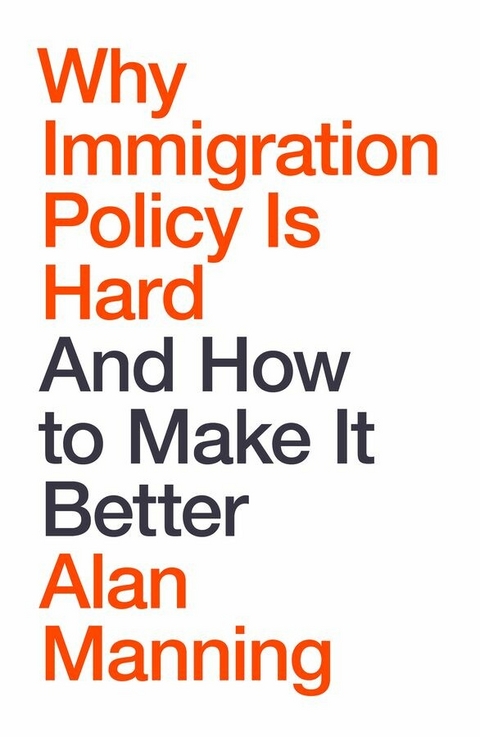
Why Immigration Policy Is Hard (eBook)
650 Seiten
Polity Press (Verlag)
978-1-5095-6366-1 (ISBN)
Immigration policy is hard, involving difficult decisions and trade-offs. But, as Alan Manning - former chair of the UK's Migration Advisory Committee - makes clear, this doesn't mean that we can't do much better.
We should start, Manning says, by ditching simplistic views that frame immigration as either wholly good or wholly bad. We will always have, and need, some level of immigration. But, just as inevitably, we will have rules on who can and cannot immigrate as more people are likely to want to move to high-income countries than residents will want to admit. To set those rules, we need reliable evidence to adjudicate among the often-competing claims of the economy, culture, justice and democracy. Manning supplies such evidence in abundance, guiding us through cutting-edge international research on the many ways immigration affects people's lives, including effects on their jobs and incomes, their taxes and public services, and their communities.
Why Immigration Policy Is Hard is an indispensable resource for informed debate on one of the most charged subjects in public life today.
Alan Manning is Professor of Economics at the London School of Economics and Political Science.
Immigration policy is hard, involving difficult decisions and trade-offs. But, as Alan Manning former chair of the UK's Migration Advisory Committee makes clear, this doesn't mean that we can't do much better. We should start, Manning says, by ditching simplistic views that frame immigration as either wholly good or wholly bad. We will always have, and need, some level of immigration. But, just as inevitably, we will have rules on who can and cannot immigrate as more people are likely to want to move to high-income countries than residents will want to admit. To set those rules, we need reliable evidence to adjudicate among the often-competing claims of the economy, culture, justice and democracy. Manning supplies such evidence in abundance, guiding us through cutting-edge international research on the many ways immigration affects people's lives, including effects on their jobs and incomes, their taxes and public services, and their communities. Why Immigration Policy Is Hard is an indispensable resource for informed debate on one of the most charged subjects in public life today.
Introduction
Immigration figures prominently in the current politics of many countries. In the campaigns of Donald Trump for US president and Nigel Farage for Brexit in the UK, immigration was centre stage; perhaps it even had a starring role. Voters anxious about immigration often support populist parties like the AfD in Germany, Marine Le Pen’s Rassemblement National in France, Giorgia Meloni’s Brothers of Italy, the Freedom Parties in the Netherlands and Austria (to list only a few), all increasingly close to or already in government. Even when these populists fail electorally, the threat they pose influences the policies of more mainstream parties.
Concerns about immigration are not new; it is easy to find echoes in history. In 1709 some 13,000 German Palatines arrived in the UK.1 Initially they were mostly welcomed, regarded like the better-known French Protestant Huguenots who had arrived some decades earlier as refugees from religious persecution and a valuable source of skilled artisans. The attitude soured when it was discovered the Palatines were mostly destitute and with few skills, and that a sizeable minority were Catholic.
In the US in the 1850s, candidates for the Know Nothings, campaigning against immigrants and Catholics, were elected as governor in eight states and as mayor in Boston, Philadelphia and Chicago.2 This electoral success faded as quickly as it had risen as the conflict over slavery became the main political issue. In 1882, the US passed the Chinese Exclusion Act, banning immigration from China, and the 1924 National Origins Act was designed to limit immigration from Southern and Eastern Europe, a policy reinforced by later legislation. In Australia, the 1901 Immigration Restriction Act sought to ensure that only Europeans migrated there, the beginnings of the White Australia policy. The 1906 UK Immigration Act was intended to limit Jewish immigration from Eastern Europe.
Two consistent features can be identified when immigration becomes a salient political issue. First, there is the perception among many citizens of the receiving country that immigration is out of control or is in danger of becoming so. One can debate in any particular case whether this is just perception or is grounded in reality, but it is perception that drives attitudes. Second, immigrants are regarded as ‘other’ in some undesirable way, perhaps in terms of religion or ethnicity or in skill level. Which ‘other’ groups are regarded as a threat varies a lot over time, as examples illustrate. Catholics were once viewed as alien, then Jews, now Muslims.
We should not conclude from these examples that concern about immigration is always a major political issue; there are long periods in many countries when that hasn’t been the case. But in higher-income countries today, there are some reasons why it is likely to be.
Why immigration has the potential to be a hot button issue
The world is very unequal. Where you are born is the single most important factor in determining your life chances, something that economist Branko Milanović has termed the ‘citizenship rent’.3 He estimates that, ‘just by being born in the United States rather than in Congo, a person would multiply their income by 93 times’ – an enormous gap. There are large gains (on average) for migrants who move from lower- to high-income countries (Chapter 4 discusses this in more detail). Understandably, there are many people who would like to move permanently from countries where life chances are lower to where they are higher.
It is easy for people in higher-income countries to underestimate how much location affects life chances. In 2020, there was an increase in the number of migrants crossing the English Channel in small boats, something the then UK prime minister Boris Johnson described as ‘stupid’.4 But a stark example suggests that migrants making these crossings are not stupid; they are making perfectly rational decisions given their situation. Crossing the Mediterranean from Libya is much more dangerous than crossing the English Channel, yet migrants often pay smugglers more than the cost of a business-class airfare for the journey. The International Organization for Migration’s ‘Missing Migrants Project’5 estimates that around 2 per cent of people die making this crossing. I suspect most readers of this book would steer clear of activities that carry a 2 per cent risk of dying in the next few hours. UN figures for 2015–20 suggest that at the age of twenty-five you can expect to live another forty-two years if you are in West Africa (where many of those making these crossings originate).6 So a 2 per cent risk of death equates to a reduced average life expectancy of ten months (a 2 per cent chance of losing forty-two years). Remaining life expectancy for twenty-five-year-olds in Northern Europe is thirteen years higher than in West Africa. Even if a migrant gets nowhere near those extra thirteen years (and they probably don’t), their life expectancy almost certainly rises if they get in the boat, even though they might die within a few hours.
How many people would like to migrate? The vast majority of people do not want to leave the familiarity of home, friends and families, but there are a lot of people in the world, so even a small proportion amounts to a lot of migration relative to current levels. To give one piece of evidence (more is in Chapter 3), the US diversity visa offers 50,000 green cards (which give permanent residence) every year in a lottery open to citizens of many (but not all) countries. There are well over 10 million applications.
Wanting to move is perfectly understandable; people have always moved in search of a better life, otherwise we would still be confined to a small area of East Africa where humans evolved. But many people are unable to realize their desire to move because of the controls on immigration enacted by the fortunate citizens of high-income countries who, for the most part, are uncomfortable with admitting all those who would like to move. Figure 0.1 shows, for some selected high-income countries, responses to one opinion poll question on whether immigration should be increased, reduced or kept the same. In most of these countries, many more people would like to see immigration reduced rather than increased. Other polls have different responses but, at best, it appears that people are broadly content with current levels of migration.
Figure 0.1 is a snapshot of opinion in 2024/25, but attitudes to levels of immigration change over time. Figure 0.2 illustrates this in the United States, the country where we have the longest run of consistent data from a Gallup question: ‘Should immigration be kept at its present level, increased or decreased?’ There is only one year in which more Americans wanted increased rather than decreased immigration. There was a trend towards a more favourable view of immigration from 2000, but this was reversed in the more recent years, contributing to Trump’s comeback in the 2024 presidential election.
Figure 0.1 Attitudes to the level of immigration in selected high-income countries, 2024/25
Sources: Data for European countries from EuroTrack, ‘Publics across Western Europe Are Unhappy with Immigration’, YouGov, and the question: ‘Do you think the level of immigration over the last ten years has been good or bad for the country?’
Data for US from Gallup, ‘Sharply More Americans Want to Curb Immigration to US’, and the question: ‘Should immigration be kept at its present level, increased or decreased?’
Data for Australia from Lowy Institute Poll 2024t, Executive Summary Data for Canada from Canadian public opinion about immigration and refugees, Fall 2024; the question is about whether respondents agree or disagree that their country accepts too many immigrants. From this question, we cannot work out how many people think it’s too low or about right, so there are only two bars for Canada. Figures may not add to 100% because of the ‘don’t knows’.
The gap between the number of people who would like to migrate and the numbers that existing residents are comfortable with sets up the tension underlying migration policy. I’m an economist, and one way to express this is to say that the supply of migrants – or, more accurately, potential migrants – is higher than the demand for migrants. Most people recognize that migrants and potential migrants are not all the same, with some types of migrants more popular than others. Migration policy reflects this by seeking to influence the mix as much as the level of migration. But the tension remains: while some migrants might be welcomed with open arms, many others are not.
Figure 0.2 Changing attitudes to the level of immigration in the US
Source: https://news.gallup.com/poll/1660/immigration.aspx
The infernal circle of immigration policy
High-income countries put controls on immigration in order to manage the level and mix of migration. Levels of migration are much lower than the number of people who would like to migrate. You might think that the wannabe migrants prevented from moving by those controls do not cause problems for high-income countries because they are somewhere else.
But it is not that easy. Unsurprisingly, some of those who want to migrate look for ways to circumnavigate...
| Erscheint lt. Verlag | 25.11.2025 |
|---|---|
| Sprache | englisch |
| Themenwelt | Wirtschaft ► Volkswirtschaftslehre |
| Schlagworte | alan manning • and how to make it better • Economics • Immigrants • Immigration • Immigration Policy • Immigration studies • Manning • Migrants • Migration • Migration Policy • Migration Studies • political economics • Political Economy • political issues • Political Philosophy • Political Science • political theory • Politics • Public Policy • sociology of immigration • why immigration policy is hard • why immigration policy is hard and how to make it better |
| ISBN-10 | 1-5095-6366-0 / 1509563660 |
| ISBN-13 | 978-1-5095-6366-1 / 9781509563661 |
| Informationen gemäß Produktsicherheitsverordnung (GPSR) | |
| Haben Sie eine Frage zum Produkt? |
 EPUB (Adobe DRM)
Kopierschutz: Adobe-DRM
Adobe-DRM ist ein Kopierschutz, der das eBook vor Mißbrauch schützen soll. Dabei wird das eBook bereits beim Download auf Ihre persönliche Adobe-ID autorisiert. Lesen können Sie das eBook dann nur auf den Geräten, welche ebenfalls auf Ihre Adobe-ID registriert sind.
Details zum Adobe-DRM
Dateiformat: EPUB (Electronic Publication)
EPUB ist ein offener Standard für eBooks und eignet sich besonders zur Darstellung von Belletristik und Sachbüchern. Der Fließtext wird dynamisch an die Display- und Schriftgröße angepasst. Auch für mobile Lesegeräte ist EPUB daher gut geeignet.
Systemvoraussetzungen:
PC/Mac: Mit einem PC oder Mac können Sie dieses eBook lesen. Sie benötigen eine
eReader: Dieses eBook kann mit (fast) allen eBook-Readern gelesen werden. Mit dem amazon-Kindle ist es aber nicht kompatibel.
Smartphone/Tablet: Egal ob Apple oder Android, dieses eBook können Sie lesen. Sie benötigen eine
Geräteliste und zusätzliche Hinweise
Buying eBooks from abroad
For tax law reasons we can sell eBooks just within Germany and Switzerland. Regrettably we cannot fulfill eBook-orders from other countries.
aus dem Bereich